




The Hall of Fame Index was first published in 201o. It had been in the works for nearly a decade at that point. The whole point was to establish a systematic way of looking at Hall of Fame candidates and those already in the Hall of Fame. At its best, it measures fitness for the Hall of Fame and aims to put players into groups with other similar players so we can compare them.
The sequel was published in 2020. It obviously updated numbers for players that were currently active, but also adjusted the
formula as we got more information. One of the key things in statistical analysis is that we are always learning something new. The formula is similar to JAWS, but has a couple of key differences. First, it combines baseball-reference.com WAR and Fangraphs.com WAR into one number. I do that for two main reasons. First and foremost, the more data the better in most instances. It gives us a cross-section of what keen sabermetric minds feel about a player.
The second reason is that there is always an intellectual divide on these things. The old formulas included win shares, but since Bill James retired, there is no longer an update on current win shares, so that one has been dropped from the formula. Like JAWS, the index includes a peak value element. However, the peak value is made up of ten seasons. I have gotten push back on this and the push back is perfectly reasonable. I chose ten years because you need to play at least ten years to get into the Hall of Fame and ten years gives you slightly more data than the seven years that JAWS brings.
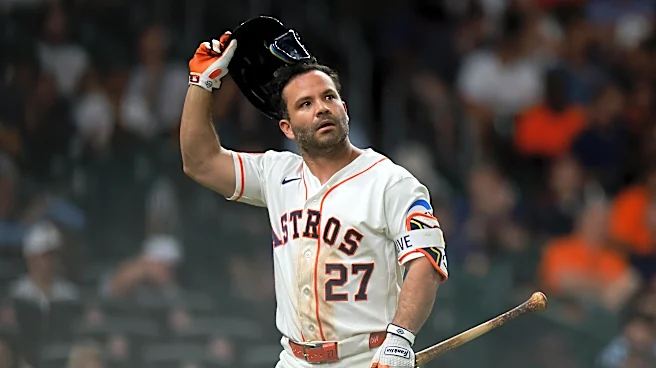
That is important distinction because I do not profile any players until they have been in the league for at least ten seasons. So, as we compare Jose Altuve to his contemporaries, there is really only one second baseman that makes the list. I will not speak for Jay Jaffe (the creator of JAWS) but the index was never meant to rank order players. It was meant to place players into groups with other similar players so that we can directly compare them using other means. I have done this before with Altuve, but since we are at the midway point of the 2026 season, it is a good time to revisit it.
The Hall of Fame Index
Most of the time BWAR and FWAR agree, but occasionally they do not. One of the things we will do is examine the reasons why that is. Suffice it to say, they have the same general concepts, but use different inputs as it regards to fielding, so the information on modern players can look radically different. I use both because it has never been my intention to pick sides. I have my own personal feelings on it, but I want to make sure that personal feelings don’t get baked into the analysis.
Historically, Altuve is most similar to Joe Gordon, Willie Randolph, Bobby Doerr, and Billy Herman historically in the index. Gordon and Randolph come above him and Doerr and Herman finish below him. Three of the four are Hall of Famers. That’s already a good start. The closest contemporary to Semien is currently Ben Zobrist. I was a huge Zobrist fan, but obviously none of the players around Semien in the current pecking order got into the Hall of Fame.
Since they are both active, there is the potential that they can add to their credentials, but one of the things the index does is suppress the positive impact of compiling. Altuve could theoretically play everyday and get 150 hits a season for the next three years, but it won’t add a ton to his overall value. Based on the results so far this year, it might add zero value. The same is true for Semien. However, the possibility is not zero that either could turn in another good season or two and add to this tally. We should look at some offensive numbers to see why things stand where they do.
Offensive Statistics
I have gotten pushback on some of these numbers as well. Rest assured, the books go into much more detail, but these are a series of numbers that say the same thing. OPS+ is well known and is a decent enough number to establish a basic benchmark. rOBA is similar to Fangraph’s wOBA. Many will consider wOBA as more accurate because it has a league adjustment, but since these players played at the same time and in the same league for most of it, the differences will be minimal. Both numbers (rOBA and wOBA) combine on base and slugging elements into one number that mimics OBP.
I think the Rbaser score would surprise most people because Altuve has the reputation as a careless base runner. It is one of the reasons why I like to include these numbers because it is easy to get bogged down into narratives. Semien is slightly better, but not unreasonably so. Offensive winning percentage is my favorite one here. It measures what a team of nine Altuves or nine Semiens would do with average pitching and average fielding. A team of Semiens likely sneak into the wild card round. A team of Altuves probably advance to the World Series.
Real offensive value (ROV) is a crude statistic I developed to marry batting average with all of the things that don’t include batting average. It takes the midpoint between batting average and secondary average. Like I said, it is crude, but when you are comparing players from the same era it becomes a little more useful. The good news is that it can be interpreted like batting average. As we can see, Altuve is better pretty much across the board.
Fielding Numbers
When you look at the differences in the two WAR formulas you can pretty much start and stop here. Rfield is the metric used for BWAR (baseball-reference WAR) while FWAR (Fangraph’s WAR) uses some derivative of OAA and FRV. Those two metrics are Statcast generated. Rfield is roughly based on defensive runs saved (DRS) which is based more on video and human calculation. Again, I try not to make value judgements here. OAA stands for outs above average and FRV stands for fielding run value.
If ten runs is worth a win then we can see that there are ten wins difference between how the different metrics rate Altuve over the balance of his career. One says he will be the worst defensive second baseman in the Hall of Fame (many of Craig Biggio’s negative runs came in the outfield and at catcher) while the other two sources say he has been more or less average.
We see the opposite effect with Semien which is interesting on a certain level and has a fascinating explanation that we just don’t have time for. To pair it down to brass tacks, OAA and FRV standardize the data a little which tends to push most players to the average. Like I said, I’m not here to rip on one or the other, but we watch Altuve on a daily basis and can decide for ourselves which one we think is more appropriate.
The MVP Test
This test is another way of expressing peak value. It asks the question of whether a player was ever the best at his position, on his team, or in the league. The answer doesn’t have to be yes to all of those. On the great Brookyln Dodgers teams or the Big Red Machine, there was room for only one best player, but most would agree there were three or four Hall of Fame level players on those teams. Only one of them could be the best.
The top category shows that each led the league in BWAR in one season. Ironically, their teams won the World Series that year. The point values for the MVP voting award ten points for an MVP award, five points for top five finishes, three points for top ten finishes, and one point for a top 25 finish. As we can see, Altuve got a little more love than Semien from the voters, but Semien was better when he was at his very best because he combined good offensive production with elite fielding production. Altuve has never been an elite fielder.
We look at the offensive, fielding, and MVP voting as further tests beyond the index. No single test confirms or eliminates a player, but we use a preponderance of the evidence to make our case. We do have one more test and that the playoff performance test. I don’t have to tell any Astros fan how this one is going to work out. However, the numbers will surprise you in one regard.
Playoff Performance
Altuve is clearly the better performer, but when you look at the slash numbers (AVG/OBP/SLG) you can see that the gap is not nearly as stark as we might have thought. Playoff production is a function of opportunity. Absolutely we should give credit to players that make the most of those opportunities, but we shouldn’t penalize players for a lack of opportunity. When we start talking about 150 or fewer plate appearances we are talking about the equivalent of six weeks or less of baseball. How much weight do we want to give to a small sample size?
Altuve is second all-time in most important post-season categories. He trails Manny Ramirez in home runs and Derek Jeter in runs scored. He has two rings. He has the walk off home run to win the ALCS in 2019. For me, postseason performance is best treated like a tiebreaker. If you have a player that’s close then these numbers should put you over the top. Semien is more of a mixed bag, but that is mostly not his fault. He just hasn’t had the opportunities.
Putting it all together
As I sit here, I don’t know what impact the scandal will have on Altuve’s place in history. We in Houston know the truth and know he wasn’t an active participant, but facts and feelings hardly mix well and as long as human brings are voting for the Hall of Fame there will be feelings involved. The index shows he is similar to a group of players that are Hall of Famers or maybe should be in Randolph’s case. The postseason numbers aren’t a part of the index, so they should serve as a boost. It will be fascinating to keep track of this to see where it all ends up.