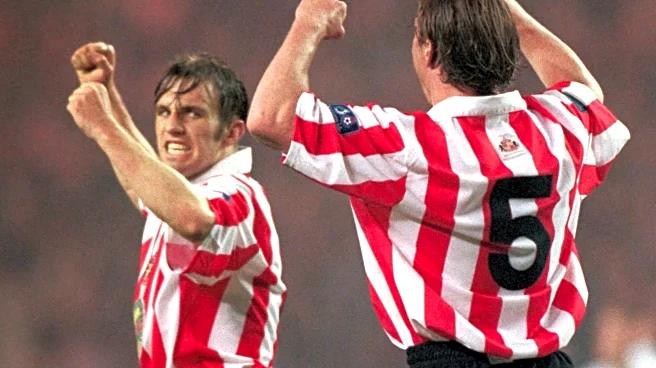

Darren Williams eventually arrived at Peter Reid’s Sunderland in October 1996. He had been recommended by future Sunderland coach and manager Ricky Sbragia, who was at that time York City youth-team coach.
Williams had a pre-season trial for Sunderland reserves, but with his contract finishing, a fee could not initially be agreed. Reid eventually got his man for £50,000 in October ’96 and often said that along with Paul Bracewell and Kevin Phillips they were pound-for-pound the three best deals he ever made.
At nineteen years old and coming into a newly promoted squad, Williams might have expected to have to wait a while to work his way into the team. His opportunity came earlier than he might have anticipated in an FA Cup tie at Arsenal in January of that season; he came on for the last ten minutes, replacing Steve Agnew in midfield. He had the unusual experience of playing his first three games against high-flying Arsenal with a draw, a win, and a loss.
A gallant but ultimately unsuccessful top-tier campaign in our last ever season at Roker Park saw Sunderland relegated. Williams made twelve appearances (plus one as substitute) in all from that January and scored two goals, one of these a late headed winner in a relegation tussle at his home-town club Middlesbrough. These twelve games would see him play in defence or midfield as the team got to benefit from his versatility.

Injuries and loss of form to other players saw Darren Williams play forty-two games in the memorable 1997/98 campaign, most of these as part of the youngest back-four defensive unit in the Championship. He formed the central defence alongside Jody Craddock, with Mickey Gray and Darren Holloway the full-backs.
The following 1998/99 season Sunderland went up as record-breaking champions. Williams’ twenty-one games plus nine as substitute are a real snapshot of his time at the club as he slots in at centre-back, full-back, central, and wide midfield.
The 1999-00 and 2000-2001 campaigns are ingrained in the memories of most Sunderland fans around at this time, as Peter Reid sent out a team playing sparkling football and gaining two successive seventh-place finishes in the top tier. In the midst of this squad and possibly to many fans unnoticed, was Darren Williams who played where he was needed in defence or midfield making forty-four appearances and twenty-three substitute appearances over the two seasons.
The next three campaigns saw a steady decline in the club’s fortunes, with Peter Reid replaced in the 2002/03 season initially by Howard Wilkinson, who was subsequently replaced by Mick McCarthy. Williams would in many respects be the victim of his versatility as he continued to play where required in defence or midfield, without ever nailing a permanent first-team position, though there are an increasing number of games at right-back as this period progresses.
Mick McCarthy did a very good job leading Sunderland to the play-offs in 2003/04 on limited finances and with a squad that he very much wheeled and dealed. Williams played twenty-seven games and twelve substitute appearances, mostly at right-back as Stephen Wright suffered an injury-plagued season. Crystal Palace beat us on penalties at the Stadium of Light to condemn us to another season in the Championship.

McCarthy continued to manage the team under financially restrictive conditions and moved a number of players occasionally for a fee, but more often to get their salaries off the wage bill to create a bit of wriggle room.
With his contract up at the end of 2004/05, McCarthy let Williams know he could leave. The manager had fit-again Stephen Wright and had also signed a young Mark Lynch from Manchester United as a long-term prospect in the right-back position.
It must have been hard news for Williams as his testimonial year approached. Forthright and at times blunt, McCarthy was fulsome in his praise for Williams saying “Darren’s contract is up at the end of the season, so I have got to give him an opportunity to look after his future and if he can earn himself a long-term contract and give his family some security no-one will be more delighted than me. He is a smashing lad and deserves that”.
A loan move to Cardiff was agreed, with manager Lennie Lawrence, who hoped to tie up a permanent move with his chairman Sam Hammam, for a player he had been a long-time admirer of.
Cardiff were in deep trouble at the wrong end of the Championship and Darren Williams’ arrival into the team had an immediate effect. With the defence shored up, results turned and the Bluebirds moved away from the danger zone.
Lawrence desperately wanted to tie up Williams in a permanent contract and managed to get a deal to the end of the season completed just before Cardiff were due to play Sunderland in mid-December.
Williams had thought he would not be playing as part of the condition of his loan, but had trained hard and prepared as if he would have a game. With a deal agreed he found himself about to play against his former employers of the last nine years and more specifically, marking one of his good friends Julio Arca.
Sunderland won this game two-nil but Williams typically played very well, in an ask-no-quarter-and-giving-no-quarter performance that left some fans and press wondering why they had let him go.
Lennie Lawrence offered Williams a new contract at the end of this season, but when the manager was replaced by Dave Jones, the offer was withdrawn, so he returned to the North-East and joined Hartlepool in League One. He stayed with the Monkey Hangers for two seasons helping them gain promotion back to League One after they were relegated in his first season.

Released by Pools in May 2007 he then joined Bradford for the 2007/08 season, playing twenty-eight games. He joined a former team-mate Alex Rae at Dundee for the 2008/09 season; unfortunately Rae was replaced by Jocky Scott as manager and Williams was told he could look for another club at the end of this season.
Spells at Gateshead, Gainsborough Trinity, and Whitby Town (where he became player/manager) followed between 2009 and 2015.
Football wisdom tells you that it is great to have a player in your team that can fill into a number of positions really well. Darren Williams’ versatility made him a manager’s dream in this regard. When you add to this a temperament and professionalism that appeared to permeate his displays, what is not to like!
I, like many Sunderland fans, have very fond memories of his performances in the 1997/98 season playing with the ‘young guns’ at the heart of our defence with Jody Craddock.
I believe he preferred to play centre-back, but possibly lacked height and bulk to play there in the top tier. I enjoyed his performances at right-back and in the centre of the midfield; he never let the team down and gave a hundred per-cent whatever way the game was going.
Another facet of this lad that used to impress me was particularly through our worst spells, he would often come out and speak to the press, to give the fans a player’s perspective. A number of the press pack make reference to this, with Paul Anderson of the Sunderland Echo recording his view that Williams would always show up, when other players might hide away after a bad result.
I also always appreciated his after-match reaction to the fans, often the last player to leave the pitch at the end of a game as he gave due appreciation to supporters for their support during the game.
His two hundred games for Sunderland between 1996 and 2004 were characterised by whole-hearted effort and no small amount of defensive skill. A quiet, unassuming player who gave his all in a number of positions for our team. Every team needs a Darren Williams!