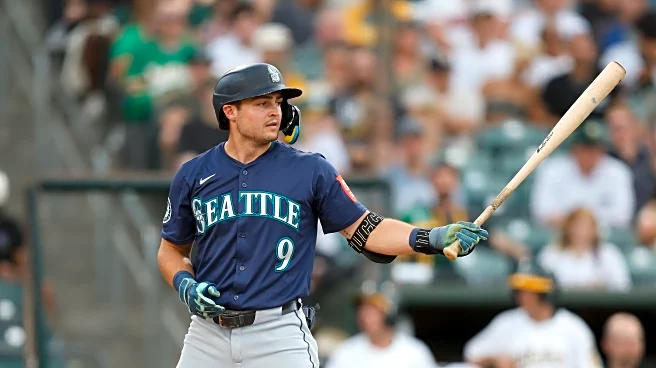

Ben Williamson doesn’t rush; he just moves quickly. The defensive standout’s quick feet and steady hands earned him a promotion to MLB after just 689 plate appearances in the minors, despite his college career coming in the decidedly mid CAA. And he spent most of the first two-thirds of the 2025 season as the Mariners’ starting third baseman, despite questions about his bat.
Yet August 1, he was back in Triple-A. While he’d been showing improvements with the bat over the course of his rookie campaign,
an Eugenio Suárez reunion was too tempting for the Mariners to upgrade Williamson’s .253/.294/.310 line.
But that batting line only tells part of the story. Williamson’s 2025 reveals a fascinating development puzzle: he improved his plate discipline and contact rates as the season progressed, yet his power indicators collapsed. And while it’s as if a light bulb clicked on when he got back to Tacoma—turning in a 135 wRC+ over the last two months in AAA–key questions lingered.
The May Baseline
We checked in on B Willy after his first month in the show, when his 63 wRC+ looked concerning but there were promising signs under the hood.
The clearest room for growth was in his approach. He chased at unacceptable rates, swinging at 22.3% of pitches in the chase zone and 42.6% of pitches that were in the shadow zone but not the strike zone. And he was simultaneously too passive on hitter’s pitches, swinging at just 64.8% of pitches in the heart of the plate, compared to the league average of 72.4%. He was going fishing while avoiding meatballs like it was a Friday during Lent. While he made enough contact to avoid a Kelenic-esque strikeout rate, his walk rate jumped off the page in a bad way: 3.1%.
But under the hood, his power indicators offered hope. His dynamic hard hit rate (DHH%) was above league average, suggesting big raw power even if it wasn’t always showing up in good contact. DHH% is the best indicator for young hitters because it shows power potential by measuring how hard a player hits the ball relative to launch angle: Despite being a worse result, an 80-mph pop up requires much more strength than an 80-mph line drive, so DHH% gives a player more credit for the pop-up. And despite not swinging at the right pitches, he still managed a hard-hit rate and a barrel rate around league average. It suggested that if he could improve his swing decisions, the offense would pop.
As the season progressed, so did Williamson, but not always in the ways the early data suggested.
Improving at a Cost
From there, Williamson’s plate discipline improved–mostly. He showed real improvement in the shadow zone, learning to lay off borderline pitches, and his walk rate doubled while he cut down his strikeouts by a quarter. But he simultaneously started making even worse decisions on pitches even farther outside the zone, in the chase region.
How could both be true? The League figured out how to attack him. He’d go fishing on changeups and sweepers about 25% more often than average. So pitchers peppered those pitches and knew they had a fat margin for error outside the zone.
This isn’t just a question of spin on the sweepers—he also struggled with sliders, but it wasn’t as pronounced. And his swing decisions and contact rates were actually better than the league against curveballs. Nor was it purely a question of timing—again, he was better against curveballs. Rather, what this suggests is a problem with horizontal movement. That’s what the changeup and sweeper have in common.
Making matters worse, the hope that he’d tap into his power crumbled along with his launch angle. He started his MLB tour with an elevated groundball rate, at 47.8% through May 15, relative to the league’s 41.8%. But from there, it’s like he was deliberately taunting the Shai-Hulud, spiking his groundball rate to 61.8%, second-highest in MLB over that stretch.
The good news is that a lot of those groundballs got through, as he kept his hard-hit rate around average. The bad news is his DHH% was a small-sample mirage, as it went from above league average before May 15 to about half of league average afterwards. There’s not as much power potential as we’d hoped, and he’s not a swing-path change away from becoming a 30-doubles hitter.
So his overall results got better, raising his wRC+ from 62 to 83, but the adjustments he made in his swing decisions weren’t enough to outrun the league figuring him out or the collapse in his launch angle. He became a better hitter in some ways while losing what made him projectable.
The Tacoma Breakthrough?
Ben Williamson’s best trait has long been his coachability. If you don’t believe me, ask his college coaches, as Kate did last summer. So it came as an encouraging sign that he seemed to learn some lessons from his first tour of MLB.
After he returned to Tacoma, his offense exploded, even by the standards of the PCL, where every night is 90s Night.
But the power was illusive. Even in Triple-A, his barrel rate was just half the PCL average, and his launch angle was just 1%. He wasn’t solving the fundamental bat path issue, just thriving despite it. His success came more from contact and discipline than from barrelling up the ball.
Unfortunately, his time in Tacoma tells us little about whether he solved his vulnerability to changeups and sweepers. He saw just 33 changeups and 43 sweepers after his demotion. The good news is he looked a lot better against the ones he saw. He cut his chase rate on changeups in half and then some, going from 45.1% in MLB to just 21.1% after his demotion; and he only whiffed twice on the 14 total swings on changeups. And against the sweepers, his chase rate fell from 39.1% to 23.1%; and he only whiffed three times out of his 19 total swings. The results were better, but the reality is that 33 AAA changeups and 43 AAA sweepers aren’t enough to know if he actually solved anything.
The Floor
Even if Williamson will never be Kyle Seager or Eugenio Suárez with the bat, his glove continues to give him a floor you could live with. He led AL third basemen in DRS at the time of his demotion, and ultimately finished sixth in MLB despite playing in just 85 games. While that didn’t show up in OAA, the eye test suggests DRS is truer to reality.
So even if his Tacoma results are his true AAA talent, and his MLB results are his true MLB talent—and it’s too early to know if either is true—you still can’t slap a Quad-A label on him.
Consider what it looks like if an 85 wRC+ bat with elite defense at third base is all he is? That’s the version of Williamson that we saw between May 15 and July 31, and it put him on pace for 1.2 fWAR over 150 games, but that’s using OAA for the defensive component, which I don’t trust for Williamson’s 2025. Looking instead at Ke’Bryan Hayes’s 2022 and Maikel Garcia’s 2023, I see pretty similar profiles (with slightly better baserunning) netting out to a 2-3 win player. Baseball Reference, which uses DRS for its defensive component, suggests a 1-4 win player.
That’s not a cornerstone of a championship favorite, but it’s good enough for an everyday player on a contender if he’s one of your weak points.
Seattle might be able to do better than that at third base in 2026. Suárez is still available for money, and Colt Emerson is knocking on the door. But having Williamson as a floor option leaves the Mariners in fine shape, even if his improvements in AAA don’t translate back to the bigs. And if they do, Williamson’s a star.