



Accolades matter in the world of college football. There’s no way around this.
For fans, they’re how we dole out bragging rights. Beating our rivals, winning the conference, and winning bowl games or national championships all factor into how much trash you get to talk about a season. Even in Ohio State’s 2024 national championship season, there will always be some chirpy Michigan fan waiting to remind us that we might have won it all, but we didn’t beat the Wolverines. There are some fans who believe,
similarly, that winning a title without winning the conference devalues the title win (I think most Buckeye fans would count ourselves out of this camp, though I do understand this line of thinking).
For players, winning rivalry games, conference titles, and playoff games are all part of how they cement their legacy as individuals and teams, and in some cases, it’s even how they boost their draft stock. So let me be clear—I don’t mean to suggest the conference championship doesn’t matter in terms of pride. It will always matter in terms of pride.
When I question the importance of this game, it’s more existential: How do these conference championship games fit into the landscape of the 12-team playoff? It seems like there’s no one right answer (or if there is, no one has landed on it yet), and this weekend was a prime example of this.
When it seemed to matter
Big 12 Championship
Ask a team like BYU whether their conference championship mattered, and I’m sure you’ll get a resounding yes, followed by a groan. After losing just twice this year—once to Texas Tech in the regular season and again to Texas Tech in the Big 12 Conference Championship, both by large margins—the Cougars finished the season ranked No. 12 in the CFP rankings, but because of the requirement that the five best conference champions get in, that won’t be good enough for a playoff spot. Had they won their conference, their playoff hopes would likely now be a playoff reality.
Teams on the cusp
In what is arguably the first time Notre Dame has had any real repercussions for not joining a conference, their No. 11 seed won’t be good enough for a playoff berth either, despite winning their last 10 games straight by double digits. Their two losses this season came to Miami and Texas A&M, both teams that made the playoffs, by a grand total of four points between the two games. Had the Fighting Irish played in a conference championship game, perhaps they would have edged out Miami, which didn’t even qualify for the ACC championship, or Alabama, which lost theirs.
On the flip side, the conference championship was critical for both Tulane and James Madison, who won the American Conference and Sun Belt Conference, respectively, punching their tickets to the College Football Playoffs in doing so, bumping BYU and Notre Dame in the process.
There are many who would argue that neither Tulane nor James Madison has any business in the playoffs, and it seems unlikely that either will even be able to play a close game in the first round. I wouldn’t count out the possibility that the playoff will continue to evolve, just as it did after last season, eventually rendering it impossible for this scenario to unfold. But for now, this is the reality, and perhaps it would look different if BYU had won its conference or if Notre Dame had aligned with one at all.
When it might have mattered
ACC Championship
The ACC Championship game mattered, but not so much to the two teams who played in it. Instead, a victory by an 8-5 Duke team over 10-3 Virginia created mass chaos in the playoff world. Neither team earned a playoff spot. Instead, the committee gave the No. 10 spot to Miami, the highest-ranked team in the ACC, but one that didn’t qualify for the conference title game, but dominated toward the end of the season and holds a head-to-head win over Notre Dame. Miami’s inclusion over Virginia or Duke opened up James Madison’s spot.
It’s hard to say whether Virginia would have edged out James Madison with a win, but the committee clearly wasn’t interested in putting a five-loss Duke team in, and for good reason, and as it stands, this game was ultimately meaningless for the two teams that played in the grand scheme of the season.
SEC Championship
There’s a contingent of folks who believe Alabama should have lost its playoff spot after losing to Georgia in the SEC Championship. Their strength of schedule—the sixth hardest in the country—and the fact that they’d previously beaten Georgia both helped, but their SEC Championship loss put them on the bubble, and some folks felt Notre Dame should have gotten their spot. Given how competitive the SEC is, it seems unlikely the committee is going to bump the SEC runner-up from the playoffs (especially in a year where James Madison gets in), so especially this year, this game seemed to matter only in the way it affected the final seedings.
When it didn’t matter at all
Big Ten Championship
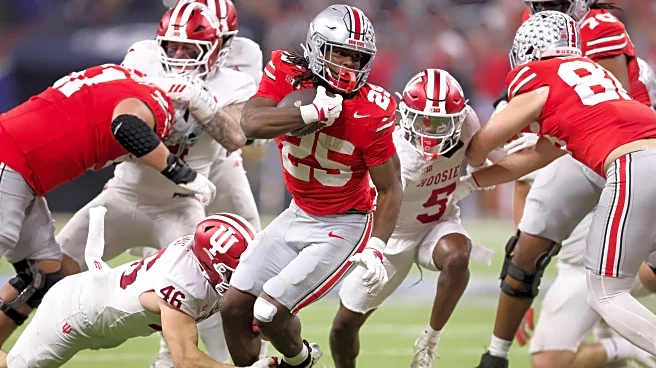
The Buckeyes and the Hoosiers went into their conference championship as the No. 1 and No. 2 teams in the country, and they came out that way, too, only in reverse order. The Big Ten runner-up Buckeyes head into the playoffs ranked higher than the conference champions in all other conferences, ultimately rendering this game obsolete for anything other than pride. Certainly, it was an exciting moment for Indiana fans, whose team had not won a conference title since 1967, but in a dominant year for both teams, sights are set on something bigger.
If they both manage to win their sides of the bracket, they’ll square off again in the National Championship, queuing up the game that really counts. If Indiana beats the Buckeyes twice to win the title, then that’s the story. But if Ohio State beats Indiana for the title, this game becomes a footnote in the season.
It almost makes you wonder—since both teams had all but locked in their playoff spot, what would the committee’s response have been if either or both had played their third-string rotation and given their starters a breather? I’m not advocating for this, as I think it’s cheap and arrogant, but I also think there’s a world where this happens at some point in the future as teams start to play the long game.
Ultimately, I think the college football playoffs are still taking shape, and with that, the role of conference title games is as well. I guess the short answer is, “It depends.”
Ohio State didn’t play in the Big Ten Championship last year but won the title. Teams made the playoffs without playing for their conference championship this year, but conversely, several teams’ playoff berths were the direct result of the conference championships. Because of the subjectivity of the rankings, no one really knows how important it is to win your conference, simply play in the game, or, in Notre Dame’s case, be in a conference at all, but it will be interesting to see how these games shape-shift as the playoff system becomes more unchanging over time.
I’m curious what other fans think—will conference championship games ever stop mattering? Do they actually matter now for the most elite teams in the field? Let us know in the comments.