
With Jose A. Ferrer being dealt to the Mariners for Harry Ford, it is no secret that the Nationals need help in the back end of the bullpen. Even before the Ferrer trade, the Nats bullpen was the worst
in all of baseball and needed help. Now the Nats have very few established relievers and even fewer with closing experience.
However, free agent relievers are flying off the board and the market is becoming thin. The Nats were never going to be in on the top of the market guys like Edwin Diaz, Devin Williams, or even Robert Suarez. It is not just those top guys who are off the board though. More realistic targets have found homes as well.
We wrote about the Nats potentially signing Emilio Pagan to reunite him with pitching coach Simon Mathews. However, he decided to go back to the Reds. Kenley Jansen was another veteran name that made some sense as a stop gap closer, but he signed with the Tigers. A Kyle Finnegan reunion is also off the table, as he also signed with the Tigers.
So where does this leave the Nats? Well, it seems like there is a chance that the Nats roll with an internal option as the closer. We discussed Clayton Beeter and his big upside. Of all the in-house guys, he is probably the most likely to close. He has a nasty fastball-slider combination and gets a ton of strikeouts. When Beeter is on his game, he can be unhittable. He does have pretty major control issues though.
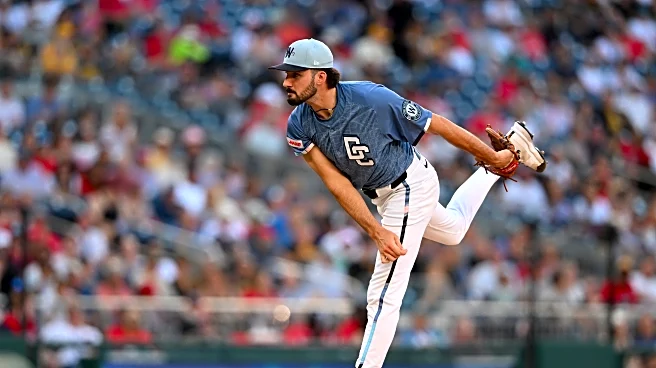
The other internal option to close games would be Cole Henry. After a bunch of injuries slowed Henry’s development, he broke through in 2025 as a bullpen arm. His season ERA of 4.27 is not overly impressive, but that number was below 4 for most of the season. Towards the end of the year, Henry hit a wall and ran out of gas.
Henry had not thrown more than 35 innings since 2o21, so it makes sense why he faded. With a full season under his belt, Henry should be able to handle the innings better. In a bullpen that was very bad, Henry was one of the best things the Nats bullpen had going on. He even saved two games last season.
Henry’s arsenal is very interesting. His two primary pitches are a 4-seam fastball and a curveball. The heater has a very interesting movement profile due to his low slot and the life on the pitch. It is comparable to some of the best fastballs in the game on pure movement.
His curveball has a ton of movement and looks almost like a sweeper. It has more side to side movement than a traditional 12-6 curve. Both the fastball and curveball generated whiff rates over 29% last season. Henry also threw a sinker, a cutter and a changeup. However, none of them were great and all were used less than 10% of the time. Finding that third pitch could take Henry’s game to the next level. If Toboni and the development team can unlock Henry, he could be a fun closing option.
Despite the options being limited, there are a couple free agent relief options I would trust to close. The first name is Luke Weaver. He has spent the past couple years in the Yankees bullpen and was very good. Weaver posted a 2.89 ERA in 2024 and a 3.62 ERA last season.
Weaver struggled a bit down the stretch and was awful in the playoffs, but he is still a fun arm. He is primarily a fastball/changeup guy and both pitches are excellent. The fastball averages 19 inches of carry, which is well above average. It also has good velocity at 95 MPH. That is why he can throw the pitch almost 60% of the time and it is still highly effective.
Weaver’s out pitch is a devastating changeup that he will throw to righties or lefties. Last season he generated whiffs at a 43.9% clip on the changeup. In 2023, it was even better, with hitters whiffing 48% of the time. Opponents only hit .129 against the changeups last year.
He will mix in a cutter and a slider, but Weaver is mostly a two pitch guy. Weaver should get a deal around what Emilio Pagan got, which was 2-years $20 million. If the Nats want to, they could try offering him a higher AAV one year deal. Weaver could be a valuable asset to flip at the deadline.
The other potential closer on the market is Shawn Armstrong. He is coming off an excellent season with the Rangers, where he posted a 2.31 ERA in 74 innings. Despite the last name, Armstrong does not have great velocity for a righty reliever, sitting around 93-94 MPH with his fastball.
He makes up for that by using a balanced four pitch mix. Armstrong throws a 4-seamer, a cutter, a sinker and a sweeper. He uses all four pitches between 23 and 29% of the time. Batters hit under .200 against all four pitches last year.
His .169 BABIP was unsustainably low, so there will be some built in regression here. However, he was very good at generating soft contact, so he should still be solid. While BABIP is volatile, it is not totally luck based either. Pitchers who keep the ball off the barrel and generate soft contact like Armstrong does tend to have lower BABIP’s.
Armstrong should get a one or two year deal. A two year deal wouldn’t feel great, but the Nats need bullpen help from somewhere. I understand that 2026 is a rebuilding year, but the Nats owe it to the fans to at least put out a semi-respectable product. Armstrong would help with that.
Names are coming off the board quicker now, so Paul Toboni is going to have to act. The Nats are one of only three teams not to sign a free agent and they have not been publicly linked to any.
This will need to change and hopefully soon. The Nats need help badly at first base and in the pitching staff. Bringing in players at those positions would not block any young players either. It is time to get this party started!