
With the College Football Playoff field officially set and Bowl Season right around the corner, draft season is quietly heating up. While many prospects will opt out of bowl games to prepare for the 2026 NFL Draft, this is still a valuable window to evaluate players — especially for teams like the Seahawks, who have very specific needs.
Seattle enters the draft with just four selections after the trade for Rashid Shaheed: one pick each in Rounds 1, 2, 3, and 6. Because of that, this list focuses on interior
offensive linemen who could realistically be available across Days 1, 2, and 3, with a particular emphasis on right guard and center.
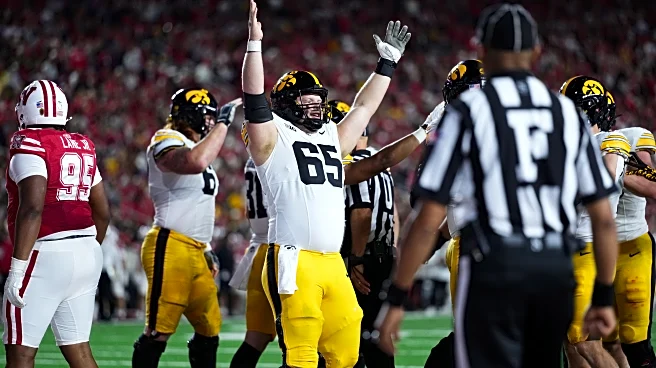
Logan Jones, C, Iowa
One of my favorite prospects in this class.
Jones is an older prospect — he’ll be 25 years old during his rookie season — and his decision to return to Iowa for another year was somewhat surprising. He originally arrived as a defensive tackle before transitioning to the offensive line, and his athletic profile is impressive. Jones has a basketball and track background, posted a 695-pound squat (an Iowa team record), and a 470-pound hang clean (second-best in program history).
He’s a highly experienced player from one of the most consistently well-coached offensive lines in college football, operating in a zone-heavy rushing attack. That same Iowa pipeline produced Tyler Linderbaum (now a free agent), Mason Richman, Connor Colby, and Dunker Gennings. That group paved the way for Kaleb Johnson’s 1,537-yard rushing season, which helped him become a third-round pick by the Steelers.
Jones consistently shows the athleticism required for reach blocks in zone schemes and excels when climbing to the second level, taking clean angles to linebackers. He also plays with good leverage against defensive linemen, making him a very clean schematic fit for Seattle’s run game.
Parker Brailsford, C, Alabama
Brailsford is an interesting evaluation when projecting fit with Klint Kubiak’s offense.
He’s undersized for a traditional center, weighing under 300 pounds — very different from the physical profiles of Jalen Sundell or Erik McCoy. That doesn’t automatically disqualify him, but it’s something worth noting. Brailsford was a standout from his very first snap at Washington, and when Kalen DeBoer took the Alabama job, Brailsford followed him.
The Aaron Brewer comparison (Dolphins) is easy to make. He’s extremely quick, light on his feet, and would function well in a zone-based system. While he struggles to displace defensive linemen and can have issues versus power due to his frame, he compensates with natural leverage and good hand usage in pass protection.
Brian Parker II, RT, Duke
Another personal favorite on this list.
Parker is likely to transition inside to guard or center at the NFL level due to arm length limitations, but his tape is excellent. He was one of the best run-blocking offensive linemen in zone schemes this season. Parker is physical, technically refined, and a very good athlete.
There are areas to clean up in pass protection. His set angles can be inconsistent, occasionally giving too much space to edge rushers, and he has a habit of lowering his head at contact, which opens the door for swim moves. Still, the foundation is strong, and his skill set projects well to an interior role.
Olaivavega Ioane, LG, Penn State
The most likely early pick on this list.
Ioane took a significant step forward this past season and has put himself firmly in the Day 1–Day 2 conversation. Depending on how the pre-draft process unfolds, he could hear his name called late in the first round.
If Seattle is looking for a guard who can move defenders, Ioane checks that box. He’s powerful, violent with his hands, and extremely difficult to beat when defenders try to win with strength. He would immediately raise the physical floor of the interior offensive line.
Athletically, he’s not elite, and his hip stiffness can show up in pass protection at times. His best fit may ultimately be in a gap scheme rather than pure zone, but even so, he would represent a clear upgrade over Anthony Bradford.
Keylan Rutledge, RG, Georgia Tech
The only true right guard on this list.
Rutledge is an old-school interior lineman — powerful, aggressive, and relentless. He’s dominant in the run game and consistently creates movement at the point of attack, piling up pancakes along the way.
The concerns are technical. His pass protection angles can be inconsistent, his footwork needs refinement, and his overall technique can get sloppy. If he’s able to clean those issues up, he has legitimate steal potential on Day 3 — unless a strong Senior Bowl week pushes him into late Day 2 consideration.
Best of the rest
This is a strong offensive line class, especially on the interior. Many college tackles are likely to transition inside at the next level, which aligns perfectly with Seattle’s biggest needs.
While it’s impossible to cover everyone, here are a few additional names worth monitoring:
Bryce Foster, C, Kansas;
Jake Slaughter, C, Florida;
Josh Kreutz, C, Illinois;
Connor Lew, C, Auburn;
Chase Bisontis, G, Texas A&M;
Emmanuel Pregnon, G, Oregon;
Cayden Green, OT, Missouri;
Seattle may not have many draft picks, but with the right evaluations, this class offers multiple paths to reinforcing the interior offensive line — arguably the biggest priority heading into 2026.