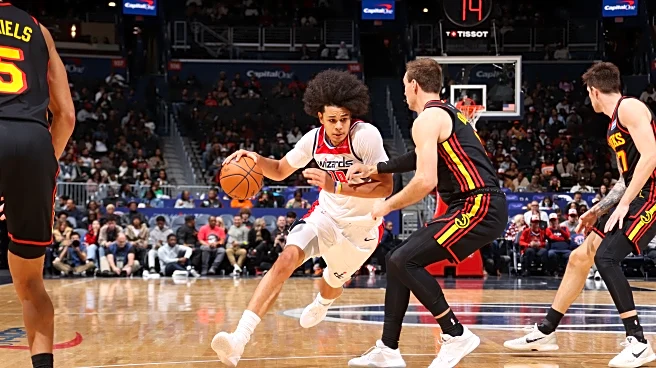




The Washington Wizards are on an epic bizarro heater — consecutive seasons of historically awful basketball, which could well end up as the worst two-year run in NBA history. Yes, even worse that The Process Sixers.
Last season, the Wizards posted the fourth worst scoring margin and the fourth worst adjusted scoring margin (controlling for strength of schedule) in NBA history. So far this season, they’re even worse — worst marks in both metrics, ever.

In The Numbers Behind the Wizards Two Main Problems,
I took a look at why they’re so bad. To sum up: they’re cataclysmically bad on defense (maybe the worst defensive team relative to average in league history), and they’re really bad on offense. I’m running out of synonyms for bad here.
Now, it’s fair to acknowledge the team wants to lose. One of their organizational goals is to avoid giving their first round pick to the New York Knicks to finish paying for the 2020 trade that sent John Wall to the Houston Rockets for Russell Westbrook. The front office wants a high draft pick in hopes of landing an elite talent.
That’s still not an excuse for being this bad. It’s possible to play hard, execute the game plan, demonstrate some kind of process that could lead to future success and lose. Other teams have managed the feat.
The Measuring Stick
Here’s where the Wizards currently rank in the various key stats of team strength (where they ranked at the last update is in parentheses):
- Offensive rating (points scored per 100 possessions): 29 (28)
- Defensive rating (points allowed per 100 possessions): 30 (30)
Offensive Four Factors
- eFG%: 19 (22)
- Offensive Rebounding Percentage: 24 (26)
- Turnover Rate: 30 (26)
- Free Throws Made/Field Goal Attempts: 28 (28)
So, shooting isn’t bad, but they don’t get offensive boards, they commit lots of turnovers, and they don’t get to the free throw line. These are indicators of a team that’s not competing physically and not stressing the defense.
Defensive Four Factors
- eFG%: 25 (22)
- Defensive Rebounding Percentage: 30 (30)
- Turnover Rate: 29 (30)
- Free Throws Made/Field Goal Attempts: 14 (22)
They don’t make the other team miss, they don’t force turnovers, they don’t rebound effectively. At least they’re not fouling as much?
The defensive numbers indicate the same thing as the offensive numbers — physically overwhelmed, not making the opposing offense work for what they get.
Player Production Average
Below is a table with updated results from the Player Production Average (PPA) metric so far this season. PPA is an overall rating metric I developed that credits players for things they do that help a team win (scoring, rebounding, play-making, defending) and debits them for things that hurt the cause (missed shots, turnovers, fouls, ineffective defense). PPA is similar to other linear weight rating metrics such as John Hollinger’s PER, David Berri’s Wins Produced, Kevin Pelton’s VORP, and the granddaddy of them all, Dave Heeren’s TENDEX.
PPA weighs a player’s performance per possession against that of his competitors season by season. While PPA falls into the category of a linear weight metric, the values for statistical categories float a bit season-to-season based on league performance.
PPA is pace neutral, accounts for defense, and includes a “degree of difficulty” factor based on the level of competition a player faces while on the floor. Beginning with the 2019-20 season, I added a position/role adjustment designed to reflect how roles and on-court positioning affect individual abilities to produce certain stats.
Inputs include:
- on-court team defensive rating
- points
- rebounds (offensive and defensive weighed differently)
- assists
- steals
- blocks
- shot attempts
- turnovers
- personal fouls
- starts
- minutes
In the table below, I’ve included each player’s PPA last time, currently (through games played Nov. 23), as well as games played and minutes per game. The Garbage Time Brigade has their own section.
Around the League in 29 Bullets
- Atlanta Hawks — Jalen Johnson has made The Leap. The 24-year-old forward is the Hawks’ best player — 196 PPA, 123 offensive rating, one of seven players averaging a triple-double per 100 possessions.
- Boston Celtics — I’m not about to argue this next guys is Boston’s best player, but he has been their most productive on a per possession basis. I’m talking, of course, about Neemias Queta converting everything around the rim, rebounding, blocking shots, and even getting some assists (3.5 per 100 possessions).
- Brooklyn Nets — Michael Porter Jr. is having the best season of his career. No long sharing the floor with all-time great passer Nikola Jokic, Porter has a 121 offensive rating on a career-high 28.7% usage. And a career-best 195 PPA.
- Chicago Bulls — Josh Giddey is an object lesson in being patient with young players. He had his issues in his first few seasons, but he’s become the Bulls’ best player, and he’s one of the seven averaging a triple-double per 100 possessions.
- Charlotte Hornets — Rookies Ryan Kalkbrenner (156 PPA) and Kon Knueppel (122) are playing great. Kalkbrenner is in his age 24 season, but his stellar play is still a positive sign Charlotte’s future.
- Cleveland Cavaliers — The Cavs have been inching down Jarrett Allen’s minutes because the coaches seem to prefer Evan Mobley in the middle. That may be the right call long-term, but this year, I think Allen has been better.
- Dallas Mavericks — How hard is it for teen-age rookies to make an impact? First overall pick Cooper Flagg has a 104 PPA — just barely above average. His offensive rating is almost 8 points per 100 possessions below league average.
- Denver Nuggets — Currently have two players with a PPA over 200 — Jokic (292), and Jamal Murray (206). If this holds up, it’s the best season of Murray’s career.
- Detroit Pistons — Cade Cunningham is playing great (175 PPA), but the “most productive” title (at least according to PPA) is Jalen Duren. The 22-year-old big man has a 193 and a 129 offensive rating. The reality when I watch Detroit is that the two make great partners in passing and finishing.
- Golden State Warriors — The oldsters — Jimmy Butler (248 PPA) and Stephen Curry (219) are putting up amazing numbers for an NBA player of any age.
- Houston Rockets — One of my favorite watches, Houston has eight rotation players with a PPA over 100, plus Tari Eason at 97. The most ridiculous stat is Steven Adams averaging 10.9 offensive rebounds per 100 possessions and 10.0 defensive rebounds.
- Indiana Pacers — Man do they miss Tyrese Haliburton. Several Pacers holdovers from their Finals run are actually playing okay — Pascal Siakam, Andrew Nembhard, Bennedict Mathurin, T.J. McConnell all have PPA scores above average. Their record is just 6-18 because they’ve all missed multiple games with injuries.
- Los Angeles Clippers — It seems like every old guy roster bet the Clippers made this offseason has come up a loser. They could still be okay if Kawhi Leonard could stay on the floor, which is a bit like saying if the Earth would rotate the opposite direction.
- Los Angeles Lakers — Three players have a PPA above 150, and none of them is LeBron James. The three Luka Doncic (238), Austin Reaves (202), and DeAndre Ayton (152). James’ PPA is 137 in just seven games so far.
- Memphis Grizzlies — The Memphis front office dealt Desmond Bane and sought to restock the roster around “stars” Ja Morant and Jaren Jackson Jr. Their best players have been Zach Edey, Jaylen Wells, and Cedric Coward. Morant and Jackson both rate well below average so far this season.
- Miami Heat — Kel’el Ware appears to have made The Leap. Tyler Herro has been awesome. Norman Powell might be an All-Star at 32. Oh yeah, Bam Adebayo is good too.
- Milwaukee Bucks — Giannis is still great (272 PPA), Ryan Rollins has been good (140 PPA), A.J. Green has been decent (117), and Myles Turner somewhat disappointing (113). The next “best” player is Kyle Kuzma with a 76 PPA.
- Minnesota Timberwolves — Five good players — Anthony Edwards (196), Julius Randle (161), Rudy Gobert (137), Donte DiVincenzo (132), Jaden McDaniels (109), and then…not much. Naz Reid has an 82 PPA so far, and Mike Conley’s play has fallen off the age cliff. Rob Dillingham has been just as bad as Bub Carrington.
- New Orleans Pelicans — Zion Williamson’s production was way down (128 PPA) even before he got hurt again. Saddiq Bey’s been good. Jordan Poole was astoundingly awful — like first year with the Wizards awful — before he got hurt. Their rookies, Jeremiah Fears and Derik Queen have been good with matching 88 PPA scores.
- New York Knicks — Eight players rate better than average — Mikal Bridges (191), Jalen Brunson (180), Karl-Anthony Towns (165), Mitchell Robinson (155), Josh Hart (144), OG Anunoby (138), Miles McBride (108), Landry Shamet (103). If healthy, that’s a helluva playoffs rotation.
- Oklahoma City Thunder — Shai Gilgeous-Alexander has The Best Ever PPA so far (338 — not a typo), AND the Thunder have two other players over 200 (Jalen Williams and Isaiah Hartenstein), plus five more guys who rate better than average. They also have Alex Caruso (85 PPA) and Lu Dort (70).
- Orlando Magic — Played better with Paolo Banchero out of the lineup, mainly because Franz Wagner and Jalen Suggs were so good (173 and 168 PPA respectively). Now they’ll have to figure out how to do it without Wagner for a few weeks while he recovers from a high ankle sprain.
- Philadelphia 76ers — Tyrese Maxey is cementing himself as one of the game’s elite players. The 25-year-old has a 196 PPA and a 121 offensive rating on 29.9% usage.
- Phoenix Suns — The Suns are recovering from the colossally stupid decisions to trade for an aging Kevin Durant and an aging and in decline Bradley Beal with a “play hard” collective effort. And they’re getting almost nothing yet from rookies Khaman Maluach and Rasheer Fleming.
- Portland Trail Blazers — Deni Avdija might be an All-Star this season — 161 PPA and a 120 offensive rating on 29.8% usage. Another object lesson on being patient with young players. He’s hitting 38.0% on threes and 80.9% from the free throw line.
- Sacramento Kings — Best player this season: 37-year-old Russell Westbrook, who’s PPA is just 123. He’s followed by 29-year-old Domantas Sabonis (117), 36-year-old DeMar DeRozan (114), and 30-year-old Zach LaVine (109). They were all poaching opportunities from their one potentially good younger player (25-year-old Keegan Murray), who’s also been hurt. #SoKings?
- San Antonio Spurs — Victor Wembanyama might be the best defensive player in league history, and he’s an offensive force as well. De’Aaron Fox has been great since coming back from injury, Stephon Castle has improved from his Rookie of the Year campaign, and Dylan Harper has been pretty good for a teenage rookie. With some just solid GMing, this team should be a title contender within the next couple seasons and retain that status for a decade.
- Toronto Raptors — The long, athletic, switchable, lineup Masai Ujiri envisioned is finally coming into focus. Scottie Barnes could be an All-Star, Immanuel Quickley has been everything they hoped he’d be, RJ Barrett is playing the best ball of his career, Jakob Poeltl is efficient on offense and an effective defender, and Brandon Ingram has been okay. They’re getting decent minutes from Sandro Mamukelashvili and Jamal Shead off the bench. That’s good enough for fifth in the East.
- Utah Jazz — Gotta think they’ll be trading Lauri Markkanen, who’s having a terrific season, again. They’re youngsters have a ways to go. Somehow, head coach Will Hardy has this in 12th place, a half game out of 10th.