
Teams that draft outside of the top fifteen or twenty spots have far less freedom to target positions of need than rebuilding teams. Instead, they must take the best players that fall to them while keeping
in mind roster weaknesses. They must also leverage redundancies on their roster by trading away older and higher-paid players and by allowing veterans to walk in free agency while retaining young talent that is still under contract.
With the emergence of Ozzy Trapilo as a stabilizing force at left tackle–and with the struggles on the defensive line–the assumption has been that Chicago needs to go “all in” on defense. Now that his recovery timeline is unclear due to his unfortunate injury, opinion has shifted to the idea that Chicago must draft a starting left tackle in April. That sort of declaration is emotionally satisfying but unrealistic. Instead, playoff teams need to try to plan free agency strategy around aligning needs with the likely availability of talent in the draft and then it needs to draft the best players available at positions of need.
With that in mind, I am going to offer a pair of mock drafts using the engine from Pro Football & Sports Network and making selections based on their board cross-referenced with the board from Drafttek, selected because when I have run cross-checks in the past, it is the most accurate “large board” that is already available. To be clear, while I am going to make adjustments based on scheme fit (I won’t be drafting 230lb edge defenders, for example), I am using the boards of other experts because this is an exercise in strategy, not personal preference. I also believe that at this stage of the process, the key role of mock drafts is introducing fans to some of the players who might be under consideration.
To prevent things from getting ridiculous in terms of offered trades, I am only allowing one trade in any direction in between selections (no trading down twice before picking, for example).
The first mock draft is going to involve reaching for positions of perceived need in order–interior defensive lineman, starting left tackle, starting safety, and rotational edge defender. The second is going to involve maximizing the long-term approach and trading “in,” trying to maximize the best players who fall to Chicago while considering positional needs but not prioritizing them or getting hungry for individual players. To be clear, I am not aiming to build a poor draft either way.
BUILD FOR URGENCY
# 25) Kayden McDonald, NT (Ohio State): If this were to happen, Poles would likely be thrilled and Dennis Allen would be beside himself–but Drew Dalman would likely need a very good health and nutrition program in order to keep up with practice. I suspect that when the actual draft rolls around, McDonald will be gone before Chicago drafts.
TRADE UP- As soon as Isaiah World went off the board, I had to make a hard decision on whether or not I was committed to getting a starting-grade left tackle. I needed to get “up” high enough to secure Monroe Freeling, the last player PFSN had left on the board in this range. And it was pricey. Chicago sent #57, #129, and #167 in order to secure #51 and #197.
#51 Monroe Freeling LT (Georgia). Freeling is rated more highly by Drafttek than consensus, and it’s understandable why opinions are split on him. He lacks the experience and the refinement that would command a first-round pick for a man with his length (6’7”). He’s also possessed of a true anchor. For myself, I wish he played with greater timing and with a punch or stab that made use of that length more effectively. Whether or not he would ultimately be worth the trade up that is made here, this is a realistic price to pay to make sure that a team gets a highly-rated tackle should one fall this far–whether that happens to be Freeling or someone else when April rolls around.
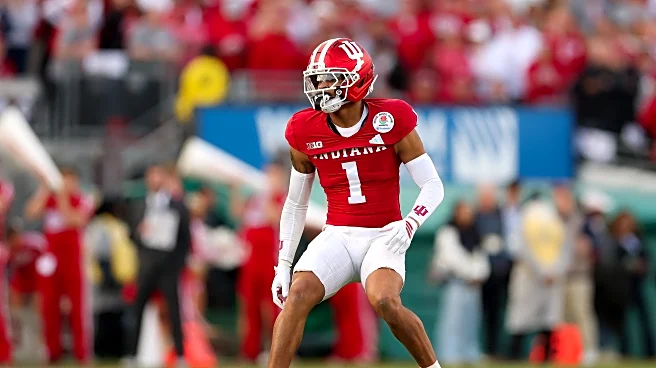
#89 Amare Ferrell, SF (Indiana): The middle of the draft was a wasteland for edges, but it’s an ideal place for safeties. Of the ones left at this point, I actually like Ferrell quite a bit for a Dennis Allen defense. It’s less that Ferrell has a particular strength as that he is well-rounded and he checks most of the available boxes.
#197 J’Mond Tapp, ED (Southern Miss): Look, I needed to pick up an edge defender and with how things played out, this was my only real option. He’s a versatile athlete who was also a track and field star and basketball player. He was formerly a wide receiver and tight end who is likely to play edge if he is drafted.
After that, Chicago has a pair of 7th-rounders for other needs.
BUILD FOR THE FUTURE
TRADE DOWN – There were multiple trades available, but the Titans were the only one that increased the odds of acquiring multiple starters in this year. As a result, the trade was #25 + #241 in exchange for for #33 + #66.
#33 Anthony Hill LB (Texas): If Chicago is going to get its cap under control, it’s going to need to make hard choices regarding who stays and who goes. Moreover, the entire Front 7 can use an overhaul. Therefore, an off-ball linebacker is not a terrible choice so long as he has proven he can disrupt the passing game. Enter Anthony Hill. He has 17 sacks, 8 forced fumbles, and 3 interceptions in a three-year career. He has the length to engage offensive linemen and has shown interior quickness and an ability to use shoulder movement and timing to shed blockers.
TRADE DOWN – Akheem Mesidor and Dillon Thieneman are both on the board, but I am worried about Mesidor’s injury history and the class is deep in safeties. As a result, when Arizona offers #65 + their 2027 3rd-rounder in exchange for #57, I cannot make the deal fast enough.
#65 Lee Hunter NT (Texas Tech): Hunter is not in the same athletic tier as Kayden McDonald or A’Mauri Washington. He lacks the “oomph” and drive that those players deliver, and when he manages to get any pass rush at all, it’s more of a team effort or an offensive failure. However, Hunter is a 6’4”, 330ish-pound run deterrent. He is a true nose tackle, but he’s strong instead of powerful and skilled instead of gifted. He represents an improvement in the defensive line’s rotation more than he represents an individual game-changer. To be clear, there are other nose tackles I prefer still available, but I am sticking to the board I am provided.
#66 Caleb Tiernan OT (Northwestern). I wish Tiernan maintained a better pad level and had more consistent play strength, but he’s an almost tailor-made swing tackle. He’s 6’7”, north of 315lbs, and has the technical movement skills that would be expected of a man who was a varsity basketball player and two-way lineman in football. He can provide the depth Chicago will need in the trenches and essentially represents a “free” chance at a starter if it works out.
#89 Jadarian Price RB (Notre Dame). Ferrell went earlier this time, and I am comfortable with the depth of the safety class while also being unimpressed by the available edge players, so I take a chance on the less-famous Notre Dame halfback. I like the power and brutality in his cuts and leans, and if he lacks the grace of nimbler running backs, he’ll also readily power his way to an extra few football lengths with his leg drive.
#129 Wheatley SF (Penn State). He’s an instinctive and athletic safety who is almost a single-high specialist. On the other hand, there are plays where he just bites and it seems like he over-pursues, over-corrects, and generally shows a lack of refinement in technique. I’ve seen him given a second-round grade, but that seems generous to me. One way or another, I think it’s reasonable that a competent safety will fall this far given their numbers in this draft.
#163 Gabe Jacas ED (Illinois). Jacas is a solidly-built menace (270lbs) who is able to get to the passer more through consistency than a specific skillset or burst. He lacks the burst, bend, or dip that would have him in the top of the edge-rushing group, and he will need to work on his skillset as a run-defender. In many ways, he’s a counterpoint to Austin Booker. However, he does enrich the rotation on the line.
After this, Chicago has only a single 7th-rounder left, but also an extra future pick.
COMPARISON
There is no doubt that the urgent draft netted a far superior nose tackle (a likely impact player compared to a snap eater). The difference in offensive tackles–whether these exact two or two others once grades are adjusted–is also likely to be tangible if less pronounced; it is also questionable how much of an improvement either would be over Theo Benedet in his third year, already familiar with the offense. Ferrell is a more complete safety than Wheatley, but Wheatley can still answer a need. Then it turns. Jacas would probably be better than Tapp, and either way Tapp would have been an option when Jacas was taken.
However, Price adds youth and power to the running back room and Hill is one of the better linebackers in this class. That’s potentially two additional starters by 2027 if not sooner, and the second approach also picked up a future pick in the first two days. This is balanced out by only an extra 7th-round pick on the other side.