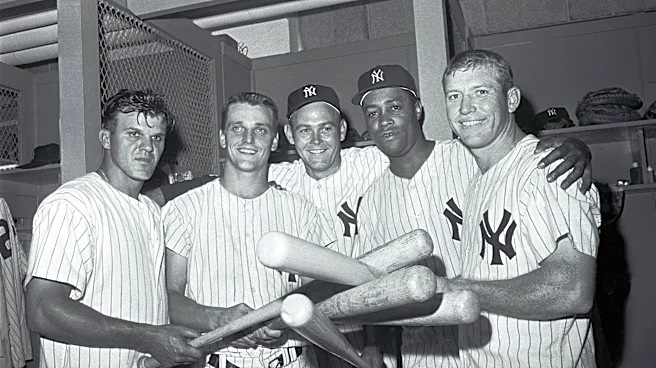


The Yankees of the early 1960s were a behemoth. Led by Mickey Mantle and Roger Maris in the lineup and Whitey Ford in the rotation, the team was stacked and fearsome, still operating at the peak of its power and winning the AL pennant nearly every year. But championships are not won solely by the top of a roster. Even the most star-studded squad needs contributions from role players to get them over the hump. One of these unheralded contributors was a journeyman lefty who brought his experience to bear
in their bullpen.
Leavitt Leo “Bud” Daley
Born: October 7, 1932 (Orange, CA)
Died: October 15, 2024 (Riverton, WY)
Yankees Tenure: 1961-64
Bud Daley grew up in southern California. He came to baseball late, playing his first organized game while enrolled at Woodrow Wilson High School in Long Beach. By his senior year, he was hitting .450 and pitching to an 11-1 record, drawing the attention of the pros. Of the many teams that came calling, he picked Cleveland because their star hurler, future Hall of Famer (and, later, Yankees manager) Bob Lemon was also an alumnus of Woodrow Wilson.
Daley had a rough start to his pro career in 1951, pitching to a 5.54 ERA in 25 appearances with Class-C Bakersfield. He started to straighten things out the following year, winning 14 games with a 3.09 ERA for Class-B Cedar Rapids, but still struggled with control, walking 125 in 227 innings. His improvement was enough to earn him a promotion to Triple-A the following year. He got his free passes in check, and by 1955, at the age of 22, he got the call to the Show.
Daley would spend all three of his years in Cleveland shuttling between the big club and Triple-A, struggling to find a consistent role. In ’58, he was traded to the Orioles as part of a deal that brought back franchise icon Larry Doby for a second act with the club. Baltimore flipped Daly before he could appear for the O’s, this time to the Athletics.
It was in Kansas City that Daley would find his greatest success. After a solid first campaign as a swingman, he joined the rotation in earnest for the ’59 season. It would be the high-water mark of his career. Daley took the decision in 16 of the A’s 66 wins, posting a career-best 3.16 ERA while making both of the year’s All-Star squads and earning down-ballot MVP votes. He’d make the All-Star teams and receive MVP votes again the following year, though perhaps largely on the strength of his breakout the year prior; Daley allowed the most runs in baseball in ’60. His All-Star berths did lead to a career highlight for the 27-year-old, who got to finish off one of the games in front of his hometown fans.
“That was one of the biggest thrills I ever had,” Daley later said. “I came in in the ninth inning to pitch the last inning and the bullpen was in dead center field. I opened the gate and started walking in. From the time I opened the gate until I got to the mound I had a standing ovation the whole way.”
The A’s were sold that offseason to the notoriously stingy Charlie Finley. After Daley got off to a slow start, he found himself on the trading block once again, this time headed to New York.
Daley’s performance was uneven down the stretch, leading to the loss of his regular spot in the rotation. But, come October, he settled into a new role. In Game 3 of the World Series, with both the game and the series knotted at 1-1, Daley entered in a critical spot. Yankees starter Bill Stafford had exited with two outs and two on in the seventh. Yankees manager Ralph Houk called on his southpaw reliever to face the left-handed Vada Pinson. The 23-year-old was one of the game’s most dangerous hitters, having just led all of baseball with 208 hits. Daley got two strikes on Pinson before inducing a fly out to right. It would be the only batter he’d face in an eventual 3-2 victory.
In Game 5, Houk would lean on his swingman for more length. With the Yankees up 6-3 with one out in the third, the skipper brought in Daley. He’d end up going the rest of the way, allowing only two unearned runs in 6.2 innings of work, earning the win as the Yankees clinched the title. Not many players in big-league history can say that they were on the mound when a championship was secured, but for all his days, Daley could.
Daley continued to work primarily out of the bullpen the next season and got another inning of work in the ‘62 Fall Classic, retiring Willie Mays and Willie McCovey to strand two runners in the eighth inning of Game 2. He wrapped up his postseason career without allowing a single earned run in eight innings of work.
Daley made just one appearance in ‘63 before suffering an arm injury that ended his season. He returned the following year but wasn’t the same pitcher. The Yankees traded him back to Cleveland before the ‘65 campaign but he failed to make their roster, hanging up his cleats at the age of 32. Daley and his family retired to Wyoming, where he lived until his passing in 2024.
While he’s far from the first name that comes to mind when remembering the mighty Yankees of the early ‘60s, Daley put together a strong, 10-year career that included excellence in World Series play. Please join us in remembering the legacy of Bud Daley.
See more of the “Yankees Birthday of the Day” series here.