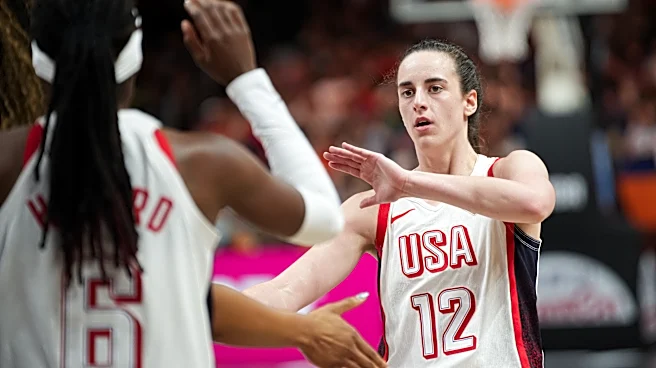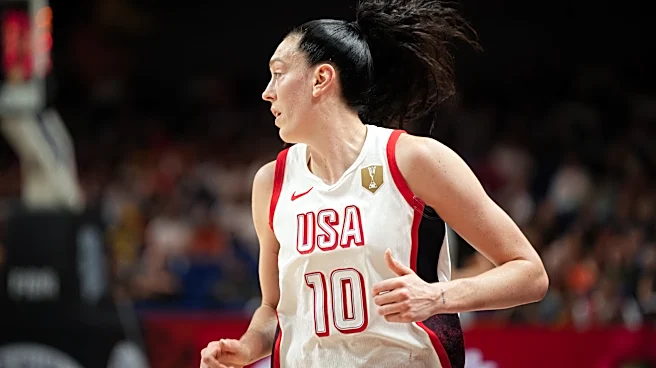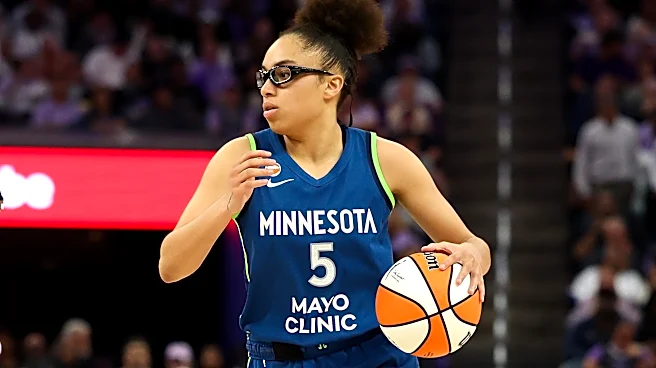




Olivia Miles is going to be the 2026 WNBA Rookie of Year. And it’s going to be unanimous.
Already, both Beckett Harrison and Zack Ward have touted Miles’ compelling MVP case, an affirmation of how her excellence has far exceeded the “rookie” label.
There’s plenty of statistics, both traditional and advanced, that can be listed to further confirm Miles’ open-and-shut case. She’s got the scoring (19.7 per game) and assist (6.0 per game) numbers. She’s got the 3-point shooting (39.6 percent). Her plus-minus
(+7.2 per game) and value plus-minus(+4.3) and PER (22.8) and net points (+130.4) are all outstanding. There’s also the array of “first to” and “fastest to” and “most” achievements that increasingly are marshaled as evidence of a player’s greatness.
Miles has miles of all those.
For me, what’s been most impressive about her Rookie of the Year season is her resiliency.
Yes, Miles is “The Spectacle.” She puts on a show, with flair, flash, poise and pizazz. She has demonstrated a precocious ability to zip to the rim for uncontested layups. She was instantly adept as an offensive orchestrator, with the savvy required to bend defenses to open up passing angles. And she also has understood how to deploy her the threat of her shot, confidently taking and making pull-up 3-pointers.
She’s done all that, over and over again, for nearly 40 games. It’s the repeatability, replicability and unsolvability that makes Miles special.
Sure, she’s had some rough games and off nights. But those have been outliers. Miles absorbs and implements her lessons. They become updates to her superstar software, not bugs that expose underlying vulnerabilities.
In short, Miles’ style is grounded in substance.
Substance, with some style, also describes the wider group of 2026 rookies.
While not (yet) on Miles’ level, there are more than four first years who have a strong case of join Miles on the 2026 WNBA All-Rookie Team. Since Miles’ ROY victory is assured, let’s use this award conversation to also highlight the four players who should collect an All-Rookie honor.
In the comments, be sure to give your takes on Liv and the best of the rest of the rookies.
Azzi Fudd (Dallas Wings)

Azzi Fudd is an easy choice. Her All-Rookie spot should be unanimous, even though a knee issue and subsequent procedure ended her season with 30 games played.
And substance, certainly, describes Fudd.
Her picture-perfect shooting translated, as everyone expected. Nearly 40 percent shooting from 3 helped produce her over 13 points per game. However, the reason she sports the highest plus-minus on the Dallas Wings (+4.7 per game), and the highest of any rookie outside of Miles, is due to her defense. Although she upped her defensive activity during her senior season at UConn, Azzi’s ability to positively impact that side of the ball at the WNBA level was questioned.
She’s provided an affirmative answer, utilizing her strength and smarts to silence any concerns about her foot speed. Her 1.7 steals per game serve as evidence.
That defensive growth suggests other areas of Fudd’s game, such as her limited rebounding and passing, could be improved with time. For now, however, what she did do in her 30 games for the Wings was more than enough to be one of the WNBA’s best rookies.
Sydney Taylor (Chicago Sky)

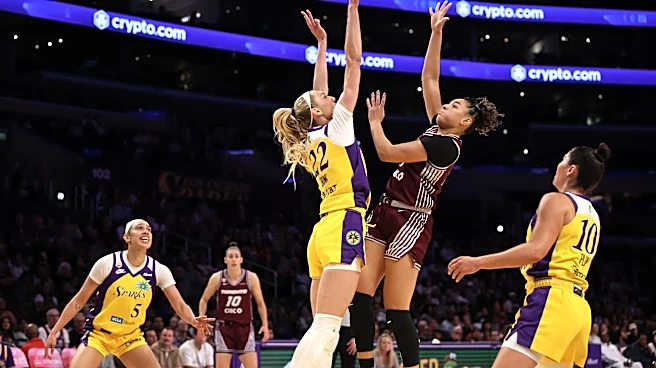
Sydney Taylor authored the most memorable plays by a 2026 WNBA rookie.
She not only sealed a Chicago Sky comeback over the defending-champion Las Vegas Aces with a game-winning 3-pointer, but she later downed the Golden State Valkyries with a game-tying and then game-winning triple.
That the Sky called Taylor’s number on those occasions, empowering the undrafted rookie when the game was on the line, is the surest testament to her talent.
For the season, Taylor, who is averaging almost 14 points per game, has been the most impactful player for the Sky, with Chicago outscoring opponents by 52 points in her minutes; she’s one of only two Sky players with a positive scoring margin.
Flau’jae Johnson (Seattle Storm)

Here’s where it stars to get tricky.
Miles, Fudd and Taylor should be All-Rookie locks. After that, different priorities can produce different candidates. Production, efficiency, playing time, impact, intangibles or projection? What matters the most? The remaining candidates are solid in some of those categories, while quite shaky in others.
Flau’jae Johnson’s rookie season resume is especially illustrative of that mix of good, okay and not-so-great.
In Flau’jae’s favor, she’s second in a number of major categories: minutes (1071), points (14.1 per game), rebounds (4.8 per game) and steals (1.3 per game). She’s played a lot and she’s produced a lot. But, that production, particularly on the scoring front, hasn’t been efficient. Less than 40 percent shooting from the field and below 30 percent shooting from 3 is not ideal.
But, the positives and the promise outweigh the inefficiencies and other issues. The rebuilding Seattle Storm have empowered Johnson to explore the extents of her game, and she’s weathered the ups and downs in ways that, overall, project an encouraging future forecast.
A comparative lack of opportunity for Awa Fam is also why Johnson has a stronger All-Rookie case than her Spanish teammate and brother.
In a re-draft, Fam would be selected ahead of Johnson; she might even be No. 2 overall behind Miles.
All-Rookie honors, however, aren’t about projection. Actual, not potential, production matters. Behind Dominique Malonga and Ezi Magbegor in Seattle’s frontcourt pecking order, Fam, with 10.3 points and 5.7 rebounds per game, hasn’t received the usage required to put up All-Rookie-worthy numbers, especially not in this season’s crowded class.
Pauline Astier (New York Liberty)

Production over projection also swings the final All-Rookie spot to Pauline Astier over the Toronto Tempo’s Kiki Rice.
Similar to Fam, Rice’s lower-usage role, plus her extended injury absence, ding her chances of receiving an All-Rookie selection, even as she appears well on her way to becoming one of the better two-way primary guards in the league. In a re-draft, she’d likely exceed her actual No. 6 overall selection, going in the top five and maybe even top three. In 24 games played thus far, Rice has averaged 12.5 points, 3.5 rebounds and 3.3 assists per game.
But Astier takes the final All-Rookie spot not because of her upside, whatever it is perceived to be, but because of how she took advantage of the opportunity in front of her.
For a New York Liberty team with injuries up and down the roster, Astier offered a reliability rare for a rookie.
In 40 games played, 35 of them starts, she has been a source of efficient scoring, exhibiting an instinct for inside-the-arc bucket getting that her size and stature belies. On 54 percent shooting, she’s scoring 9.2 points per game, while also contributing 3.4 assists per contest. The Liberty also have outscored opponents by 96 points in her minutes, the second-best total mark on the team.
And like Taylor, the undrafted Astier earns this spot without the reputational boost that tends to benefit highly-touted NCAA prospects.