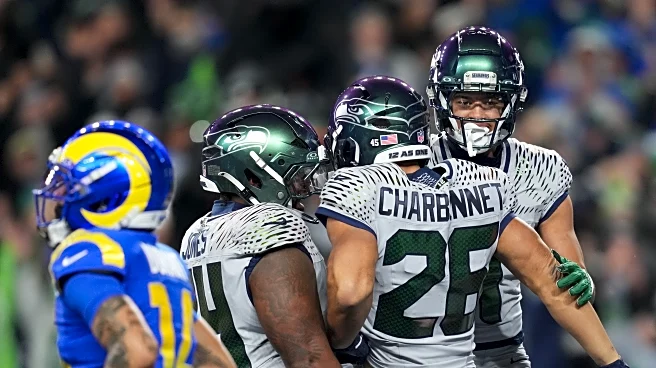


In the span of a couple of minutes, the Seattle Seahawks were able to turn a 30-14 deficit in the fourth quarter to a 30-30 tie against the Los Angeles Rams. While the winning two-point conversion was ultimately made in overtime by Eric Saubert, the most talked about two-point play was undoubtedly running back Zach Charbonnet’s heads up recovery of this deflected screen pass throw by Sam Darnold.
As the teams were ready for kickoff and a 30-28 Rams lead, referee Brad Allen said that the play was under
review. Replay showed a clear backwards pass from Darnold, with a clear recovery from Charbonnet, and therefore two points in one of the most freakish of circumstances.
Watching the play live, there is a clear whistle blown shortly before Charbonnet picked the seemingly dead ball up in the end zone. So shouldn’t the whole play be over and therefore no conversion? Not necessarily.
Terry McAulay, a longtime NFL referee who officiated multiple Super Bowls and is now a rules analyst for NBC and Prime Video, explained on social media why the call was reversed from an incomplete forward pass to an end zone recovery of a backwards pass.
“When a backward pass is ruled forward and incomplete, Replay can reverse if there is a clear recovery in the immediate continuing action,” McAulay said. “The recovering team is awarded the ball at the spot of recovery. Let me make this perfectly clear: whether a whistle is blown or not is completely irrelevant.”
We see this happen almost all the time in the NFL thanks to modified replay over the past several seasons; a loose ball recovery can be granted even if a whistle is blown. Charbonnet met the criteria of immediate continuing action
The other aspect of this is the distinction between a backwards pass and a fumble; they are not necessarily the same thing, something that even tripped me up.
“It’s not a fumble, it’s a backward pass and anyone can recover and advance at anytime,” McAulay noted.
The reason why that is important is because two-point conversions actually have special fumble rules applied. For fumbles on 2-point conversions, 4th down, or any time after the two-minute warning, the ball cannot be advanced by anyone other than the original ball carrier. If, for instance, Darnold was strip-sacked and the ball went backwards, Charbonnet could not pick it up and score. Darnold’s pass was not a fumble, and the folks at Football Zebras did an excellent job clearing up any confusion.
All of this is to say that Charbonnet grabbing the ball in a nonchalant manner turned out to be maybe the most important play of the season, as well as the most pivotal moment of his young NFL career. I’m sure Sean McVay will understand once he’s calmed down.