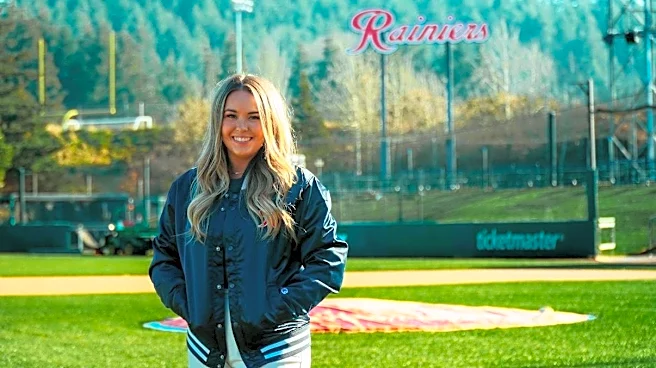

Rylee Pay has never had trouble finding the beat. From a storied competitive dance career to a meticulously-rehearsed game day routine, the Tacoma Rainiers’ radio play-by-play announcer simplifies high-intensity tasks with routine and rhythm. While navigating player interviews, show recordings, game notes, news write-ups, and usually a second coffee, Pay brings a unique consistency to an hours-long, multi-step pregame process before she even puts on the headset.
Multitasking is a skill that Pay has
been developing since she was a child, as every year of her life from first grade until the end of college was occupied by competitive dance. She developed an early passion for athletics and was a four-year member (and eventual captain) of the Pom Team at University of Nevada, Las Vegas (UNLV). The Pom program supports UNLV athletic events through competitive cheer and dance teams by showcasing rigorous, detail-oriented routines. While Pay found herself immersed in the UNLV sports scene through Pom, she eventually became curious about a career in the broadcast department and how her athletic background could translate to a new profession.
Pay transferred quickly from her previous accounting path to the school’s sports media program, and built up her resume through roles with the UNLV athletic department and student radio. She immersed herself immediately in the industry with the Wisconsin Rapid Rafters of the Northwoods League, a collegiate wood-bat league where she assumed the roles of on-field MC and athletic marketing intern. When given an opportunity to shadow the team’s radio crew, Pay knew her true interest lay in the booth.
During her senior year while working as a sideline reporter for the Coutit Ketleers of the Cape Code League, Pay was asked to join the team in an additional play-by-play role. She took the job without hesitation, showcasing her dance background again with her ability to close her eyes and take the leap. Pay’s brave and adventurous personality led the trajectory of her sports career to a completely new focus.
“It terrified me at first because it’s so new, but I always say yes to an opportunity,” she said. “The challenge of it was something that hooked me really early on.”
Pay continued to challenge herself to improve after each game, and pursued a full-time broadcast career directly out of college. She was initially searching for a role in minor league baseball but knew the consistently low volume of openings would provide an additional test. She was fortunate to find an assistant broadcast opening with the Double-A Portland Sea Dogs out of Portland, Maine that summer. Pay was ecstatic for the opportunity to work with Emma Tiedemann there, one of few female broadcasters in baseball at the time.
“I really wanted to go learn from her because it was someone who sounded like me, and that’s not always the case in this setting of broadcast,” Pay said. “I got to learn from her and her cadence.”
She spent two formative seasons with the Sea Dogs building her own unique broadcast identity with the help of Tiedemann, and covered a third and first place divisional finish for the team in 2023 and 2024, respectively. When Pay joined Tiedemann initially in 2023, the duo became just the second all-female broadcast booth in the history of affiliated professional baseball. In 2024, Pay and Tiedemann made history again as the first all-female broadcast crew to call a Boston Red Sox game at Fenway Park, as they took over the booth during the team’s Women’s Celebration Game.
After her time as an assistant with the Sea Dogs, Pay explained that the next common career step is taking over a broadcast department. She was fortunate in the timing of her job search, as longtime Rainiers broadcaster Mike Curto had just announced his retirement at the end of the 2024 season. The Rainiers’ position was one of five minor league jobs that opened that offseason, and Pay was incredibly excited to join a team and market that she’d always heard glowing reviews about.

She was selected over 250 applicants to become the new radio play-by-play voice of the Rainiers, and has now just wrapped up her second season with the team. Through an important balance of routine within her busy schedule, Pay has locked down the most efficient ways to complete her broadcast duties with the help of repetition and practice. She credits her time at the Sea Dogs and athletic background for the ability to manage numerous tasks at once and stay focused for long periods of time.
“There aren’t many non-game days in the minor leagues, it’s go go go for the entire season and then catch up on sleep when it’s over,” Pay joked.
Her typical week includes the minor league setup of six-game series, which means the team will be in the same place Tuesday-Sunday. While Monday is set up as an off-day, it’s generally used as a travel day, essentially leaving Pay the morning to catch up on “typical life activities” such as laundry and grocery shopping.
For home games, Pay’s routine stays the same. She arrives at the ballpark two hours before batting practice, five hours before first pitch, and begins by assisting the media relations staff with player stats and pitcher notes before catching up on the previous day’s baseball news. She heads down to the field next to shoot the Rainiers’ pregame show, which goes on the video board and TV broadcast. Pay is responsible for editing and uploading it as well as gathering highlights to send to the control room for use.
“I’ll usually do player interviews during batting practice, talking to anyone that has something noteworthy going on that’s timely,” Pay says. “That’s where I feel like I get the most in storylines.”
She then walks back up to the broadcast booth to edit her interviews and send them to the radio station, and goes over her game notes for further preparation on air. Pay focuses on highlighting important stats based on the game’s matchups and fills out her scorebook with the lineup as helpful tools for organization. An hour or so before the game, she will have dinner and a second coffee, and then the headset goes on. For games at Cheney Stadium, Pay is joined by Andy Helwig, the team’s director of media relations who brings another fresh, young voice into the booth. After the final out, Pay goes straight down to the field to record the postgame show before she wraps up for the day.
On the road, games follow a very similar schedule except Pay will be the only person on radio. There are also generally more storylines for her to cover because there is more flexibility and time to fill. Pay additionally helps with the game recap, posts highlights from social media, and sends all of her content to media relations contacts during away games, and she sometimes even has time for a walk before first pitch.
“Every day is similar in some sense but at the same time there’s something usually different no matter where we are,” Pay said. “No game is the same so I get to have different experiences every day.”
One of the main preventers of her organizational rhythm, however, is the consistent change within the minor leagues. Pay is tasked with getting to know a constantly-rotating group of players on the Rainiers’ roster, from prospects to seasoned veterans. In Double-A with the Sea Dogs, Pay noted that from the halfway point of the season on, the roster was generally set. In Triple-A, the roster changes all of the time and can do so very early and late in the season. Her first realization of that was during last season’s progression of pitching injuries, which caused the Rainiers to lose many members of their pitching staff within the first few weeks of the season.
While the sudden changes could be a detriment to doing her job, such as a player she’s been following a storyline on gets called up or traded, Pay sees this challenge as a strength because it provides her with more stories to tell. Getting to know players and their stories has a much quicker pace because the roster can be altered at any time, but learning a new routine is one of Pay’s most adaptable skills.
“In Triple-A, once you’re at that point where you have so many veterans throughout the league, it’s cool to know every day you’re coming to the ballpark watching big leaguers that have years of experience,” she said. “Some have even won the World Series. To have so many cool stories to share is fascinating from a broadcast perspective, especially getting to hear how the minor leagues change over time.”
With both top prospects coming through and big league names temporarily completing rehab starts, Pay makes each player feel valued by highlighting their strengths. She views an essential role of her job to be promoting every player the best way she can, and relates to the minor league journey as a broadcaster with so many different paths available in her field.
“Every story is interesting in some way,” Pay said. “At the end of the day, my job is to highlight everyone equally and be that person to share things with people that they don’t already know. I think that is my biggest responsibility, because I have the access to the players that other fans don’t.”
Part of that rotating cast in 2026 were the additions of top prospects Lazaro Montes and Michael Arroyo, who both made their way to exciting MLB debuts this season for the Mariners. Pay watched their progression firsthand and spoke of the excitement for their entry to the Rainiers.
“The home runs we’ve seen have been exactly as advertised,” Pay said initially of Montes. “Defense is something that stuck out early, and observing the energy he plays with in the outfield is really cool. He’s been able to make impressive plays in right field already, you can definitely tell by the edge he plays with that regardless he will give his best effort to make those plays.”
Arroyo entered with the same poise and determination as Montes, and both made immediate impacts to the team.
“I was really impressed with how he didn’t miss a beat at all,” Pay said, noting she was equally struck by Arroyo, the lesser-heralded prospect. “In his second or third game at Triple-A, he finished a double shy of the cycle. He totally seemed comfortable and confident, and didn’t seem to have any of those growing pains of switching level to level.”
In 44 games for the Rainiers, Montes recorded a .274/.369/.571 slash line with 13 home runs, 30 RBIs, and a .940 OPS. In Arroyo’s 49 games with the team, he slashed .277/.353/.490 with 8 home runs, 41 RBIs, and a .843 OPS.
“I’d heard so many good things about the types of people they are so it’s fun to have them around in the point of the season we’re at right now and contributing to the lineup,” said Pay.
Each of those remarkable traits showed up in Montes’ and Arroyo’s debut MLB seasons, acting as a bright spot amid a difficult Mariners year.
With her second season in Tacoma slowly fading into the rearview mirror, Pay has already made a lasting impact on the team and minor league baseball. As a woman making history in her role, she has become the person for the next generation that Tiedemann was for her as a young professional searching for representation. Pay deeply values the people of the sport, and has found a welcoming home within the Mariners organization.
“Broadcasting is definitely a career you can’t be perfect in because there are so many games, but my heart is in all of it more than anything,” Pay said. “I love being around the game, being at the ballpark, the magic of baseball is something I’ve loved from a young age. More than anything, I hope people can feel that when they listen to a broadcast. Even amid some of the inevitable storylines of first this or or that as a woman in my role, I hope that isn’t the only thing that defines me but more so my work ethic and love for what I do”