


CJ Gunn did enough.
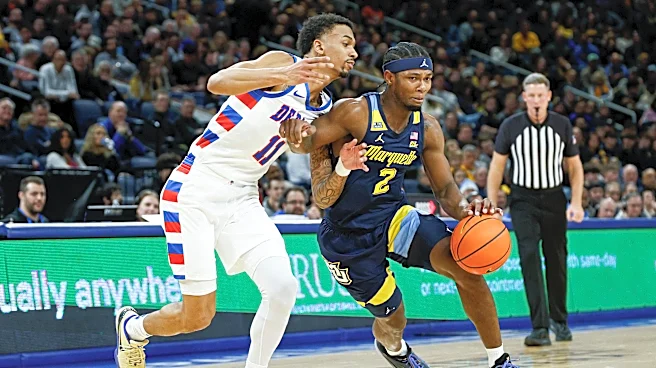
Midway through the first half, DePaul’s wing switched a ghost screen and picked up Jaylin Sellers, Providence’s shifty combo guard. Gunn needed only a timely first slide to cut off Sellers’ left-handed drive. When big man Oswin Erhunmwunse trotted toward the slot to set another ball screen, Gunn remained attached.
Staying in front was all that was required.
But Gunn kept pressing after Sellers retreated. The 6-foot-7 senior’s pressure loosened the handle just enough to expose the ball,
and Gunn raked it free. He dropped to the Amica Mutual Pavilion floor, batted the loose ball toward a sprawling Brandon Maclin, then peeled himself off the hardwood, sprinted ahead and finished the sequence with a layup.
That possession is a useful snapshot of the bet Missouri made this offseason. The Tigers don’t necessarily need every perimeter defender to erase actions outright. They need more guards and wings capable of surviving the first exchange, keeping the ball in front and, occasionally, turning a neutral possession into something more.
Last season, too many possessions traveled in the opposite direction. One clean turn of the corner became another rotation, another scramble and, eventually, another trip to the paint. By February, those leaks had become increasingly difficult to contain.
That matters because the roster’s most obvious offseason change happened behind them.
Reductive as it sounds, Mizzou’s response has been to simply get bigger. Undoubtedly, adding Bryson Tiller ($), Jaylen Carey ($) and Toni Bryant stocks the rotation with more positional size, length and mobility — all of which offer insurance behind a play. Trent Burns showed flashes as a low man, the kind helpful in anchoring the bottom of a zone. And, assuming he’s available, Mark Mitchell’s presence further reinforces the frontcourt.
But here’s the thing: MU wasn’t tiny last season. The Tigers ranked third nationally in effective height, per KenPom. And while it helped plug some of the leaks that sprung on the perimeter, the basement finally flooded in the final month of the regular season, which also happened to be the toughest stretch on the slate.
Over those 13 games, opponents averaged 20 on-ball possessions — defined as pick-and-rolls, isolations and handoffs — per game, and those touches generated 1.050 points, per Synergy Sports. Simultaneously, opponents saw their volume of shots at the rim climb, evidence that the backline wasn’t simply mopping up anymore. Unfortunately, dealing with seepage from perimeter breakdowns ($) had become the default.
Consider the chart below, which plots the average volume of pick-and-rolls defended each game and the efficiency allowed by high-major guards last season. Anthony Robinson II graded out elite. But even granting that defensive play-type data requires context, none of T.O. Barrett, Jayden Stone, Trent Pierce or Jacob Crews measured up well.
So, the more pressing question isn’t whether the program suffused this roster with enough size or brawn. It’s whether Gates and his staff have built a backcourt capable of reducing the frequency at which opponents cleanly drive the ball to the paint. Finding that answer takes on added urgency when Jason Crowe Jr. and Aaron Rowe are slighter, leaner guards, the kind of frame opponents love to hunt in screening actions.
Yet that same scatter plot might also highlight three plausible answers in Gunn, Kennard Davis Jr. and Jamier Jones.
Now, no member of that trio shows up as a lockdown defender. But that’s not necessarily a problem. What matters is whether their individual strengths overlap enough to collectively prevent the same structural problems.

CJ Gunn: The Disruptor
The level of harassment we saw earlier from Gunn wasn’t sporadic.
The veteran wing, who started his career at Indiana, surrendered only 0.697 points per possession in pick-and-rolls, ranking in the 71st percentile nationally, per Synergy Sports. Even better, 21.2% of those ball-screen possessions resulted in a turnover. After factoring in Gunn’s handiwork defending handoffs and isolations, he yielded 0.763 PPP when matched up with a shot creator. Crucially, that stingy nature carried over to a five-game sample that represents a typical slice of his final campaign at DePaul.
Gunn’s best attribute starts with an unglamorous trait: staying connected. He has little trouble getting his lean frame narrow, slithering over a screen and catching up to a dribbler’s hip. Sure, he’s disruptive. But it was more routine to see him fight back into a play to contest jumpers or floaters around the nail and mid-post.
The accompanying tape also accentuates the difference between Gunn executing a coverage cleanly and creating a problem for himself. Staying in contact through an exchange or screen still affords him the chance to alter shots from a trailing position. However, ducking under a screen while a big sets in deep drop coverage, as you can see above, negates any of that.
The type of ball handler Gunn confronts also has ramifications.
For example, he’s a competent switch defender against handlers who rely more on pace than burst. In those situations, his lateral agility neutralizes an initial attack and keeps him in the play through a reset. Meanwhile, his length lets him contest shots late or wall up. That matters much less if Gunn draws a power wing or four-man, situations where brute strength lets them play through his chest.
Given MU’s struggles at the point of attack, having a defender like Gunn around to bottle up shot creators is useful. But the genuine upside is his gift for havoc. Our pool of scouting film featured 14 PNR possessions, and five ended in turnovers. Gunn might not notch a steal for himself, but he can compromise passing decisions.
Expose the ball before a screener arrives or get loose with a handle after an exchange, and Gunn’s likely to get a paw on it.
That said, Gunn could still benefit from some moderation and discipline. Sometimes, doing your job is the win: stick to a hip, usher a driver toward a rim protector, stay in front during an ISO, or string out a dribbler deep into a possession. There are moments when Gunn cannot help himself, producing unnecessary reach-ins, hacks or block attempts.
In our five-game audit, Gunn permitted an astronomical 0.714 free-throw rate. At the point of attack, the players he guarded attempted 13 free throws against just 10 shots from the floor. And when they stood at the charity stripe, they converted 77% of those freebies. Had Gunn trusted verticality or stayed chest to chest, several of those possessions would have ended in his favor.
Play charting backs that up. Gunn’s isolation possessions in our subset, for example, were worth 1.50 PPP. Yet four of them failed to generate initial separation. The problem? Aggression provoked four fouls and seven free throws.
Assuming Gunn is eligible, MU might have snagged a rangy perimeter defender flexible enough to defend across the backcourt and snuff out possessions. The question is whether Gunn can learn enough restraint to avoid becoming a high-variance solution who takes himself out of the mix by running up a hefty foul tally.

Kennard Davis Jr.: The Repair Man
If Gunn’s appeal is his ability to sow chaos, Davis offers almost the inverse: a defender whose value comes from keeping a modest advantage from spreading.
The BYU transfer’s reliability might also be just what the Tigers need.
Last season, the St. Louis native, who started his career at Southern Illinois, wasn’t a make-or-break presence in coach Kevin Young’s rotation. Davis posted a minus-0.8 on-off split defensively, while the most-used lineup featuring him — one that logged roughly 450 possessions — posted a 100.9 raw defensive rating. It’s also easy to trace fluctuations in the Cougars’ performance to the frontline combinations Young rolled out.
More importantly, his perimeter containment stayed stable during a stopover in Provo.
Last season, Davis conceded 0.787 PPP as a terminal defender in pick-and-rolls, handoffs and isolations. We can go a step further by looking at five games that reflect a typical slice of his season based on workload and efficiency. Davis endured modest slippage compared with his time at SIU — about 5% — but still checked in at 0.861 PPP. Even his poor handoff results, as you can see below, warrant caution, because another Cougar finished all five possessions in our video breakdown.
Like Gunn, Davis’ most transferable trait is maneuvering around screens after contact, though he leans more heavily on body control and length than Gunn’s quickness. He gets skinny enough to clear a screener, absorb contact, fall briefly behind in trail position and recover. At that point, Davis’ length functions as a leveling tool, letting him contest shots from the side or muddy up passing windows.
That’s the first contrast with Gunn, whose quickness generates more direct pressure. For his part, Davis spends more of his time repairing an advantage than inverting it.
Yet a vulnerability shows up when a set keeps flowing. For example, re-screens can catch Davis before he partially shrinks the distance with a dribbler. Once that handler has built a real head of steam, any leeway for error is gone. It also means that a driver’s strength, body lean, extension or crafty use of ball fakes makes Davis’ life hard in the lane.
None of this implies Davis is easy to break down.
He generally grasps when to chase his man over a screen, switch automatically or peel off late. He also tends to hold his own reasonably well when he can confront an isolation squared up. Six of eight charted isolation possessions didn’t engineer an advantage. That fits the broad contours of our film study: Davis wins the first slide, redirects a counter and steers a creator toward help or a lower-value shot, like a pull-up in the mid-post.
Davis is also like Gunn in another way: forfeiting a possession after doing the hard work. Eight of 36 charted on-ball possessions included a foul, resulting in a 0.52 free-throw rate. The pattern is also familiar. Davis recovers but succumbs to the urge to reach, chase a block from behind or bite on a shot fake.
That’s why Davis feels like a sturdier counterweight to Gunn. And how Gates apportions minutes could reveal which tradeoff he values more. Leaning heavily on Gunn might signal a preference for disruption and turnover creation. More minutes for Davis, meanwhile, might reflect a more pragmatic bet on containment, reducing pressure on MU’s backline and, downstream, improving outcomes at the rim.

Jamier Jones: The Gatekeeper
Projecting Jones’ impact, though, entails some careful speculation.
Providence was just as inclined to use him as an undersized four as a wing, and his individual defensive impact is tricky to isolate. The Friars’ defense improved by 7.2 points per 100 possessions with him on the floor, but many of his minutes overlapped with a traditional rim protector.
Jones’ catalog of reps is equally thin. He averaged just 6.0 defensive possessions per game, which ranked sixth in a nine-man rotation. So, statistics like conceding 0.439 PPP in pick-and-rolls come with a note of caution. And that’s before isolating a five-game block to mirror the methodology used for Gunn and Davis.
Whittling the dataset down leaves us with a whopping 14 direct reps to evaluate. While Jones’ performance (0.43 PPP) mirrors his season average (0.471 PPP), that sliver of trips matters because it exposes the difference between process and outcome.
Yes, opponents only racked up six points, but a ball handler manufactured an advantage on eight of those possessions. Charting those possessions shows they produced two open shots and five more that were lightly guarded. Opponents shot only 17.6% from beyond the arc, meaning shooting variance, not lock-tight defense, explained the glittering results.
To Jones’ credit, he displayed the dexterity to survive switches across the positional spectrum. Faced with a smaller guard, Jones can stay square with the ball and erase a straight-line drive. Asked to handle a bigger wing, his broad chest and core strength make it easy to take contact without getting bumped off.
However, Jones’ perimeter poise begins to buckle when opponents layer actions. Handoffs are a prime example. If it’s a normal dribble-handoff, Jones wasn’t troubled and could slide over the top to stay engaged through the exchange. But the moment an opponent adds a trigger action, a wall screen, a pindown or a UCLA screen, Jones has to make an earlier route decision. Even if a shot clanks, as it does in the snippet below, it doesn’t absolve him of taking the wrong course.
But again, several variables are at play. Providence used three undersized ball handlers and would sometimes switch aggressively. That made its perimeter shell vulnerable. Using Stefan Vaaks as a 6-foot-7 combo guard didn’t resolve the problem. In fact, that move actually made the Friars more porous, with only Oswin Erhunmwunse around to reliably clean up messes on the back end.
Columbia should offer Jones a different environment. He’ll likely slide up the positional ladder, but he’ll also play in lineups with more size and length around him. That ought to provide more insulation when layered actions stress his processing. Jones’ comfort switching and absorbing straight-line drives equips MU with a more physical option that can complement Gunn’s disruption and Davis’ steadier containment.
Gates’ four years on the job have repeatedly reinforced the same lesson: He sees depth as a conduit for tactical flexibility. Some nights, MU will mix a mutating zone with man-to-man. On others, Gates can dial the pressure of that man look up or down depending on personnel and ball-screen coverage.
Yet that flexibility has come with a cost. Across four seasons, Missouri has struggled to establish a recognizable defensive identity ($), cycling between pressure-oriented schemes and more conservative half-court approaches without consistently excelling at either.
So, it can be too simplistic to ask whether MU found an on-ball stopper in the portal, a player tasked with tracking an opponent’s top perimeter option each night. Again, the Tigers had one of those in Robinson, and his feisty presence didn’t prevent MU from leaking oil.
The more useful question is whether Gunn’s disruption, Davis’ containment and Jones’ physical versatility give Gates enough complementary pieces to establish a coherent defensive approach — one with principles that remain intact even as schemes and assignments change. Their differing strengths offer ways to keep the first crack from becoming a full breakdown, but only if those strengths serve something larger than another round of tactical experimentation.
Sitting here in October, there’s a case — a cautious one — that MU has made enough collective upgrades to stop that flow. Whether Gates can turn those individual improvements into a dependable defensive identity is another matter. And given the ambitious slate he assembled, it won’t take long to see if drips emerge.