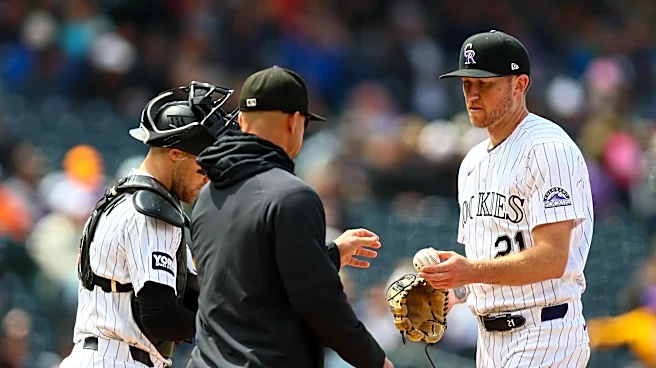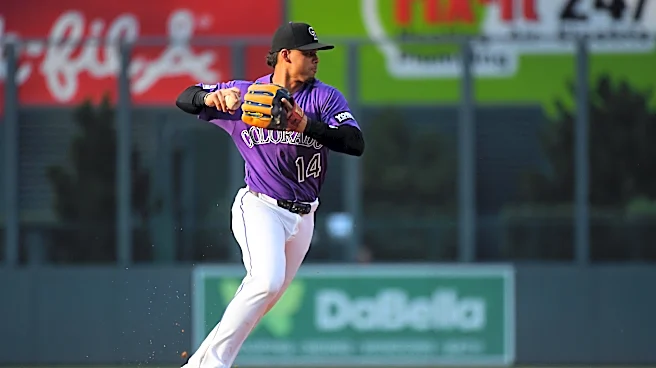





Shortstop was supposed to be one of the Rockies’ few settled positions. Ezequiel Tovar’s offensive limitations were obvious, but elite defense and extra-base power gave the profile a workable floor.
His 2025 season offered reasons for patience. Hip and oblique injuries limited Tovar to 95 games and made it difficult to separate regression from compromised health. Even amid those interruptions, his strikeout and walk rates moved modestly in the right direction.
A rebound in 2026 was a reasonable expectation.
It has not happened.
Through July 12, Tovar was hitting .200/.243/.330 with eight home runs and a 41 wRC+. His defense, once among the best at the position, has graded almost exactly average by several metrics.
Colorado should continue trying to recover the player Tovar was in 2024. His contract, age and past success, however, can no longer exempt him from competition. Ryan Ritter is the clearest upper-level alternative to evaluate, Willi Castro is more valuable in the multi-position role that makes him useful, and moving Cole Carrigg out of center field could create a second premium-position problem.
The Rockies do not need a permanent answer today. They do need to admit that shortstop is no longer settled.
The production has been the worst at the position
Tovar has appeared at shortstop in 92 games, starting 86 and logging 752.1 innings. He has received the overwhelming majority of Colorado’s playing time at the position.
Among the 32 players on FanGraphs’ shortstop leaderboard with at least 150 plate appearances, Tovar ranks:
- 32nd in fWAR at minus-0.9
- 32nd with a 41 wRC+
- ninth-highest with a 25.1% strikeout rate
- fifth-lowest with a 5.0% walk rate
He has received the 12th-most plate appearances in the group, so this is not a lightly used reserve dragging down the leaderboard. Colorado has received the least value from one of baseball’s larger shortstop workloads.

Tovar has not been the worst defensive shortstop in baseball. He has been almost exactly average.
The problem is that average defense leaves nothing to counterbalance the least productive bat at the position.
The familiar flaw stopped producing familiar damage
The Rockies did not discover this year that Tovar swings too often.
During his 2024 breakout, he posted one of baseball’s highest chase rates and walked in only 3.3% of his plate appearances. He also led the National League with 45 doubles, hit 26 home runs and won a Gold Glove.
The aggression was inefficient, but it was dangerous.
As Cory Cohen explained in April, that balance began breaking down early this season. At the time, Tovar was chasing 48.7% of pitches outside the zone and swinging at the first pitch nearly 60% of the time. He began more than three-quarters of his plate appearances with a strike.
His increased chase contact initially looked like progress, but much of it produced only additional foul balls and weak contact.
The hoped-for adjustment was never that Tovar would stop being aggressive. It was that he would become more selective around the edges, find better pitches to damage and preserve the power that made the approach tolerable.
That has not happened.
Through July 12, Tovar carried a minus-22 Batting Run Value. His .275 expected wOBA, .221 expected batting average and .367 expected slugging percentage offered little evidence that poor luck was hiding a strong offensive process. His average exit velocity ranked in the 18th percentile, his hard-hit rate in the 17th and his squared-up rate in the sixth. His 45.6% chase rate ranked in the first percentile.
His barrel rate has fallen from 9% in 2024 and 9.3% in 2025 to 6.8% this season.
The most damaging change has come against four-seam fastballs. Tovar is hitting .146 with a .272 slugging percentage against the pitch, producing a minus-12 Run Value and a 35.5% strikeout rate.
That is a devastating weakness for a hitter whose offensive value depends on punishing early-count velocity. If pitchers can challenge him with four-seamers without fearing damage, they control the plate appearance before his chase tendencies even become relevant.
Tovar’s .247/.305/.388 line in May was much more survivable than his .471 OPS in April, but it did not hold. He hit .173/.198/.309 in June and .143/.179/.343 through July 12.

The rebound was a temporary reprieve, not a recovery.
His range is no longer producing extra outs
I love watching shortstop played well.
Shortstop can be a beautiful position: the quick first step at contact, the glove working through a difficult hop, the body control to gather, twist and fire a strike across the diamond for the out.
A good shortstop completes the routine play. A great one reaches a ball that looked like a hit.
Tovar has shown that kind of defense before.
His arm has never been the defining feature. Tovar became an elite defender at shortstop through his range, instincts, hands and body control.
Statcast credited him with 15 Outs Above Average and 11 Range Runs in both 2023 and 2024. Those totals fell to three OAA and two Range Runs in 2025, when injuries limited him to 95 games.
That context matters. One injury-shortened season did not prove that Tovar’s defensive ability had permanently changed.
The concern is that the neutral results have carried into a healthy 2026 season. Through July 12, Tovar had zero OAA and zero Range Runs across 752.1 innings. Defensive Runs Saved also graded him at zero.

Tovar can still make a beautiful play. The problem is that a highlight is not the same as a season’s worth of defensive value. His range regularly created extra outs in 2023 and 2024. That surplus diminished during an injury-marred 2025 and has not returned this season.
Even a return to Gold Glove-level defense would struggle to make a 41 wRC+ acceptable over a full season. In 2026, the Rockies have received neither the offense nor the defensive surplus that once made the arrangement workable.
Willi Castro can cover shortstop, but that is not his job
Castro has appeared at shortstop in 19 games, starting 12 and logging 102 innings. That is enough usage to show that Tovar’s hold on every available inning has loosened — if only slightly.
Castro does offer a clear offensive upgrade. Through 320 plate appearances, the switch-hitter has hit .260/.331/.378 with seven home runs. His 8.4% walk rate is more than three percentage points higher than Tovar’s, and his .331 on-base percentage is nearly 90 points better.
The performance is not without limitations. Castro has struck out in 27.8% of his plate appearances. He currently carries a minus-4 Batting Run Value and has posted a modest .294 expected wOBA. Still, he has provided functional major-league plate appearances.
Castro’s greater value comes from his flexibility. He has appeared at six positions and changed positions during games 37 times, allowing Warren Schaeffer to make matchup moves and cover injuries without exhausting the bench. As Cohen recently described it, Castro may not be the first choice at any one position, but he is often the second choice everywhere.
Making him the everyday shortstop would work against that value. The defensive results have not supported a permanent move, either. In 102 innings at shortstop, Castro has recorded minus-3 OAA, minus-3 Fielding Run Value, minus-2 Defensive Runs Saved and four errors. The sample is limited, but the direction is consistent.
Castro has not stabilized shortstop; he has changed the compromise. His bat is more functional than Tovar’s, but his weaker defense and greater value as a multi-position player make him a substitute at shortstop, not the answer.
Ryan Ritter remains the unanswered question
Ritter received his first extended major-league opportunity in 2025 while Tovar was injured. Across 207 plate appearances, he hit .241/.296/.337 with a 29.5% strikeout rate and weak contact quality. The bat did not establish him as an everyday player, but the glove provided some reason to keep evaluating him.
Ritter played 265 innings at shortstop, where Statcast credited him with one OAA. His overall range ranked in the 75th percentile.
He has shown more offensive viability in Triple-A this season. Across 121 plate appearances with Albuquerque, Ritter is hitting .283/.403/.414 with two home runs, 15 walks and 25 strikeouts. His 20.7% strikeout rate is manageable, even allowing for an expected increase against major-league pitching. He had also begun to show some slugging before an ankle injury sent him to the injured list on April 15 and kept him out of regular Triple-A action until June 16.
Ritter is not knocking down the door, but he has shown enough on both sides of the ball to make another evaluation reasonable. He has also continued to receive the majority of his minor-league defensive work at shortstop, starting 20 games and logging 163.2 innings there this season.
None of that establishes Ritter as an everyday shortstop. It does suggest his glove may be serviceable enough for the Rockies to evaluate whether his offensive profile can survive in the majors.
Continuing to let Tovar search for his previous form against major-league pitching is defensible. But with two minor-league options remaining, a reset in Albuquerque is no longer an extreme response to a temporary slump. His bat has been the least productive at the position, the Rockies remain firmly in an evaluation phase, and Tovar is only 24.
In that context, this may be exactly the right time to give him everyday work away from the pressure of carrying the major-league position while opening a real evaluation window for Ritter.
What makes less sense is a loose platoon that leaves both players short of regular work. Tovar needs everyday repetitions if he is going to rebuild his offensive process and regain his defensive sharpness. Ritter needs them if the Rockies want an actual evaluation rather than another small, inconclusive sample.
Ritter may not be the solution, but another meaningful evaluation is justified. Tovar’s performance has made the competition necessary.
Cole Carrigg creates a different choice
Carrigg has logged three major-league innings at shortstop. His arm strength and athleticism make the position plausible, but that sample tells us nothing about whether he could handle it every day.
Center field may still be the best use of those tools. Moving Carrigg to shortstop could solve one premium-position problem while creating another in Coors Field’s enormous outfield.
That makes Ritter the cleaner alternative to evaluate first. Tovar’s value is concentrated almost entirely at shortstop; Carrigg can provide defensive value in places Tovar cannot.
More talent is applying pressure, but from a distance
Tyler Bell and Ethan Holliday (No. 2 PuRP) provide legitimate long-term pressure, but neither changes the immediate calculation.
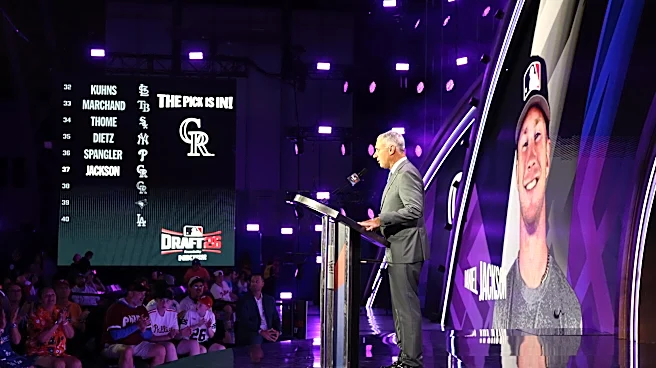
Bell, the 10th overall pick in the 2026 MLB Draft, has shown the footwork, anticipation, body control and arm strength to remain at shortstop at the professional level.
His offensive profile also gives Colorado something intriguing.
Bell hit .343/.510/.608 at Kentucky with a 13.5% chase rate, drawing 30 walks against 36 strikeouts while playing through a torn labrum in his non-throwing shoulder.
He described his goal as remaining aggressive to the pitch he wanted without chasing outside the zone. The distinction is important: aggression does not have to mean surrendering control of the plate appearance.
Holliday brings a different kind of ceiling. The fourth overall pick in the 2025 draft entered professional baseball with considerable power, a patient approach and real uncertainty about how consistently he would make contact against better pitching.
His 2026 performance was beginning to look like a step forward. After striking out in 39.3% of his plate appearances during his brief debut, Holliday lowered that rate to 28.3% while hitting .262/.395/.557 with nine home runs, five doubles, two triples, and 23 walks in 152 plate appearances for Low-A Fresno.
The contact concerns have not disappeared, but the combination of damage and on-base ability represented meaningful progress before a stress fracture in his left foot required season-ending surgery.
His eventual defensive home remains uncertain. Holliday has the hands and arm strength to continue receiving work at shortstop, but his lateral range, footwork and quickness will ultimately determine whether he can remain there. A move to third base remains plausible. His bat could still make him an impact player there, though it would make him less of a direct answer to Colorado’s shortstop question.
Bell and Holliday carry far more upside than the other lower-level alternatives, but both remain distant from the major-league decision. Bell is expected to require surgery on his injured shoulder, with the timing still to be determined. The recovery will likely sideline him for several months and delay the start of his professional career. Holliday must also complete his recovery from foot surgery and return healthy before continuing his development against more advanced pitching.
Neither solves the present problem. Their presence does give the Rockies another reason to keep evaluating shortstop rather than treating it as permanently assigned.
Two related problems
The Rockies were not wrong to invest in the 2023-24 version of Tovar. None of their alternatives has matched his defensive ceiling, led the National League in doubles or produced 3.7 fWAR at age 22.
That player was worth believing in.
Past success, however, cannot permanently insulate him from present performance.
Tovar has no obvious everyday fallback. Center field at Coors Field is not a realistic alternative; second base would reduce the positional value of his glove; and his bat is nowhere near the standard required at third base, first base or an outfield corner. If he is going to be a valuable everyday player, it will almost certainly be at shortstop.
That leaves Colorado with two connected but distinct tasks: recover Tovar and get more production from shortstop. His contract, age and past success make him worth trying to fix. They do not make the current arrangement acceptable.
The Rockies do not have to give up on Tovar.
They do have to stop waiting passively for the position to fix itself.
Join the conversation!
Sign up for a user account and get:
- Fewer ads
- Create community posts
- Comment on articles, community posts
- Rec comments, community posts
- New, improved notifications system!
Please keep in mind our Purple Row Community Guidelines when you’re commenting. Thanks!