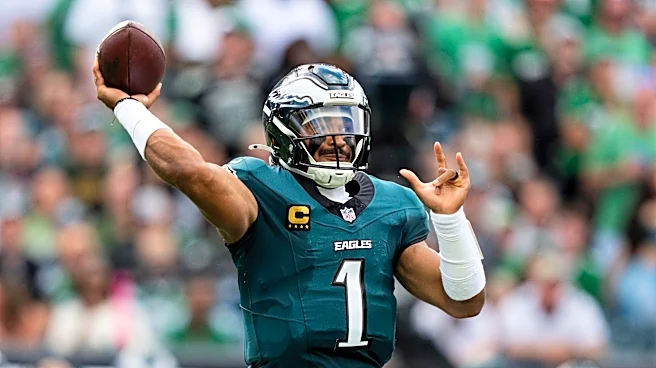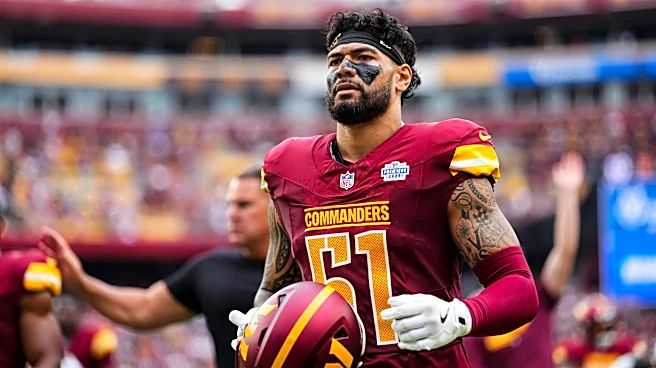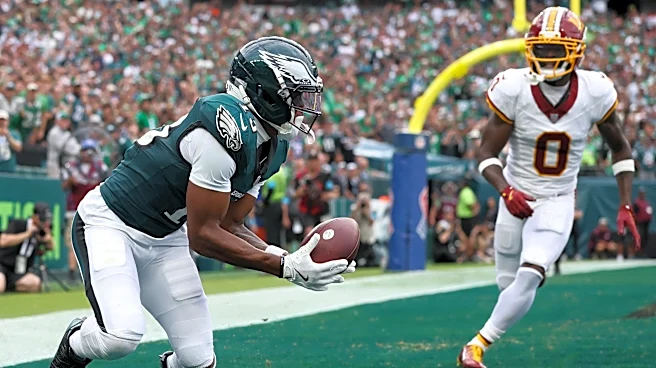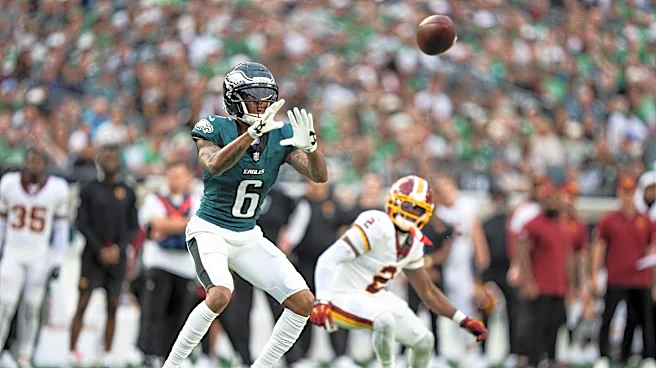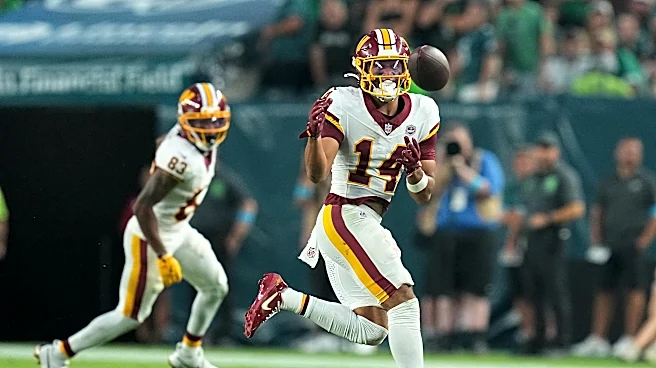



Much has been made about the Commanders’ opening road loss to the 5.5-point favorite Philadelphia Eagles. While they did leave ample winning opportunities on the field, when the final whistle blew, the Commanders had held their top-ranked division rival to just 24 points and 318 total yards on offense. And, perhaps most importantly, they beat the spread.
While the opening day performance left plenty of room for improvement, their first game with new offensive and defensive schemes went better than
might have been expected based on some of the doom and gloom prognostications making the rounds.
Against one of the better teams in the league, on the road, the Commanders offense ranked 17th in yardage gained and 20th in scoring; while the defense ranked 17th in yardage and 16th in score containment. Not top of the league table, but a fair bit better than the bottom of the league Week 1 power rankings might have suggested.
In terms of offensive and defensive efficiency, as quantified by EPA/play, the Commanders and their opponents started their seasons right in the middle of the pack:

Graphic courtesy of RBSDM.com
Those looking for signs of hope for improvement this season might take inspiration from standout performances and flashes of potential by Pepsi Rookie of the Week winner WR Antonio Williams, LB Sonny Styles, 2026 FA additions Amik Robertson and Nick Cross, and special teams demon Tyler Owens, among others.
Now, let’s take an in-depth look at who stood out, who stood down, and who just stood around in the 22-24 road loss to the Eagles
Stats in this article were obtained from three main sources. Official stats from the NFL gamebook, are treated as a source of truth. Advanced stats (eg. pressures, yards before contact, yards allowed in coverage) were sourced from Pro Football Focus (PFF) and Pro Football Reference (PFR). Advanced stats rely on tape analysts’ judgement and often differ between services. Where there were differences, data from both sources is cited. When there was consensus, sources are not cited.
OFFENSE

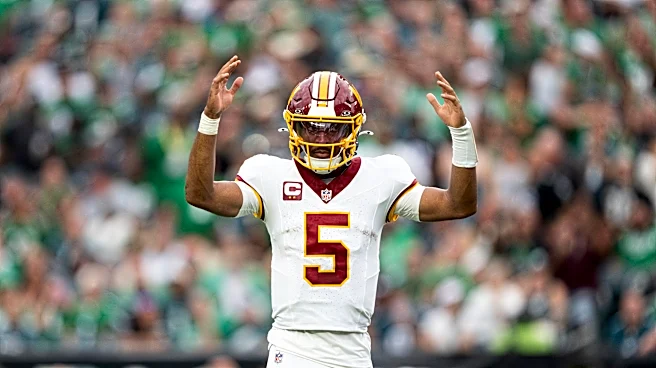
Jayden Daniels’ stat line as a passer was an unimpressive 18 comp/34 att (52.9%) for 164 yds, 2 TDs and 0 INT.
But there were really two parts to his game. Through the first three quarters he looked off, as did his receivers. His stat line at the end of the third quarter was 9 comp/23 att (39.1%) for 50 yds and 0 TD. In the fourth quarter, he locked in, throwing for 9/11 (81.8%) for 99 yds and 2 TDs.
According to PFR, his incompletions included 5 throw aways and 4 drops by receivers. PFR counted pressure on 18.4% of dropbacks (NFL rank 23rd), which might have contributed to his 17.2% bad throw rate on passes which were not throw aways.
PFF has a lower threshold for recording pressures, making their pressure stats not comparable to PFR. PFF counted 16 pressures (NFL rank 6; 42% of dropbacks). His 1 sack taken gave him a respectable 6.3% pressure to sack rate. PFF counted 3 drops and 0 turnover worthy passes.
On the ground, JD5 rushed 5 times for 31 yds (6.2 Y/A), including 3 scrambles, with 1 broken tackle, and 21 YAC per PFR (37 per PFF).
He was charged with delay of game penalties in the 2nd and 3rd quarters for 10 total yards.
Daniels’ 66.4 Total QBR ranked 14th in the NFL in Week 1. Not terrible given the heavy pressure rate and all the drops by receivers. Hopefully the slow start was Jayden shaking off the rust of an injury-plagued 2025 season and lack of pre-season snaps. If the fourth quarter was indicative of his performance in the new offense, or Blough adjusting the scheme to suit his QB, then the Cowboys could have their hands full.

Bill Croskey-Merritt led the Commanders’ rushing attack with 16 attempts for 63 yds (3.9 Y/A), 7 first downs, and 1 TD. His 50.0% rushing success rate ranked second on the team. PFF counted one forced missed tackle, but PFR did not. Bill had one fumble, fortunately recovered by teammate Josh Conerly. He caught one screen pass and was tackled 7 yards behind the line.
PFF recorded 1.25 YBC/att, just slightly below league average for RBs using 2025 stats. Like pressures, PFR uses a higher threshold for recording contact, making their numbers not comparable to PFF. According to PFR, Bill averaged 2.6 YBC/att, which is just below the 75th percentile for RBs based on 2025 figures. His room to run was therefore somewhere between league average and a little above average, depending on which stat service you believe.
Bill recorded his first career penalty, a 10 yd infraction for holding in pass protection.
Rachaad White rushed 7 times for 22 yds (3.1 Y/A) and 1 first down, with 1 broken tackle. His 42.9% success rate was the lowest on the team. He caught 2/2 passes for 5 total yds. PFF gave him more YBC/att (1.57 yds) than Bill, while PFR gave him fewer (2.0 yds), so it is difficult to know which to believe.
Rookie Kaytron Allen had 4 carries for 16 yds (4.0 Y/A) in his NFL debut. He led the team with a 100% rushing success rate. He should be given more carries to see if he can keep that up.

In his NFL debut, Antonio Williams led Commanders’ receivers with 64 receiving yards, despite getting less than half the playing time of starter Terry McLaurin. He caught 4/4 targets for 64 yds, 1 TD and 4 first downs (100% success rate) at an ADOT of 13.8 yds. His receiving productivity was in the elite range at 5.82 Y/RR, albeit on a very small sample of receiving snaps.
There was some question before the game about how David Blough might deploy the rookie WR. Williams took 15 snaps out wide and 11 in the slot. There is little question that he should get more playing time against the Cowboys. He was clearly Washington’s best receiver.
Stefon Diggs was second on the team with 55 receiving yds and 1 TD. He had the same number of receptions as Williams (4), but more than twice as many targets, giving him the lowest reception rate on the team (44.4%). PFR credited Diggs with 3 drops in the game, equalling his season totals in 2025 and 2024. Even so, he was the Commanders’ second most productive receiver at a respectable 2.2 Y/RR.
Diggs’ game mirrored that of his QB to some extent. Through the first three quarters he caught 2/7 passes for 28 yds. In the fourth quarter, he caught 2/2 for 27 yds and a TD.
Compounding the slow start, Diggs’ game was also marred by an unsportsmanlike conduct penalty for 15 yards, following his 4th quarter TD to bring the score to 15 to 17. The gaffe moved the Commanders out of position to attempt a 2 pt conversion to tie the game.
Terry McLaurin caught 2/4 targets for 14 yds. Jaylin Lane caught 1/1 targets for 4 yds. Dyami Brown failed to catch either of his two targets, albeit at a challenging ADOT of 31 yds.

Chig Okonkwo ushered in his Commanders’ tenure by catching 2/3 targets for 16 yards, including 1 contested catch.
John Bates also caught 2/3 targets, for a total of 13 yds. Bates got the lions’ share of snaps at FB.
Ben Sinnott ran 10 routes without being targeted and mainly contributed as a run blocker.

Pressure counts were sourced from PFF. PFF and PFR use different thresholds for scoring pressures, making their counts not directly comparable, despite being correlated. The higher total pressure counts from PFF provide larger samples for statistical comparisons.
LT Brandon Coleman took the brunt of the Eagles’ pass rush to the tune of 6 pressures in 37 pressure opportunities, including 1 sack. His 13.5% pressure rate is a bottom of the league figure for starting OTs, based on 2025 figures. His 64.3 run blocking grade was a little below median for OTs. Coleman committed one false start for 5 yards.
RT Josh Conerly fared slightly better, allowing 4 QB hurries in 37 opportunities. His 10.8% pressure rate is a bottom-10% figure based on 2025 numbers. His 71.5 run block grade was above median for starting OTs. Conerly committed one false start for 5 yards.
LG Chris Paul allowed just 1 pressure in pass protection (pressure rate). His 56.6 run blocking grade was a little below average for a guard.
PFF only credited Nick Allegretti with 1 pressure allowed (2.6% pressure rate), but gave him a substandard 47.3 pass blocking grade. His 42.1 run blocking grade was the lowest on the Commanders’ OL, and is below standard for a starter.
RG Sam Cosmi was credited with a single pressure in pass protection (2.6% pressure rate). His 71.6 run blocking grade was the highest on the OL and was above average for starting guards.
DEFENSE
In his debut game with Washington, Defensive Coordinator Daronte Jones delivered on his promise to bring pressure from everywhere. According to PFF, 10 different Commanders pressured Eagles’ QB Jalen Hurts, with the following breakdown by position group:
Interior Defensive Line: 8 pressures, 0 sacks
Off-ball Linebackers: 5 pressures, 2 sacks
Edge Defenders: 4 pressures, 1 sack
Secondary: 1 pressure
Another noteworthy aspect of Jones’ new look defense is that there were no penalties.
Well, that sure is different. Now, let’s see how the individual players fared in the new scheme.

Odafe Oweh recorded 2 TFL, 1 tackle assist, and 1 sack per NFL official stats, for a total of 3 defensive stops.
K’Lavon Chaisson registered just 2 QB hits, per NFL stats. PFR counted 2 missed tackles, while PFF counted 1. Chaisson dropped into coverage on 6 of 28 passing plays (21.4%). He was targeted twice and allowed 1 reception by WR DeVonta Smith for 10 yds.
Joshua Josephs did not register any official or advanced stats. But he did throw 325 lb OT Lane Johnson into Jalen Hurts.
It’s a shame that stats aren’t kept on OL bowling. Josephs also dropped into coverage on 1 of 9 pass plays (11.1%) without being targeted.
Javonte Jean-Baptiste did not record any defensive stats.

Daron Payne recorded 1 tackle, for a run stop. According to PFF, he generated 4 QB hurries. His 19.0% pressure rate and 4 total pressures were both the highest on the team. A 19% pressure rate is off the chart, based on 2025 iDL season stats. PFR counted a missed tackle, but PFF did not.
Javon Kinlaw moved around the most of the iDL. He had 1 TFL and 1 tackle assist, both of which contributed to run stops. His 13.3% run stop rate is above the 90th percentile for iDL based on 2025 stats. PFF also recorded 1 QB hurry.
Charles Omenihu had just 1 pass breakup on the official stat sheet. PFF also recorded 2 QB hurries (14.3% pressure rate). Despite not being designated a starter, Omenihu played the third most defensive snaps on the iDL.
Tim Settle played nose tackle, which is actually a more varied assignment in a Flores-derived scheme than a traditional nose tackle role. He generated 3 tackle assists, contributing to 1 run stop. His 9.1% run stop rate was above the 90th percentile for iDL based on 2025 season stats. According to PFF, he generated 1 QB hurry in the pass rush. PFF counted 1 missed tackle, which PFR did not see.
Shy Tuttle had 1 tackle assist, which contributed to a run stop.

Sonny Styles had a productive debut performance in burgundy and gold, splitting snaps between run defense (16), pass rush (8) and coverage (24). The rookie defender recorded 3 tackles (2 TFL), 1 assist, 1 sack, 1 QB hit, and 3 total defensive stops (2nd on team). PFF counted 2 missed tackles (40% miss rate), while PFR only counted 1 (20%).
In coverage, PFF counted 2 targets and 1 reception by Dallas Goedert for a 43 yd TD. PFR attributed the reception to another defender.
Frankie Luvu generated 1 TFL, 3 assists, 1 sack and 1 QB hit (2 total stos). In 15 coverage snaps, PFF recorded 2 targets and 2 receptions for 13 yds. PFR counted 1 target and reception for 8 yds.
Leo Chenal recorded 1 tackle and 2 assists, with 1 stop. He was not targeted in 12 coverage snaps. He had 1 missed tackle to spring Saquon Barkley on a long run, and also took teammate Amik Robertson out of the play (25% missed tackle rate).
Jordan Magee had 1 tackle assist. He generated a QB hurry on 1 blitz and was not targeted in 9 coverage snaps.

Amik Robertson, making his debut for the Commanders, had arguably the best overall defensive performance on the team. According to PFF, in 35 coverage snaps he was targeted twice, allowing 1 reception for 3 yds (0.09 Y/Cov Snap). Alternatively, PFR counted 3 targets and 2 receptions for 8 yds (0.23 Y/Cov Snap). Either way, is rate of yardage allowed in coverage was in the elite range for a starting CB, indicating either near-total lockdown coverage or other defenders drawing the bulk of the target share.
On the official stat sheet, Robertson recorded 3 tackles and 3 assists, for the second most combined tackles on the team. He recorded 1 defensive stop and 1 missed tackle.
Mike Sainristil played a mixture of boundary and slot corner, with 11 snaps at other alignments. He picked up in coverage where he left off last season, allowing 3 targets and 2 receptions by WR Deontayvion Wicks for 73 yds and 1 TD (2.15 Y/Cov Snap), per PFF. PFR attributed Wicks’ 64 yd reception to another defender, dropping Sainristil’s yardage total to just 9 yds and a respectable 0.26 Y/Cov Snap.
Sainristil also recorded 4 tackles and 1 assist, with 1 TFL. PFF counted 1 missed tackle, but PFR did not.
Rasul Douglas was targeted 4 times in coverage per PFF (3 tgt per PFR) and allowed 1 reception by WR DeVonta Smith for 39 yds (1.94 Y/Cov Snap). He made 1 tackle and the only pass breakup by the Commanders’ secondary. PFR counted 1 missed tackle, which PFF did not see.

Making his debut for the Commanders, Bowie MD native Nick Cross recorded 5 tackles, 3 assists and 2 TFL, with 1 missed tackle. He led the team in tackles (5), combined tackles (8) and stops (5). He generated 1 QB hurry in 2 blitz attempts.
Cross mainly split time between free safety, box safety and slot coverage assignments. According to PFF, in 33 coverage snaps, he allowed 3 targets and 3 receptions for 4 yds (0.12 Y/Cov Snp). PFR recorded 5 targets and 4 completions for 47 yds and a TD (1.42 Y/Cov Snap).
Jeremy Reaves played predominantly at free safety and in the box. He recorded 2 tackles and 2 assists. In 35 coverage snaps, PFF recorded 1 target for a 17 yd TD reception by TE Dallas Goedert (0.49 Y/Cov Snap). PFR recorded 3 targets and 2 rec for 81 yds and the TD (2.31 Y/Cov Snap).
Quan Martin recorded 2 tackles with 1 TFL and 2 total stops. PFF counted 1 missed tackle, which PFR did not see. In 13 coverage snaps, PFF recorded 2 targets and 2 receptions for 9 receiving yards (0.69 Y/Cov Snap). PFR recorded 1 target and reception for 12 yds (0.92 Y/Cov Snap). He should play more in Dallas.
SPECIAL TEAMS

Jaylin Lane returned 4 punts for 53 yds with no fair catches or fumbles. His 13.3 Y/A average ranked 5th in the NFL in Week 1 (min 2 returns). He also returned 3 kickoffs for 95 yds, and a very healthy 31.7 Y/A average.
In his rookie debut, UDFA and Mason/Brennan program graduate Drew Stevens made 1 extra point and had a second attempt blocked by Jalen Carter. Similarly, he made his first field goal attempt from 55 yards in the first quarter, but missed one wide from 54 yards in the third.
Tress Way punted 6 times for a total of 318 yards, with 4 returned for 37 yds (43.5 Net Y/A), 1 touchback and 1 fair caught. His 9.3 Y/Ret average in the game was more than twice his 2025 season average.
Rachaad White returned 2 kickoffs for 59 yds (29.5 Y/A).
One day the league will start keeping long snapper stats to allow us to appreciate Tyler Ott’s greatness.

Tyler Owens led the Commanders with 2 coverage tackles, including this one which earned him the coveted Angry Runs Scepter:
Special teams regulars Jordan Magee, Quan Martin, Jeremy Reeves and Javontae Jean-Baptiste each recorded single tackles.
Kain Medrano had 1 tackle and 1 miss. And Percy Butler just had 1 miss.
There were no penalties on special teams this week.