




This column was written and originally scheduled to be published before the DePaul game on Friday. All statistics and trends DO NOT incorporate DePaul, which will be covered in the next edition.
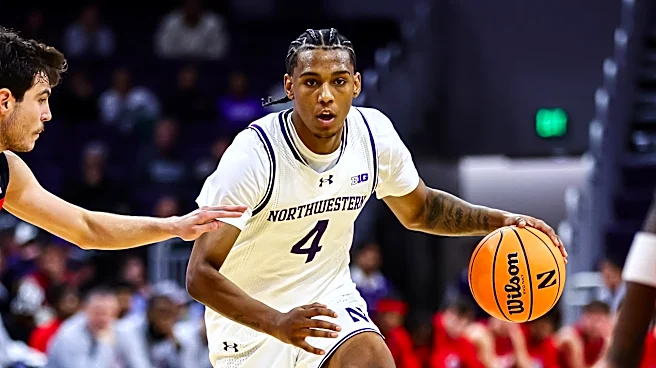
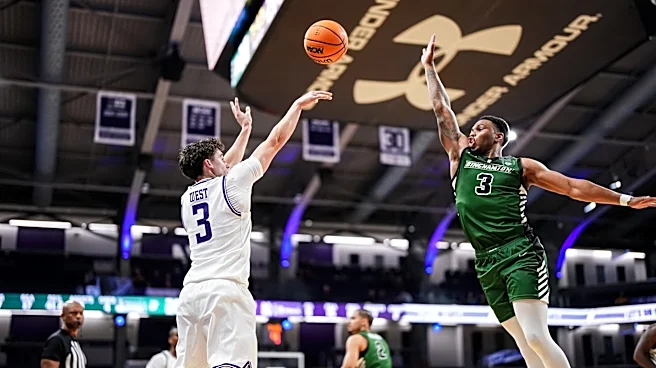
Northwestern has begun the season 3-1, with seemingly easy wins over Binghamton, Stony Brook and Boston University (although the BU game got sketchy for a minute or two). Jake West is a newfound star, averaging over 21 points and eight assists. It’s important to be careful about judging a team based on its
buy games (Northwestern murdered their early-season opponents last year and had its worst season in a half decade), but we can certainly learn things about the team and its play style, so let’s jump in.
Thinking three
If you’ve watched Northwestern this year, you may have noticed that the ‘Cats have taken a lot of threes. If the volume of threes felt unusual so far, you’re not alone. So far this season, NU has attempted 47.6% of their shots from three (3-point attempt rate, or 3PAr). If that number holds, it would be the highest of the Chris Collins era comfortably.
The gap feels even starker because each of the past two seasons, with Nick Martinelli acting as the offensive fulcrum, Northwestern posted a 3PAr of 34.0% and 34.2%, two of the three lowest in the Collins era. If you’re wondering, only the abysmal 2019-20 squad took a smaller percentage of triples.
For context, this number tends to be pretty stable from early-season trends. Last year, the Wildcats posted a 3PAr of 32.8% through the initial troika of games and finished at an even 34. In 22-23 (the last time Northwestern took over 40% of their shots from three), its 3-point attempt rate through three games was 42%, with a full-year finish of 41%. In the last five years, the gap between first 3-game 3PAr and full-season 3PAr only exceeded 1.5% one time — and that was a 2.9% increase in 3PAr in ‘24-25. So even if NU ticks down a few points throughout the year, it would take a drastic, unprecedented swing for a Collins team not to finish with the highest 3PAr of his head coaching career.
Here are the shooting maps, so you can get a sense of how it has looked three games into each season. Red is more than the NCAA average, blue is less, and you can compare the exact shot totals as well. NU has taken 20 more threes than a season ago through three games.

So now we’ve established that Northwestern is chucking from deep. What about why?
Well, the answer is threefold. The first answer, as mentioned above, is Nick Martinelli. For as good as Nicky Buckets was, he didn’t contribute a whole lot in the passing department. When the ball went to Martinelli, it rarely came back out. Second, Northwestern simply didn’t have good shooters a season ago. Clayton and Reid were at best okay shooters in the back court. Page took too many and made too few. Max Green and K.J. Windham were both afterthoughts in the rotation. Ciaravino was a non-factor. Martinelli was the best shooter on the floor, which is a problem for a team that needed to space around him to maximize the offense. The final reason is by far the most important one: the emergence of the one Jake West.
West has officially broken out as the next star guard in the Collins system. He posted a career-high in scoring and his first career double-double with 20 points and 12 assists in the opener. He broke that career-high four days later with 23 points against Stony Brook. He followed that up with 21 points and eight more helpers against Boston University.
We know he can shoot it. West was one of the better snipers last year at 36.4%. He’s been as good this year, knocking down 35% of his triples despite a 1-for-7 game against BU. But what I want to focus on is the rim pressure West has gotten that leads to open threes for everyone else.
Time and time again, West has put teammates in position to hit threes by drawing help, creating passing angles and generally wreaking havoc. Paint touches don’t all come equally, and defenses are more pressured to defend an effective blow-by drive than a post-up, even from the Big Ten leading scorer. As impressive as West has been scoring the ball, with three straight games of 20 to begin his sophomore year, I’d hazard that his passing ability is going to be more important to creating an offense that can score with anyone.
Expanding the Range
Speaking of stretching the floor, a few other guys have made changes to their games that have opened up unforeseen (to me) layers of this offense.
First and foremost is LA Pratt, who I envisioned as a slasher, breaking out as what appears to be a legitimate threat from deep. A year ago, Pratt played three games and shot 27.3% from deep with a 27.5% 3-point attempt rate. So far this year, he’s taken threes at a 43.9% rate, much more in line with his 24-25 season of 44.2%. The change, however, is that Pratt has made 38.9% of his threes so far compared to 29% a couple of seasons ago, while also taking an additional 1.5 or so per night. His ability to space the floor next to West has created more driving room and allowed Northwestern to use West off the ball at times, because Pratt can be a multidimensional scorer on the ball instead of someone defenses can sag off of. It also helps because Northwestern’s second-best player, Angelo Ciaravino, is a complete non-shooter from deep.
However, Ciaravino’s offensive evolution is worth noting. He’s still looking for his first connection from three (0-for-7 on the season) but has unveiled a deadly midrange jumper. Gelo has hit 5-for-7 of his non-paint twos, a legitimately impressive showing for anyone, but especially considering half have come in late-clock, fadeaway contexts. For comparison, he took 10 non-paint twos last year, and made exactly one of them. While it seems like a stretch to expect the captain to step out and shoot the three with any consistency, adding a layer of midrange to his off-ball cutting and offensive rebounding ability could turn him into a real offensive threat.

His shooting charts are pretty much inverted from this year (left) and last year (right), and while all areas will certainly regress towards the mean, the fact that Ciaravino has taken seven shots outside the paint but inside the arc when he only took 10 all of last season speaks to the confidence and freedom he’s playing with and, more importantly, the fact that the coaching staff trusts him to take those shots when they didn’t a season ago.
Decoding DePaul
Tonight, if you’re reading this on Friday when it comes out, Northwestern takes on DePaul at Welsh-Ryan Arena. The Blue Demons come in 3-0 as well, but with the best combined win of the two teams when it knocked off South Florida last Thursday. The expectations are high in Lincoln Park with a rejuvenated roster thanks to former Ohio State coach Chris Holtmann in his third year.
DePaul will roll eight deep, with size and length throughout. The calling card of this team is the defense, with a 91.1 DRTG so far per CBB Analytics. The Blue Demons have been especially tough to score on inside, where opponents have shot well under 60%. Northwestern thus far has struggled inside and lacks athleticism in the forward department outside of Ciaravino (who could easily be considered a guard). Smith, Federiko, Soulis and Karasinski (if he plays) don’t pose much threat around the rim, so it’ll be up to the guards/wings in West, Pratt, Ciaravino and possibly Gill to threaten the interior. DePaul doesn’t mind allowing the deep ball, so expect the Wildcats to continue to chuck, especially if the inside offense provides issues in the early going. It’ll be important for Northwestern to get paint touches leading to threes, instead of hovering on the perimeter and hoisting contested looks.
Offensively, DePaul is a balanced scoring roster, with four players between 11 and 13 points per game so far, and all eight rotation players of 10+ minutes averaging 7+ PPG. Noah Meeusen is the sophomore who will conduct the show, with 15 assists to only one turnover after an okay freshman year at Arizona State. However, Meeusen missed DePaul’s game on Monday and is considered day-to-day with a sprained ankle. Without Meeusen, Northwestern could force DePaul into some turnovers. Ade Popoola is a headache to game plan for, as he has shot 46% from the 3-point range so far while making four a game. It’s no fluke either, as Popoola was the best shooter in the AAC last year on a dynamite Tulsa offense.
Magoon Gwath was brought in for his defensive impact as a center at San Diego State, but has been an offensive revelation as well, with a reworked three-point shot. Koree Cotton is the team’s leading scorer and will probably be the primary slashing threat for the Demons.
Schematically, DePaul is going to shoot even more threes than Northwestern, with nearly three of every five field goal attempts coming from deep. This game may simply come down to who shoots better from three, but more likely the story will be decided on the inside. Northwestern will be out-rebounded, but if they can keep the rebound margin close, they could mitigate the shot difference in what will likely be a turnover advantage for the ‘Cats. If Northwestern can score on the interior and protect their defensive glass, they should come away with a win.
If you’re into advanced analytics sites, BartTorvik gives Northwestern a 60% chance to win, while KenPom favors DePaul by a 51/49 split. Both sites have the predicted score within two points. If you’re into my honest opinion (and I don’t know why you would be), I lean DePaul if both rosters are fully healthy, but I see this being a game that frustrates both fanbases and ultimately comes down to who executes better in crunch time. Keep an eye on Karasinski’s and Meeusen’s status, as the healthier team probably wins. I lean toward picking Northwestern if both miss, since I think Karasinski’s shooting is more replaceable than Meeusen’s passing. Huge game for Northwestern; we should learn a lot about the state of this team by the weekend’s conclusion.