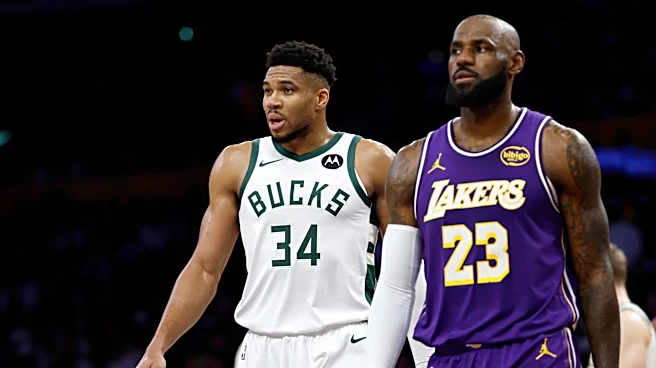


For most of LeBron James’ career, the Celtics have been waiting for him somewhere.
Sometimes, they were the wall he could not get over. Other times, they forced him to find another way around it. Eventually, they became the opponent he could dismiss on command, no matter which players happened to be wearing green.
The rivalry went quiet when James moved west, but it never disappeared completely. Even without a Finals meeting, he joined the Lakers and helped Los Angeles pull even with Boston at 17 championships.
Now, almost two decades after their first playoff series, the rivalry is back in a form no one saw coming.
James is a Philadelphia 76er. So is Jaylen Brown.
The player who spent years tormenting Boston has joined forces with one of the stars who carried the rivalry into its next generation. The Celtics will see James again in the Eastern Conference, only this time, Brown will be standing beside him.
Before we find out how this chapter ends, it’s worth going back to see how they got here.

The wall
LeBron had already reached the NBA Finals by the time he first encountered Boston in the playoffs. He was a scoring champion, a perennial MVP candidate and the Chosen One expected to eventually inherit the league.
The 2008 Celtics did not care.
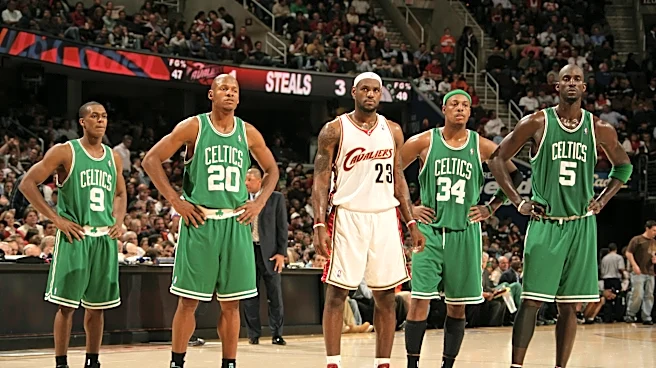
Boston had won 66 games after bringing Kevin Garnett and Ray Allen together with Paul Pierce. They had the best defense in basketball and the confidence of a team that believed its championship window had opened immediately.
Practically all by his lonesome, James still nearly took them out.
The series went seven games, and the Celtics needed every piece of their newly constructed superteam to survive. James scored 45 points in the finale at TD Garden. Pierce answered with 41, and Boston escaped with a 97-92 win on its way to Banner 17.
Years later, Brian Scalabrine remembered how quickly James challenged the Celtics’ belief that even the league’s best individual players could be swallowed by their defense.
“He could beat you with his brain, he could beat you with physicality, and he could beat you at the rim,” Scalabrine told ESPN.
That series established the first version of the rivalry. Boston was the finished product. LeBron was the singular force still trying to figure out how to defeat one.
The Celtics had Garnett directing the defense, Pierce accepting the scoring duel and a rotation built to make every drive exhausting. James could easily blow past his primary defender, but still look up to find several more bodies waiting for him.
Boston became the standard he had to reach.
The breaking point
Two years later, the Celtics became something more consequential.
Cleveland entered the 2010 postseason with the NBA’s best record and what appeared to be James’ clearest path yet toward a championship. Boston had slipped to fourth in the East, looked old at various points during the regular season and no longer carried the same aura as the defending champions.
Despite it all, the Celtics beat the Cavaliers again.
James struggled badly in Game 5 at home, finishing with 15 points on 3-of-14 shooting as Cleveland was booed off its own floor. The Cavaliers’ season ended two nights later in Boston. James walked off the court in a Cleveland uniform, removed his jersey in the tunnel and entered an offseason that changed the NBA.
The Decision is remembered as a response to years of organizational failure in Cleveland, the lure of playing with Dwyane Wade and Chris Bosh, and James’ growing desperation to win his first championship.
The Celtics did not make The Decision for him, but they certainly helped turn up the heat.
Boston had eliminated James twice in three years. Its own Big Three had demonstrated the value of stars sacrificing individual control to extend their championship window. The Celtics had also made clear how difficult it would be for James to keep dragging an overmatched Cleveland roster through the East by himself.
Miami’s new superteam was built with Boston in mind.
The Celtics understood that too, and they enjoyed it. Doc Rivers later recalled Garnett refusing to recognize Miami as a legitimate Big Three because, in Garnett’s mind, that title still belonged to Boston. The Heat may have assembled the league’s most hated team, but the Celtics saw them as challengers who still needed to take the conference away.
Boston won James’ first game with Miami, an ugly season opener at TD Garden that briefly made the league’s grand new experiment look vulnerable.
The Heat eventually found their footing. More importantly, James finally found his way through Boston.
Miami eliminated the Celtics in five games during the 2011 conference semifinals. When the series ended, James dropped to his knees near midcourt. Beating Boston did not bring him a championship that year, but it removed an opponent that had come to represent every doubt surrounding him.
He had cleared the wall, but would soon need to do it again.
The stare
The Celtics arrived at Game 6 of the 2012 Eastern Conference Finals with a 3-2 series lead and a chance to end the Heat’s season in Boston.
It was the kind of night TD Garden had been built for. The veteran Celtics were nearing the end of their run together, but they had one more chance to break the team created to replace them. Miami faced an offseason of impossible questions if it lost. Erik Spoelstra’s future would have been uncertain. The Heat’s Big Three might not have remained intact.
James entered the building looking as if he had already considered every possibility.
The expression from that night has become one of the defining images of his career. Eyes forward, jaw set, locked in beyond measure. We all know the picture.
Then, the game started.
James scored 30 points in the first half and finished with 45 points, 15 rebounds and five assists. He made 19 of his 26 shots. Jumpers that Boston’s defense had once invited became automatic. Every time the Celtics threatened to pull the crowd back into the game, James answered.
Scalabrine later called it “the most dominant performance” he had ever seen. Rivers believed Boston would have won the series without James producing that kind of game and admitted that the result might have broken Miami apart.
Instead, the Heat won Game 6, returned home to finish the series and captured James’ first championship two weeks later.
Boston had initially shown James what he lacked. Four years later, it provided the stage where he showed everyone what he had become. The Celtics had helped push him toward Miami. Now, they had helped summon the version of James they spent years trying to prevent.
The gatekeeper
At first, Boston was LeBron’s wall. Eventually, he became theirs.
The Pierce-Garnett era ended in 2013, but James’ relationship with the Celtics continued. The uniforms stayed the same. Nearly everything else changed.
He eliminated an overmatched Celtics team in 2015 after returning to Cleveland. He swept Boston again in the 2017 conference finals, although Avery Bradley’s Game 3 winner at least spared them the indignity of going quietly.
By then, the rivalry had become lopsided. Boston kept finding its way back into the postseason while Danny Ainge rebuilt the roster, and like clockwork, James kept sending the Celtics home.
He beat them five straight times after losing the 2008 and 2010 series, winning matchups in 2011, 2012, 2015, 2017 and 2018. The power had shifted so completely that James became the expiration date stamped on nearly every promising Celtics season.
The characters in green kept changing. Rajon Rondo and Kevin Garnett gave way to Isaiah Thomas and Al Horford. Brad Stevens replaced Doc Rivers. Boston moved from squeezing one last run out of its veterans to building around draft picks who had grown up watching James dominate the league.
The Celtics changed, sometimes for better and sometimes for worse. LeBron just kept getting better.
The kids
The 2018 Eastern Conference finals should have been a transition year for Boston.
Gordon Hayward had been lost five minutes into the season. Kyrie Irving underwent knee surgery before the playoffs. Jayson Tatum was 20 years old. Jaylen Brown was 21.
Somehow, the Celtics reached Game 7 against James anyway.
That series produced the image Boston fans remember most: Tatum driving the lane, throwing down a dunk over James and bumping him afterward as TD Garden erupted.
For a moment, it felt like the future had arrived early.
But as he so often did during that decade, James won.
He played all 48 minutes in Game 7, finishing with 35 points, 15 rebounds and nine assists. Cleveland survived 87-79, and James reached his eighth consecutive Finals.
The young Celtics had their chances. They led the series 2-0 and 3-2. They held a fourth-quarter lead in the deciding game. Marcus Smart blocked a James dunk attempt in Game 6. Tatum put him on a poster in Game 7.
None of it was enough.
“We were right there,” Smart later told ESPN. “But LeBron turned into LeBron on us. There was nothing we could really do that day.”
Smart also believed the experience accelerated Boston’s young core. Tatum said being placed in those high-pressure moments as a rookie helped prepare him for everything that followed. Brown later described those early playoff runs as the place where the Celtics learned the maturity required to win.
The 2018 series was different from the battles with Pierce and Garnett. Those Celtics were established champions trying to hold off a still young but dominant James. Tatum and Brown were only beginning to understand what they might become.
James was no longer trying to prove he belonged in that setting. He had become the test that Boston’s next generation needed to pass.
They came close. He left the conference before they had another chance.
The distance
James’ move to Los Angeles placed the rivalry into something resembling hibernation.
The Celtics and Lakers remained the NBA’s foundational enemies, and James added his own history to that tension. His 2020 championship in the bubble brought the Lakers level with Boston at 17 titles, giving Los Angeles something it had spent years chasing.
Still, Boston and James never met in the Finals.
Their regular-season games produced occasional drama. There was Tatum’s late scoring duel with James in 2020. There was the chaotic overtime game in Boston in 2023, when James erupted over a missed foul call at the end of regulation and Patrick Beverly tried his hand at photography. There were the usual split crowds, national broadcasts and debates about how much hatred Celtics fans should direct toward James compared to the uniform he now wore.
It never carried the same weight.
The Celtics were building toward a championship with Tatum and Brown. James was trying to extend his career on the other side of the country. For the first time since Boston assembled its Big Three, their seasons no longer seemed destined to collide.
The rivalry had started to look like history, something to revisit through grainy highlights and increasingly dramatic anniversary posts. But the 2026 offseason pulled off a twist even the most deranged NBA trade machine user probably would have rejected: LeBron James and Jaylen Brown, together in Philadelphia.
The finale
James will return to the Eastern Conference with Philadelphia, joining Joel Embiid and the former Celtic who helped shape the last chapter of this rivalry.
Brown’s arrival reportedly factored heavily into James’ decision to sign with the 76ers. That alone would have sounded absurd a few months ago.
Their history has not always been seamless. Cameras caught Brown questioning whether Bronny James belonged in the NBA during the 2024 Summer League. James referenced the incident after playing Boston last season, though he also praised Brown’s leap and questioned why he was not receiving more MVP consideration.
“We’ll be all right,” James said of their relationship.
Now, they have to be.
The visual will take some getting used to. James and Brown sharing the floor as teammates. Brown returning to TD Garden in a Philadelphia uniform. The two of them trying to end the Celtics season.
For Boston, James will once again be attached to a defining emotional question. The first version asked whether the Celtics could contain the league’s rising force. The next asked whether their aging champions could hold him off one more time. In 2018, Tatum and Brown had to prove they were ready to occupy the stage he had controlled for years.
In 2026, the Celtics may need to confront James alongside a player who helped deliver Banner 18 and once appeared certain to spend the rest of his prime beside Tatum.
That is what has allowed this rivalry to survive several different Celtics teams, four LeBron uniforms and enough roster turnover to make the original cast nearly unrecognizable. Boston has been his obstacle, inspiration, victim and measuring stick.
Now, he will battle the Celtics with Jaylen Brown at his side.
Maybe this final chapter ends quietly. James is deep into a career that has already lasted longer than the entire Celtics tenures of most players who opposed him. Philadelphia’s collection of stars brings obvious questions about age, health and fit.
History suggests Celtics fans should expect something more complicated.
For nearly 20 years, whenever the Celtics and LeBron James have appeared to be finished with each other, another chapter of the rivalry has emerged.
This is almost certainly the last one. After everything that came before it, good luck predicting the ending.