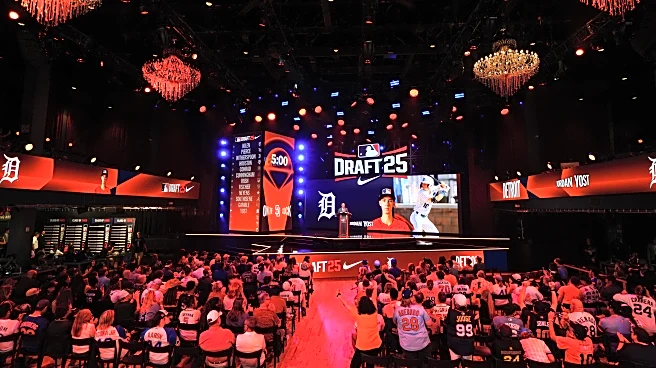

While the 2026 MLB draft is six months and an entire spring season away, it’s time to start looking at mocks now that the draft order is set.
Things will no doubt change rapidly once the college and high
school seasons begin this season. Typically even the current top amateur players in the country will be shuffled as injuries, breakouts, or regression take hold. Currently BA has the White Sox taking UCLA shortstop Roch Cholowsky with the first overall selection in the draft, but even that is unlikely to hold up unless Cholowsky lives up to the pressure and has a great junior season as expected. Still, for now he’s pretty comfortable the consensus choice.
The Detroit Tigers have the No. 22 overall pick, and Baseball America’s first mock draft now predicts right-handed pitcher Tommy LaPour out of Texas Christian University as the selection.
“LaPour has a power pitcher’s frame at 6-foot-4, 230 pounds and a 100 mph fastball to go with it,” wrote the BA staff. “He transferred from Wichita State to TCU in 2025 and posted a 3.09 ERA over 16 starts and 90.1 innings with a 23.4% strikeout rate.”
Once again, things will evolve a lot over the next seven months. So don’t get too attached to LaPour just yet.
Why LaPour makes sense
Detroit’s farm system is one of the most talented in baseball, but it’s position-player heavy. Center fielder Max Clark and shortstop Kevin McGonigle are the headliners, followed by catcher Josue Briceno and shortstop Bryce Rainer. There’s a clear pattern here: left-handed bats that play positions up the middle of the field.
Typically, that S-tier and A-tier crop of players features a pitcher, but Detroit lacks a true pitching star in its B-tier and possibly even C-tier. Baseball America recently released its top-10 prospects list for each team, and the Tigers didn’t have a single arm mentioned.
Kelvis Salcedo, Jake Miller, Jaden Hamm, Andrew Sears and Malachi Witherspoon are the closest to cracking the top 10, but none of them warrant a future value grade above 45 at this point; not to mention, Witherspoon is in rookie ball, while Salcedo won’t even turn 20 until January and hasn’t pitched above Single-A yet. Hamm battled some injuries and his velocity collapsed for a long stretch this year. Miller too had injury trouble though he’s closest to major league ready. So, going pitcher-heavy in the 2026 draft feels right for an organization over-saturated at the other important positions.
LaPour is the kind of arm that any scout is going to take multiple looks at. He’s got the height and size to sit in the upper-90s with his fastball, albeit somewhat ordinary in shape and command, and an 89-91 mph changeup is a common complementary pitch. However, it’s his slider that makes him a potential 50 FV player. LaPour had a 40.8 whiff percentage with it last year, and opponents only hit .182 against it last year.
If LaPour can learn to rely on his slider late in counts and command it a bit better, it’s a plus pitch with two-plane depth. Adding a low-90s cutter also adds some depth to his arsenal, but that’s a work in progress. LaPour’s slider was in the mid-80s early in 2025, but it dipped to the low-80s and high-70s later on in the year.
Physicality, a repeatable delivery and three strong pitches are the makings of a starting rotation arm, without a doubt.
The case against LaPour
While LaPour’s slider has the potential to miss bats, his 23.4 strikeout percentage leaves something to be desired. His line-drive rate went from 13.2% to 20.8% after joining the Big 12 Conference, and a 6.8% home run-to-fly-ball ratio suggests some luck. Regression is almost certain against quality minor league hitters. Major leaguers will be able to sit on his slider, especially if he can’t learn to control it, and take advantage of his fastball.
Command has been an issue against Power Four bats, which translates to High-A ball at best. Back-to-back starts with five earned runs in May may also signal some stamina issues. However, he went seven innings or more in the four starts before that and had six straight games with 100 or more pitches.
Most importantly, he feels like a reach in the first round at this point. While his supporters have him sneaking into the first round, his detractors have him graded as a second to third-round talent. After a lukewarm draft in 2025, Detroit doesn’t need to go cheap or rely on college talent this time around. However, their strategy picking this far down the board again will likely see them looking to save a little money early on and try to haul in another big crop of prep players.
It’s a big spring for LaPour, and Baseball America clearly believes he’ll continue developing.
Other options at No. 22 for Detroit
Going with a pitcher feels like the right move for Detroit this year, but top-end college talent such as Florida’s Liam Peterson and Coastal Carolina’s Cameron Flukey will be off the table. UC Santa Barbara’s Jackson Flora could slip a little, but that would likely mean the questions about him being a two-pitch arm weren’t answered this spring.
So, why not a high school arm?
Carson Bolemon and Logan Schmidt come off the board just before Detroit’s pick in Baseball America’s mock, but both would be strong options if they fall. Bolemon is considered the most polished arm in the draft, and Schmidt will be 17 with the same amount of potential in June.
My favorite arm, though, is Gio Rojas out of Marjory Stoneman Douglas. While early mocks and prospect lists had him in the mix for a top-10 pick, often linked to the Atlanta Braves, he’s fallen a bit thanks to the rise of the other high-school lefties mentioned above. If he’s on the board at No. 22 as BA thinks he will, Detroit would be foolish to pass him by — no matter the cost.
Full disclosure, I’ve worked closely with Douglas doing media for the Eagles the past three years, so there is some bias.
Rojas is the most effortlessly talented pitcher in the class. With the right discipline and coaching staff, he has the highest ceiling of any pitcher heading into the 2026 season. He’s from Colorado but moved to South Florida — one of the true hotbeds of prep baseball — before his sophomore year to face stronger competition. Even at 16, his slider looked special. His fastball is already up to 99 mph with good ride, and the slider makes the best high school talent look silly. Rojas is working on his changeup, which he said was his favorite pitch to throw in Fall 2024.
He possesses the same love of the game that makes Tarik Skubal so endearing to Detroit fans, and he thrives in big games. He was with Team USA this summer and wasn’t supposed to throw too much. Instead, he was the team’s co-ace, throwing a two-hit, 10-strikeout complete game against Korea in the Super Round of the WBSC U-18 World Cup. You have to pry him off the mound.
The other high school arm worth considering is Coleman Borthwick — the other Team USA co-ace and tournament MVP — out of South Walton High in Florida. A legitimate two-way prospect, Borthwick projects better as a pitcher. His 6-foot-6, 255-pound frame has him throwing 98 mph with a power slider and good control. He might be the best right-handed high school arm in the class. Like Rojas, Borthwick is working on a changeup but uses it sparingly.
If Detroit opts to go the position player route, center fielder Brady Harris out of Trinity Christian Academy in Jacksonville, Fla. is a strong option. Like Rojas, Harris has seen top-10 projections but slipped as of late, likely due to an average summer on the travel-ball circuit.
Detroit could use a right-handed bat, and he has some of the best hand speed at the prep level. Plus speed and a potential plus-plus arm in the outfield make him a legitimate option in center field, although he’d likely move to left at some point if he’s in the same system that has Clark.
Texas A&M third baseman Gavin Grahovac is an organizational fit, being a right-handed college bat who plays a position of need for the Tigers. Erratic defense, shoulder surgery and an aggressive approach at the plate could put him in range for Detroit. However, a healthy, bounce-back season could move him too far up the draft board.
Amateur scouting is a fluid game, but there should be plenty of options for Detroit at No. 22 come June. This is a strong, shortstop-heavy draft class, and the Tigers benefit from having an abundance of talent at that position already working its way up the farm. That may allow them to go another direction, and while most of the top prep pitchers are likely spoken for in the first round, there’s a pretty deep ground of second tier arms there where the Tigers could focus much of their bonus pool beyond the first round.