
The 2025 Giants wound up right about where they were expected to be even though they could’ve been a little bit better than 81-81. For the third year in a row, Dan Szymborski’s ZiPS projections for the 2026 San Francisco Giants see them flirting with .500 but with enough in-house talent already to push that win total north.
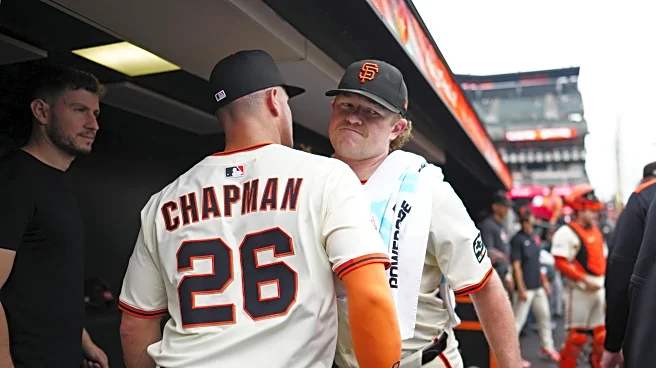
Last year, ZiPS suggested the likeliest outcome as a team “a skosh” above .500, and if you look at Matt Chapman’s missed time and some surprisingly awful negative regression by
some members of the bullpen futzing up some Justin Verlander starts, then you can very easily assemble “a skosh.” I mention that because projection systems — while, yes, being mere projections — have quite a lot of utility, and Dan’s is one of the best. At the very least, they give the average fan a general sense of their favorite team’s direction (also, every team has their own internal projections based on their own methodology). As many visitors to this site have attested in the comments over the past year or so, the Giants are actually in pretty good shape.
Highlights
The team has a solid core with Logan Webb again a ZiPS darling (projected 4.8 fWAR), and decent projected contributions from Robbie Ray (2.2) and Landen Roupp* (2.2). Chapman (4.9), Willy Adames (4.4) and Rafael Devers* (3.4) are right there behind them on the offensive side, with Jung Hoo Lee, Heliot Ramos, and “the Casey Schmitt/Christian Koss/Tyler Fitzgerald chimera at second” projected to contribute around league average (~2 fWAR). Patrick Bailey’s bat gets a bit of a glowup and the Jesus Rodriguez acquisition looks like a good fit.
Lowlights
The Giants’ vaunted pitching depth was either a total miscalculation or an act of marketing, because it’s pretty barren when it comes to starting pitching. Kai-Wei Teng, Hayden Birdsong, Trevor McDonald, and Carson Whisenhunt are, combined, projected to equal about one Landen Roupp* or Robbie Ray. It’s a similar situation in the outfield, where a lot of guys might add up to something average. Drew Gilbert, Luis Matos, Joey Wiemer, and Jerar Encarnacion (who bounces around the projection as a 1B and DH, too) are all decent enough back of the roster-types, but they’re penciled in for now as a mega platoon and, well, that’s unlikely to work.
The bullpen is not great in my view, but Dan’s comment that it’s not bad if the focus is on improving the rotation is noted. It’s unclear just how much the Giants have to spend on improving the roster overall, but they have certainly been signaling they’re less interested in spending much to address the rotation. At least, what might be theoretically necessary in a market where Dylan Cease gets $210 million over 7 years. Incremental improvement won’t really cut it.
Surprises
There’s a whole subculture of this site that has in depth knowledge of the farm system and so it’s basically red meat for the base to see ZiPS spotlight Bo Davidson. His 80th percentile projection is a 3-win player, but his 50th percentile projection (which is the figure Dan uses to project the team in his article) is around league average (again, about 2 fWAR). That’s… astonishing, and the notion that a computer thinks he’s already one of the best backup outfield options available to the team is exciting. Heliot Ramos doesn’t get very much love from ZiPS (basically where he was in 2025, about 2 fWAR), but let’s say that Davidson is “merely” another Heliot Ramos. That’s sort of a development win, I’d think? And both have the chance to be better than that.
Meanwhile, Justin Verlander projects to have a 2026 virtually identical to his 2025 and Ryan Walker figures to be good (80th percentile: 1.7 fWAR. 20th percentile: 0.4). If I had sat and thought about it before reading the post, I would’ve probably predicted that for Verlander but certainly not for Ryan Walker.
Lastly, I was heartened to see that the computer thinks Tyler Fitzgerald should keep playing baseball. Let’s all hope that rib injury is behind him and was the cause of his disastrous 2025. His talents, fully activated, sure would be nice to see.
Disappointments
Bryce Eldridge is still very much an unknown. There’s a lot of variability in the profile, no doubt because of his age, but it makes clear that for all the potential, nobody knows what the Giants have in him yet. And, unfortunately, with the Giants having activated his clock at the end of last season, the team will need to figure out who he is pretty quickly.
The projections for Hayden Birdsong and Carson Whisenhunt are not encouraging in that they’re 1) not where the team needs them to be and 2) far lower ceilings than was hoped for, meaning that they might not wind up as development failures, but if they do become successes, they will be meager ones. Again, according to the computer.
Projections are nice to have and Dan’s constant adjustments to ZiPS is why I think it’s one of the best out there, but if you’ve noticed those asterisks in the piece, it’s because there are limitations to them all. For one thing, while FanGraphs does have an injury factor, we know that Landen Roupp’s background is largely injury-based. The notion that he would pitch enough innings to generate 2-WAR of value doesn’t track with his history. It certainly could happen, but for the purposes of knowing the state of the rotation, it’s not something to count on, which is why the team needs at least two starters in trade or free agency.
Also, he admits that Devers’ projection is tricky because of the split between first base and DH and I’m just going to stake my claim now, or join the group that’s already out there — whatever — by saying that I think Devers will be a fine first baseman in 2026 and will spend the bulk of his time there.
We also have no idea just how much of an impact Tony Vitello’s first year as a major league manager will impact these projections, positively or negatively. We’d all like to imagine that Buster Posey’s attempt at replicating Farhan Zaidi’s first post-Bochy staff is as successful as those first two Kapler seasons, but we just won’t know until the games are played.
Dan’s premise this year is that the Giants and their fans are probably wanting to close the competitive gap with the Dodgers, but as I mentioned earlier in the offseason, the smart money’s on ditching the rivalry altogether. Indeed, it seems the Giants did a long time ago and instead remain committed to Brian Sabean’s guiding principle of aiming for 85 wins and hoping to get lucky. In a three Wild Card world, that’s not even Smart Baseball — that’s the default strategy. With such a low bar, which means it’s easier than ever to field a competitive or even quasi-competitive team.
That’s all the Giants have been trying to do, and once again, they’re projected to be right there: somewhere between “not bad” and “maybe good.”