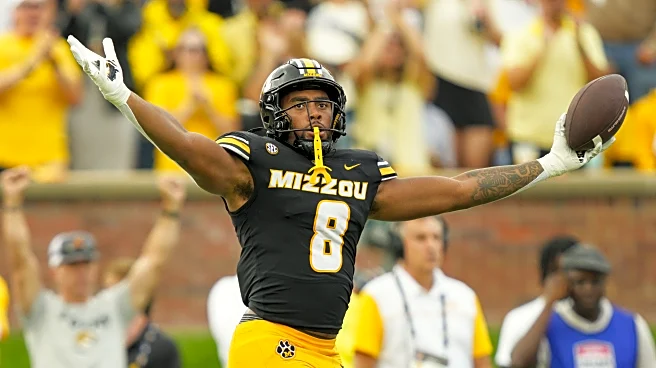


The past couple of weeks, I’ve been grading out how the Mizzou football team performed throughout the 2025 regular season. First, I took a holistic view of the team and graded out all three sides of the ball. Last week, I dug a bit deeper into the offense and graded out the offensive position groups individually. This week I’ll put a bow on these grades by looking at by far the most successful side of the ball for the Tigers in 2025: the defense. Let’s break that unit down further to see how each
group performed.
Defensive tackles
Mizzou’s defensive tackle group anchored the interior of the Tigers’ defense with strength and consistent production. Senior Chris McClellan was the centerpiece of the unit and one of the most effective interior defenders in the SEC. McClellan finished the 2025 season with 42 total tackles, seven tackles for loss, and excellent five sacks; production that consistently disrupted opposing run games and collapsed pockets from the middle.
Sterling Webb complemented McClellan well, providing steady snaps and physicality against the run while chipping in tackles for loss of his own. Webb finished the year with four tackles for loss and 2.5 sacks. Marquis Gracial and Jalen Marshall rounded out the rotation and played an important role in keeping the unit fresh, contributing meaningful snaps and holding up at the point of attack. Together, the group helped Mizzou remain stout against inside runs and allowed linebackers to flow freely to the football.
The interior defensive line, like the defense as a whole, was never the reason Mizzou failed this season. That reliability made the defensive tackle unit a key part of the Tigers’ defensive identity.
Defensive tackles grade: B+
Defensive End
The defensive ends were the driving force behind the Tigers’ 2025 defense and formed one of the most productive pass rushing tandems in the SEC. Zion Young and Damon Wilson consistently pressured quarterbacks and altered game plans with their ability to win off the edge.
Young led the Tigers with 15 tackles for loss while adding 6.5 sacks, combining power and effort to disrupt both the run and pass. Wilson complemented him perfectly, finishing the season with nine sacks and serving as the primary speed threat off the edge. Together, they created constant pressure and forced opposing offenses into uncomfortable passing situations.
Depth was another strength of the group. Darris Smith made significant strides, emerging as a reliable rotational pass rusher and even quarterback spy on occasion. He contributed four sacks himself while freshman Daeden Hopkins also flashed potential in limited action, showing early signs that he could develop into a major contributor in future seasons.
With elite production at the top and improving depth behind them, the defensive end unit set the tone for the entire defense.
Defensive ends grade: A

Linebackers
Mizzou’s linebacker corps combined elite production with impressive depth, making it one of the most complete units on the roster. Transfer Josiah Trotter made an immediate and dramatic impact in his first season in the black and gold after arriving from West Virginia. Trotter lead the team with 84 tackles, 13 tackles for loss and two sacks, earning first team All SEC honors and quickly establishing himself as the leader of the defense.
The strength of the unit went well beyond its star. Khalil Jacobs provided steady play and physical run defense, while Triston Newson contributed valuable snaps and experience. The rotation allowed the Tigers to stay fresh and aggressive throughout games. Nick Rodriguez also showed exciting flashes when given opportunities, positioning himself as a potential key piece of the defense moving forward.
The combination of top end talent, consistency, and depth made the linebacker group a stabilizing force all season long.
Linebackers grade: A
Cornerbacks
The cornerback group showed measurable progress over the course of the 2025 season and played a critical supporting role in Mizzou’s defensive success. Senior Toriano Pride took a noticeable step forward in his final collegiate season, improving his consistency and competitiveness in coverage and led the team with two interceptions.
Dreydon Norwood delivered another solid season, holding his own against a variety of receivers and contributing reliably in both coverage and run support. Stephen Hall added depth and provided important snaps throughout the year, as a reliable third options.
This unit was far from dominant and struggled to create havoc. They also had moments of vulnerability against the big play. That said, the cornerbacks generally competed well and were able to avoid too many catastrophic breakdowns toward the end of the year. Their steady improvement helped keep Mizzou among the nation’s better defensive units.
Cornerbacks grade: B

Safeties
The safety unit entered the season with high expectations, especially following the arrival of transfer Jalen Catalon, but the results were uneven. Catalon’s season was somewhat disappointing relative to the preseason hype. While he brought experience and physicality, he did not consistently deliver the level of playmaking impact many anticipated, particularly in coverage.
One of the most positive developments came from Santana Banner, who proved to be a strong addition to the unit. Banner provided stability, range, and reliable tackling, helping settle the back end during key stretches of the season. Marvin Burks showed clear improvement from the previous year, becoming more confident and dependable within the defensive scheme.
Senior Daylan Carnell turned in a relatively solid, if quiet, final season. He handled his responsibilities, avoided major mistakes, and served as a steady veteran presence. Overall, the safety group did enough to support a strong defense, but inconsistency and unmet expectations prevented it from becoming a true strength.
Safeties grade: B
The 2025 Mizzou defense was defined by an aggressive and productive front seven that consistently controlled the line of scrimmage. The defensive ends and linebackers drove the unit’s success, while the interior defensive line provided stability and toughness against the run. That foundation allowed the Tigers to remain competitive in every game, even when the offense struggled.
The secondary showed improvement as the season progressed and held its own for much of the year, though it remains the area with the most room for growth. When pressure and coverage worked in tandem, Mizzou overwhelmed opponents. When either faltered, vulnerabilities surfaced.
Even with those limitations, this was a defense that consistently gave the Tigers a chance to win. With continued development on the back end and sustained excellence up front, Mizzou’s defensive ceiling moving forward remains extremely high.