
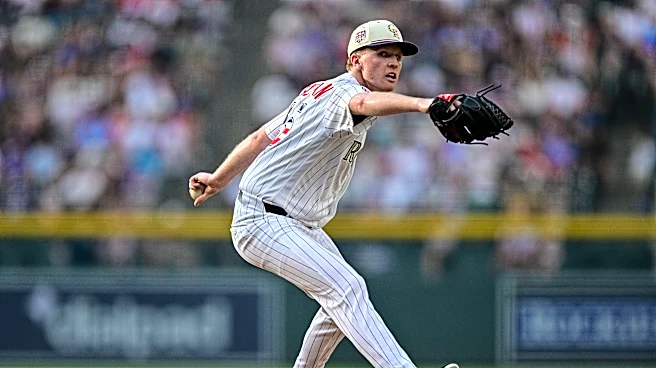
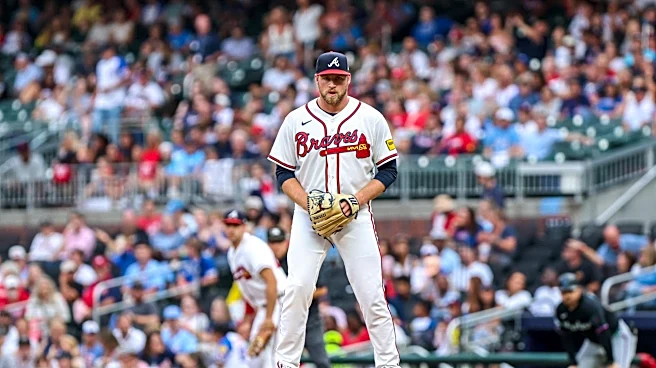
Now we enter the top half of the mid-season 2026 Purple Row Prospects (PuRPs) list. Previously we had PuRPs 30-26, 25-21, and 20-16. As a reminder, in this edition of the PuRPs poll, 29 qualifying ballots were cast, with 30 points granted for a first place vote, 29 for second, etc.
For each player on the PuRPs list, I’ll include a link to individual stats and contract status (via Baseball-Reference), PuRPs voting stats, a note on the 2026 season to date, and a scouting report from a national prospect
writer where possible. I’ll also include where I put each player on my personal ballot. All ages are as of the date the article is posted.
15. Jack Mahoney (397 points, 27 ballots) — Preseason Ranking: HM — High Ballot 8; Mode Ballot 8, 9, 11, 14, 16, 17, 18, 19, 22, 25
How did he enter the organization?
2023 Third Round, University of South Carolina
Why did he make the PuRPs list?
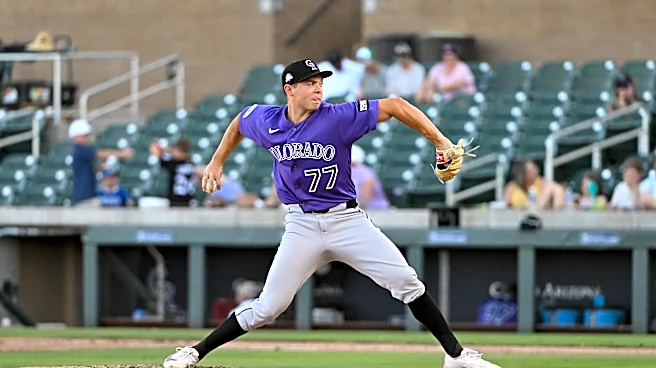
Mahoney, a polished right-handed pitcher who relies on a heavy sinker/slider combo, has flown a bit under the radar as a prospect until this season. The 6’1” 25-year-old was briefly a two-way player at South Carolina and needed Tommy John surgery mid-way through his sophomore year, but recovered his stuff enough as a junior to get drafted in the third round, was Colorado’s third rounder in 2023, going 77th overall and signing for a slightly below slot bonus of $925k.
Mahoney was handled more slowly than a high-round SEC pitcher draft pick might expect, spending most of his first full season in 2024 at Low-A Fresno, but a jump up to Double-A Hartford in 2025 had him back on his expected trajectory. With Hartford (where he was 1.7 years younger than league average), Mahoney made 24 starts with a 5.93 ERA (4.40 xFIP), 1.67 WHIP, 7.0 K/9 rate, and 4.0 BB/9 rate in 104.2 innings. He struggled to provide length in his outings — only twice did he get through six innings, though some of that is undoubtedly development-related by the Rockies. After the regular season, Mahoney was assigned to the Arizona Fall League for another 15.2 innings, where Purple Row’s own Samantha Bradfield interviewed the pitcher last November.
In 2026, Mahoney was sent back to Hartford, where he was about a year younger than league average. He made two April starts then was shelved on the IL for about a month. After returning, Mahoney got better results, throwing 68 innings across 13 Hartford starts with a 1.99 ERA (4.07 xFIP), 1.27 WHIP, 8.5 K/9 rate, and 3.2 BB/9 rate. He was especially good over his last five appearances, all of which were quality starts in which he allowed just a .561 OPS and 1.65 ERA in 32.2 innings. Mahoney was promoted to Triple-A Albuquerque in April, where he’s made three additional starts, allowing eight runs on 19 hits and seven walks with 11 strikeouts in 13.1 frames.
There isn’t much recent video of Mahoney, so please enjoy this brief clip of him mowing through hitters in Low-A in 2024:
What do the scouts say?
FanGraphs ranks Mahoney 30th in the system as a 40 FV player, giving him 55 future grades on the fastball, slider, and change-up:
[Mahoney’s] a good example of a prospect whom we might have fallen harder for 15-20 years ago, because while he touches 98 and sits in the mid-90s, the shape isn’t great. Moreover, his cutter is a little soft and the breaking stuff can roll together, which limits the utility of what is on paper a pretty deep arsenal. All that said, we still like him in a bullpen role. If he can live close to the top of his velo bands in shorter stints, he’ll have a few above-average offerings to lean on and more pitchability than you often get out of a middle reliever. He’s still starting down on the back fields, and perhaps the new dev group can find a path forward for him in the rotation, but he has the look of a guy who could move fairly quickly if Colorado changes course.
Mahoney was 30th overall in their system rank as a 40 FV player before 2025 (he isn’t in the current top 30):
With a sturdy 6-foot-3 frame, Mahoney appears built to eat innings. He can run his fastball up to 97 mph, sitting more around 93 mph, and it has good natural sink to it that helps him get ground-ball outs. His changeup might now be his best secondary offering, thrown in the mid-80s with good fade and the ability to miss bats and get weak contact. His slider, also around the mid-80s, can also be an out pitch at times, with horizontal and vertical break.
A former high school quarterback and position player, Mahoney’s athleticism helps him repeat his delivery and fill up the strike zone, providing a good combination of pitching to contact to get ground balls and miss bats. His time with Spokane wasn’t as smooth, so he’ll have to work on his overall command within the zone, but he has the makings of a back-end starter.
When’s he going to get to the Rockies and how good will he be once he’s there?
Mahoney’s athleticism, command, and starter projection drive the profile for me — though the overall package might not be as exciting as other pitchers in the system, he’s close to big league ready. As such, I ranked him 21st on my list as a 40 FV player. Mahoney will be Rule 5 eligible after the season, so if the Rockies are interested in protecting him they might call him up down the stretch for a look in the Show.
14. Brody Brecht (412 points, 28 ballots) — Preseason Ranking: 3 — High Ballot 5; Mode Ballot 16, 17
How did he enter the organization?
2024 Competitive Balance Round A, University of Iowa
Why did he make the PuRPs list?
The statuesque Brecht, a 6’4”, 235-pound, 23-year-old right-hander, was the highest ranking (and highest-ceiling) pitching prospect in the system in the pre-season PuRPs list at #3 overall. A season shortened by injury has dimmed his star somewhat a few months later, but Brecht’s arsenal that includes a high-80s slider that most scouts consider to be plus-plus and a fastball that touches triple digits means his ceiling is tough to touch. The rub, of course, is below-average control of the fastball in particular and the attendant relief role risk.
Brecht could have been an early draft pick coming out of high school in 2021, but he wanted to play college football as a wide receiver at Iowa. When that didn’t work out as hoped (due in part to concussions), Brecht concentrated on baseball full-time starting as a sophomore. He showed enough promise on the mound to earn an over-slot (by $250k) $2.7 million bonus from the Rockies as the 38th-overall pick of the 2024 draft. In his sophomore year at Iowa, Brecht struck out 109 batters (nearly a third of those he faced) but walked 61 (7.1 BB/9). Though there was some improvement in his draft year (5.6 BB/9 rate with an outstanding 14.7 K/9 rate), it’s a major reason the Rockies were able to get Brecht with pick 38 rather than the top 10.
In his first professional season last year, the Rockies sent Brecht to Low-A Fresno and kept him on a pitch count (he didn’t eclipse 72 until his last three starts of the year, when he got up to 88 pitches), so it’s unsurprising that he also didn’t go deeper than five innings in 15 of his 16 starts with Fresno. Those 16 starts were split into two periods by a back injury that kept Brecht away from the California League for over two months with four strong rehab appearances with the Complex League team in the interim. In Fresno, Brecht showed the bat-missing stuff that got him picked in the top 40 of the draft. In 55.1 innings, Brecht posted a 2.60 ERA (3.18 xFIP), 1.34 WHIP, 14.2 K/9 rate, and 5.2 BB/9 rate. Basically, 51% of plate appearances against Brecht in 2025 ended up as a strikeout (37%) or a walk (14%). You can read more about Brecht’s 2025 campaign in this interview Samantha Bradfield had with him during spring training.
This year, Brecht was promoted to High-A Spokane, where he is of league average age. Brecht made seven short starts in April and May, never eclipsing four innings or 66 pitches, before ending up on the IL with right shoulder impingement. Brecht continued missing bats, throwing 20.2 innings with a 5.23 ERA, 1.40 WHIP, 6.5 BB/9 rate, and 13.5 K/9 rate. Brecht’s 3.72 xFIP indicates some poor fortune and good process, as does holding the opposition to a .565 OPS and not allowing a homer. Of the 90 batters he faced, 46 of them struck out or walked.
Here’s Brecht in action for his second professional start last spring in Fresno (game action starts at the five minute mark, side views of his delivery are at the 14 minute mark, and slo mo shots begin at the 16 minute mark):
What do the scouts say?
Baseball America ranked Brecht as the fourth best prospect in the system before the season and listed him as the number two starter in the 2029 rotation (with the best slider and changeup in the system):
Brecht is a fireballing righthander with questions around his command and below-average fastball shape. A talented athlete with a prototype starter’s build, Brecht looks the part on the mound. … His fastball sits in the 96-97 mph range and has been up to 101 with hard cutting action that has made his fastball both a miss and groundball-inducing pitch. He throws a high-80s slider more frequently than his fastball, and over the offseason worked to add multiple shapes to the pitch. One is a shorter gyro offering and the second a breaking ball with more sweep. Whichever variant he settles on should have double-plus upside given his feel to spin the ball at high velocities.
Keith Law of the Athletic ranked Brecht fifth in the system in February:
Brecht came into the Rockies’ system out of the University of Iowa, where he was also a wide receiver, with relatively little pitching development behind him, so it was almost like he was a high school pitcher in a 21-year-old college football player’s body. When he pitched in 2025, he was in the mid to upper 90s again with his four-seamer, mostly throwing that and the slider, but he mixed in a new-ish splitter that looks like a real weapon for him, and the Rockies have worked with him on tunneling his pitches to get more deception out of his delivery. His walk rate is too high, at 13.5 percent, as he tends to miss by a lot when he misses. He also hit the injured list for about two months with a back injury he may have suffered while lifting. (Shakes head in general direction of football.) He’s athletic with a loose arm, has the makings of three pitches and is still pretty young in pitching years. There’s serious reliever risk here, to be clear, but if the Rockies can make him a starter, it’s a high-upside package.
Brecht was ranked 21st overall in the 2024 draft by MLB Pipeline and they rank him 15th in the system as a 45 FV player with a plus-plus (70) grade on the slider, a 65 on the fastball, and 50s on the curveball and slider with 40 control:
When Brecht is locked in, he can deliver an outing like that postseason one, giving some hope to his ability to start-long term. He’s touched triple digits in the past with his fastball and was sitting more in the 96-mph range with Fresno. The velocity is nice, but it can straighten out too much at times. The true out pitch is his slider, which he can crank up to 90 mph with horizontal and vertical action to it, a breaker that elicited a 58 percent miss rate last year, per Synergy. He added a curve at instructs, which immediately looked like a solid third pitch, while his splitter is a distant fourth.
As athletic as Brecht is, his delivery has some timing inconsistencies, he can land too firm on his front side and he will change his arm slot at times. The lack of mound time because of his back didn’t help, but he’ll have to show he can find the zone more regularly after walking 5.2 per nine during his debut if he wants to stay in a rotation.
FanGraphs grades Brecht as a 40 FV player, 23rd in the system. They hang a 60 future grade on the fastball and slider with 55 future grades on the splitter and curve, paired of course with 30 future command:
Brecht was among the college game’s elite strikeout pitchers while he was at Iowa, which prompted the Rockies to pop him in the first round back in 2024. Back injuries interrupted his debut season, but when he did get on the mound, A-ball hitters struggled to make contact, striking out (36.7%) and walking (13.5%) half the time. Brecht’s upper-90s fastball, tight upper-80s north-south slider, and sinking change all flashed plus. This spring, he’s added a mid-80s curve, with good depth but also a big hump; it should be effective, if not a big bat-misser.
While Colorado should make every effort to start him, Brecht looks like a reliever. He’s an open strider, and the way his delivery works often leaves him pulling the ball with him, where he’s prone to missing badly glove side. He only sporadically locates his fastball arm side, and his catchers are constantly backhanding his slider in the dirt. On movement, both the slider and change grade well, but the lack of deception and predictable locations limit Brecht’s ability to leverage that quality. All of that will still matter, if a bit less, in the bullpen. He projects as a solid middle reliever with upside from there if his control jumps ahead of where I’m forecasting.
When’s he going to get to the Rockies and how good will he be once he’s there?
In terms of pure stuff and ceiling, Brecht is among the system’s best. His slider, when it’s being commanded, is probably the filthiest pitch in the system. Of course, to reach that ceiling, Brecht will need to demonstrate sufficient command to get upper-minors hitters out and go deep into games regularly, not to mention staying healthy. If he isn’t able to do that, Brecht’s stuff still works in a high-leverage relief role as a fallback.
It’s an exciting profile to be sure, though of course the risk is high that Brecht busts to some degree as nobody is confident he’ll be able to harness the stuff with a starter’s workload. That’s why I ranked Brecht 16th on my list as a 40+ FV player as a raw high upside prospect who will probably end up as a late inning reliever. Brecht will likely repeat High-A next year, but he will be Rule 5 eligible at the end of 2027 so no doubt the Rockies will want to see him against upper-minors pitching by seasons’ end.
13. Roc Riggio (469 points, 29 ballots) — Preseason Ranking: 14 — High Ballot 9; Mode Ballot 15
How did he enter the organization?
2025 Trade, New York Yankees
Why did he make the PuRPs list?
Riggio, who was the headline prospect in the Jake Bird trade with the Yankees near last year’s trade deadline, is a decent up-the-middle defender who has both power and patience at the plate, all in a compact 5’9” package. The 24-year-old lefty-hitting, righty-throwing second baseman had a breakout 2025, tearing up High-A and Double-A for the Yankees before joining the Rockies organization (where he didn’t quite keep up that torrid pace but was still above average).
Riggio was a well-regarded player out of high school, but a commitment to Oklahoma State resulted in a fall to the 11th round in 2021 (though he didn’t sign with the Brewers who had drafted him there). Two strong years with Josh Holliday’s team (including a 1.139 OPS his draft year) led to Riggio getting drafted in the fourth round of 2023 by the Yankees and signing for a $693k bonus that was almost $200k over the slot value.
After a solid first full season as a professional in 2024 (117 wRC+ in High-A), Riggio began 2025 back in High-A but only after he was delayed a month by a hand injury. He quickly showed that he had mastered the level, hitting .264/.436/.597 with six homers in 94 plate appearances while walking 21% of the time, which was a 195 wRC+. That earned Riggio a promotion to Double-A, where against upper minors pitching, Riggio kept on hitting well. In 170 plate appearances with New York’s Double-A affiliate, he hit 11 homers and 10 doubles en route to a .261/.335/.542 line (155 wRC+, though he only walked in 8% of PA) before getting traded away to the Rockies at the deadline.
Riggio was assigned to Hartford (which is the same league he was beating up on in the Yankees system), where his power surge diminished a bit. Riggio hit .256/.346/.389 with two homers and six doubles in 107 plate appearances (113 wRC+), buoyed by a 13% walk rate. Those Hartford numbers were bolstered by an excellent September in which Riggio put up a .905 OPS in 39 plate appearances. In the field, Riggio committed seven errors in 66 games at second base.
In 2026, Riggio went back to Double-A Hartford, where he was roughly league average age. Riggio has had a cool month followed by a hot month this year, starting with a .718 OPS April, then a .990 May, a .740 June, a 1.057 July, and a .729 August so far. In 89 games with Hartford, Riggio hit .256/.356/.492 with 16 homers among his 41 extra-base-hits and 20 steals in 380 plate appearances (126 wRC+). Riggio was bumped up to Triple-A Albuquerque last week, where in three games he is 2-10 with a walk and six strikeouts.
Here’s a look at Riggio’s 2024 offensive and defensive highlights, beginning with a double play that has to be seen to be believed and which shows Riggio’s baseball IQ (as does his straight steal of home later in the video):
What do the scouts say?
MLB Pipeline ranked Riggio as the ninth best second base prospect in the sport before the season and currently rank him 13th in the system with a 45 FV grade, though without any standout tools:
As an undersized masher who doesn’t get cheated at the plate, Riggio has reminded some of a left-handed-hitting Dustin Pedroia type, albeit without the same pure hit tool. With an open stance and a leg kick, he thrives on getting the ball in the air to his pull side, with the bulk of his 20 homers a year ago leaving the yard that way. He’s not afraid to work counts or draw walks and can punish fastballs, but while his overall approach is solid, he struggles with breaking stuff (40 percent miss rate in 2025) and didn’t handle lefties well.
While he’s a below-average runner, Riggio likes to move on the basepaths, though he was less successful last year when attempting to steal. He’s likely limited to second base, but he has enough skills to perhaps stick at the keystone as a bat-first regular, with perhaps a floor on the long end of a platoon.
FanGraphs liked Riggio the most of the Rockies’ trade acquisitions last year (ranking him 10th among players dealt at the deadline and comparing him to Roughned Odor in both skill and demeanor). They grade Riggio as a 40+ FV player, 13th in the system with a 55 raw power grade:
At the plate, Riggio has a desirable blend of short arms and above-average power. He swings hard but is under control. His closed finish allows him to cover the outside part of the plate, and his bat is quick enough to leave him no worse for wear on balls in. He’s able to manipulate his path on balls up and has enough loft in his swing everywhere else to project average game pop. While he’ll start to expand late in counts, Riggio is judicious early in at-bats and had some very impressive takes on pitches just outside the zone this spring. He may hit too many fly balls to hit for a high average, but he should get on base and hit for power.
Defensively, clunky actions, a slow internal clock, and just fair range limit his projection; there’s enough here to play second, but not in a way that shines. With those limitations, Riggio looks more like a good sub or a second-division guy than a 50. At the same time, he is also the kind of player who gets the most out of himself. He plays hard, and he does the little things. For just one example, he ran a perfect banana route to first on a dropped third strike in a game this spring; he didn’t reach, but the way he made the play more difficult on the catcher speaks to his feel for the game. Plus, the way he’s added a leg kick and learned to cover the outer half of the plate in pro ball speaks to his aptitude for improvement. He’s in the right place to get a shot at an everyday role, which could come as early as later this summer.
Keith Law of the Athletic didn’t rank Riggio in his top 20 in February, writing that:
Riggio is an undersized second baseman who swings straight up, somehow slugging over .500 in Double-A Somerset in 40 games, then slugging .389 at the same level in Hartford afterward. I don’t think he’s more than an emergency call-up
When’s he going to get to the Rockies and how good will he be once he’s there?
Riggio has big league-regular potential at second base thanks to his power/patience combo, defensive instincts, and overall baseball IQ. I’m excited about his offensive potential with the Rockies and am inclined to round up his likelihood of reaching it, ranking him 11th on my ballot as a 45 FV player. Riggio will need to be added to the 40-man roster at the end of the season, so it’s possible he gets a big league look by then.
12. Daniel Jackson (567 points, 28 ballots) — Preseason Ranking: NR — High Ballot 6; Mode Ballot 9
How did he enter the organization?
2026 Competitive Balance Round A, University of Georgia
Why did he make the PuRPs list?
Jackson terrorized college pitching this season with Georgia en route to the Golden Spikes award, given to the best amateur player in baseball. The Rockies drafted him 37th overall and signed him to a bonus just shy of $2.3 million, about $400k below slot. As a prospect, Jackson combines defensive utility as a catcher with a well-rounded bat that includes big power and good athleticism. The 21-year-old righty spent his freshman year at Wofford before transferring to Georgia in 2025, where he split his time behind the plate and in the outfield grass en route to a .240/.365/.612 line in 148 plate appearances with 14 homers and 12 steals, worth a 107 wRC+. Jackson struck out nearly 30% of the time (walking 13%) in 2025.
This season, Jackson was behind the plate full-time and all he did was win the SEC Triple Crown with a .379 average, 32 homers, and 87 RBI (not to mention 26 steals in 28 attempts) in 319 plate appearances across 67 games in the toughest college baseball conference as he led Georgia to the College World Series semifinals. Jackson’s full line for the season of .379/.473/.803 also saw his strikeouts cut to 21% of plate appearances while walking in 14% of them, good for a 168 wRC+.
Jackson was recently assigned to Low-A Fresno, where he is roughly league-average age. In five games so far, Jackson has split time with fellow PuRP and 2026 draftee Jack Natili behind the plate while going 3-for-18 with a homer and a double.
Here are some of Jackson’s many 2026 college highlights:
What do the scouts say?
MLB Pipeline ranked Jackson 28th overall among draft prospects and now rank him 6th in the system as a 50 FV player with a 60 power grade and 50/55 grades everywhere else:
Jackson is extremely strong and hits the ball extremely hard from the right side of the plate, looking like a taller version of Tyler O’Neill. He has demonstrated a selective approach throughout his college career and did a much better job this year of making contact, both against velocity and against non-fastballs. There’s still some swing-and-miss to his game but he’s getting to his well-above-average raw power more consistently and crushing homers from foul pole to foul pole.
More athletic than most catchers, Jackson can flash plus speed and regularly posts average run times. He’s improving behind the plate and projects as an average defender once he polishes his receiving and blocking. He features solid raw arm strength but throws with effort and needs to improve his technique and accuracy. If he can’t stay behind the plate, he could handle the outfield corners in pro ball.
FanGraphs ranked Jackson 27th overall in the draft and now places him 7th in the org as a 45 FV player with 60 future raw power and 60 speed but considerably more concern about the hit tool:
Jackson is incredibly twitchy. He has rare athleticism for a catcher and a volcanic muscularity. He’s fast, he swings hard, and he really stings the ball when he makes contact, with a 55% hard-hit rate and a 108 mph EV90 in 2026. Whether or not Jackson will hit in pro ball is up for debate. His underclass strikeouts, including on Cape Cod, were out of control, and even as they improved in 2026, he still had some markers of a player whose whiffs are going to be a problem. He doesn’t track the baseball especially well because he swings out of his shoes, his bat path is grooved through the middle of the zone, and he has crazy home/road splits, with Jackson whiffing at nearly half the breaking pitches he sees on the road compared to just 25% of them at home. There are plenty of power-over-hit catching prospects who pan out, but Jackson’s hit tool risk is greater than most of them.
The quality of the Georgia pitching staff’s stuff forced him to elevate his game on defense, and Jackson pretty soundly projects as an above-average catching defender. His arm and framing are both above average, and while his ball-blocking technique needs work, he easily has the athleticism to improve it. He’s one of several toolsy, risky college hitters in this draft class, and is pretty likely to come off the board in the mid-to-late first round.
Keith Law of the Athletic was lower on Jackson, ranking him 82nd in the draft:
Jackson can hit, and has real power, but he’s really rough behind the plate and I think he’ll end up moving to first base. He already has 25 homers through May 10 with an .818 SLG and a strikeout rate a shade under 20 percent on the season. His receiving and blocking are below average; prior to this year he wasn’t a full-time catcher, so perhaps he could improve with more reps, but he has a long way to go.
When’s he going to get to the Rockies and how good will he be once he’s there?
The Rockies drafted Jackson as a hitter, but that’s not all he is. Though reports are mixed on the defense, an athletic college catcher with corner outfield ability carries some defensive utility as well. On offense, the question is whether his elevated college strikeout rate (especially against off-speed stuff) will continue as Jackson makes his way up the minor league ladder.
It’s an exciting athletic profile and Jackson has made it work in the SEC, which is why, despite the warts, I ranked Jackson as a 45 FV player on my ballot, ranking him 8th. I’d expect Jackson to split time with Natili next year in High-A, though the rep share will be telling as to how the Rockies view the two.
11. Jackson Cox (581 points, 29 ballots) — Preseason Ranking: 16— High Ballot 5; Mode Ballot 12
How did he enter the organization?
2022 Second Round, Toutle HS (WA)
Why did he make the PuRPs list?
Cox’s calling card as a prospect is his 3,000+ RPM curveball, described as a slurve with “deep and late bite” which the now 22-year-old paired with a low- to mid-90s fastball and a developing change-up in a repeatable delivery. Cox was Colorado’s second-round pick in 2022, 50th overall, out of a rural high school in Washington state. To get Cox out of his commitment to Oregon, the Rockies signed the 6’2” righty starter for a $1.85 million bonus — well over the pick’s $1.54 million slot value.
Cox was assigned to Low-A Fresno in 2023 for his professional debut, where he was 2.9 years younger than league average. The Rockies handled Cox carefully, never allowing him to go past four innings in a start or 65 pitches an outing in his ten games (nine starts). Nonetheless, Cox suffered an injury that required Tommy John surgery in July (as did fellow PuRPs Jordy Vargas and Gabriel Hughes), which ended his 2023 season and caused him to lose all of 2024 as well (he did pitch in fall instructs, just not an affiliated ball game).
It was a long road back to Fresno in 2025 for Cox, who was still younger than league average. He made 23 starts but was handled carefully, not passing the three inning threshold in any of those starts until June and only exceeding five innings his final two appearances. In total, Cox threw 85 innings with a 3.39 ERA, 1.12 WHIP, 9.7 K/9 rate, and 2.6 BB/9 rate. The trajectory was good too: since a rough April, in which Cox had a 15.43 ERA, he posted a 84:19 K/BB ratio and a 2.31 ERA in 78 post April innings plus a 0.90 WHIP and .199 BAA in the second half of the season.
This year, Cox moved up to High-A Spokane, where he was a year younger than average. In 11 starts totaling 55.1 innings, Cox posted a respectable 4.23 ERA (3.57 xFIP) with a 1.27 WHIP, 2.8 BB/9 rate, and an outstanding 12.7 K/9 rate. Cox was allowed to go around 80-90 pitches in his Spokane appearances, including three quality starts.
In mid-June, Cox got promoted to Double-A Hartford, where he is one of the younger players at nearly three years below league average. Cox has made seven starts with Hartford with decent results against upper minors hitting, throwing 37 innings with a 3.89 ERA (5.09 xFIP), 1.27 WHIP, 10.7 K/9 rate, and 5.1 BB/9 rate. The final three of those games (in July) were all quality starts in which he allowed just two runs on five hits and six walks with 18 strikeouts in 18 innings. Unfortunately, Cox went on the IL on July 24th, so his season might end there.
Here’s some highlights from Cox’s penultimate start of the season thus far in July:
What do the scouts say?
Keith Law of the Athletic ranked Cox 4th in the system in February:
Cox was one of the three Rockies pitching prospects who went down with torn UCLs all at once in 2023, with the team announcing the trio all on the same day as if they got a bulk discount on the surgery. Cox has had the best recovery from the surgery, as his velocity and his curveball came all the way back. The Rockies gave him a slider as well, so he’s got a four-pitch mix, although he mostly throws his fastballs and curveball. He made 23 starts last year, working on very tight pitch and innings limits, so it added up to only 85 innings, but he walked just 7.3 percent of batters and struck out 27 percent even though it was his first time on a mound in two years. At worst, he should be a solid two-pitch reliever who can miss bats with the breaking ball, and there’s at least fourth starter upside here.
MLB Pipeline ranks Cox 8th in the system as a 45 FV player with a 60 curveball and 55 fastball:
Cox’s stuff started coming back once he was on the mound, running his fastball up to 95 mph routinely and reaching back for more at times with good life up in the zone, but it’s his curveball that is still the talk of the town. He registers elite spin rates with the 1-to-7 breaking ball that features sharp bite, missing plenty of bats with it. He was way too fastball-heavy when he first entered pro ball, and in 2025, he found a better balance between the heater and the curve. He has a changeup, but it’s too firm and he doesn’t pronate all that well, leading some to think that he might be a candidate to add another pitch, perhaps bringing the cutter he had worked on previously back into his repertoire.
There could be more consistent velocity from Cox as he gets further removed from Tommy John and he did a nice job of being around the zone and repeating his delivery well during his first season back. The gloves will come off a bit more and there’s a chance that Cox, at age 22, could reach a different plane as a pitching prospect.
Cox was ranked 8th in the system by Baseball America before the season as a 50 FV player and is projected to be the Rockies’ #3 starter in 2029:
Cox’s combination of present stuff and a deep arsenal stands out in an organization thin on starting pitching prospects. He attacks hitters with a five-pitch mix that includes a four-seam fastball, curveball, slider, changeup and cutter. His best pitch remains his plus curveball, a hellacious two-plane breaking ball with spin rates between 2,800–3,000 rpm that serves as a legitimate out pitch. Cox’s strike-throwing is below-average but should improve as he gets healthy.
Cox’s combination of velocity, spin and his ability to develop different pitches gives him a chance to develop into a solid mid-rotation starter in an organization that has struggled recently to develop starting pitchers.
FanGraphs lists Cox 25th in the system as a 40 FV prospect with a 55 future grade on the curve and cutter:
Cox touches the mid-90s and generates excellent raw spin rates. At this year’s Spring Breakout Game, his breaking ball pallet looked a little different than it did a year ago. He still has a projectable 11-5 curve, but in lieu of the low-to-mid-80s slider that missed so many bats a year ago, he was throwing a hard cutter instead. It’s a promising offering, just a tick or two slower than the fastball with barrel-dodging late break, but I hope the slider continues to be part of the mix as well. With average arm strength and mostly average stuff, Cox will need as many weapons as he can muster. Another key going forward is his command. Everything besides the change tends to wind up arm side. He’s a good enough athlete to project on this a bit, and the forecast is for enough improvement here to develop into a no. 5. He has the ceiling of a no. 4 if that undersells how much growth he has left in him.
When’s he going to get to the Rockies and how good will he be once he’s there?
Cox found another gear this year, seeing a big step up in his strikeout rate even as his competition grew more advanced. Cox has a foundational breaking ball to build around and that mid to upper 90s fastball, making him a mid-to-back-end rotation candidate if it comes together. I ranked Cox 12th on my list at the top of my 40+ FV tier due to the pedigree, stuff, and performance against upper minors hitting.
Cox will be Rule 5 eligible this off-season and, barring a bad announcement about his injury, he should be a very strong candidate to add to the 40-man roster. He’ll likely begin 2027 in the upper minors but is a big league rotation candidate next year given the rough state of that unit.
Tomorrow, we get into the top ten of the mid-season 2026 PuRPs list!
Join the conversation!
Sign up for a user account and get:
- Fewer ads
- Create community posts
- Comment on articles, community posts
- Rec comments, community posts
- New, improved notifications system!
Please keep in mind ourPurple Row Community Guidelines when you’re commenting. Thanks!