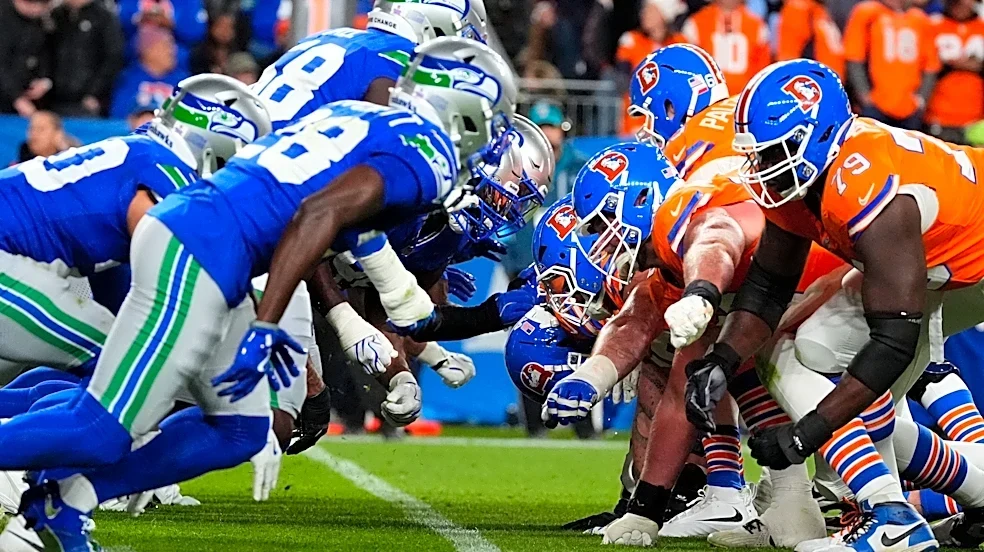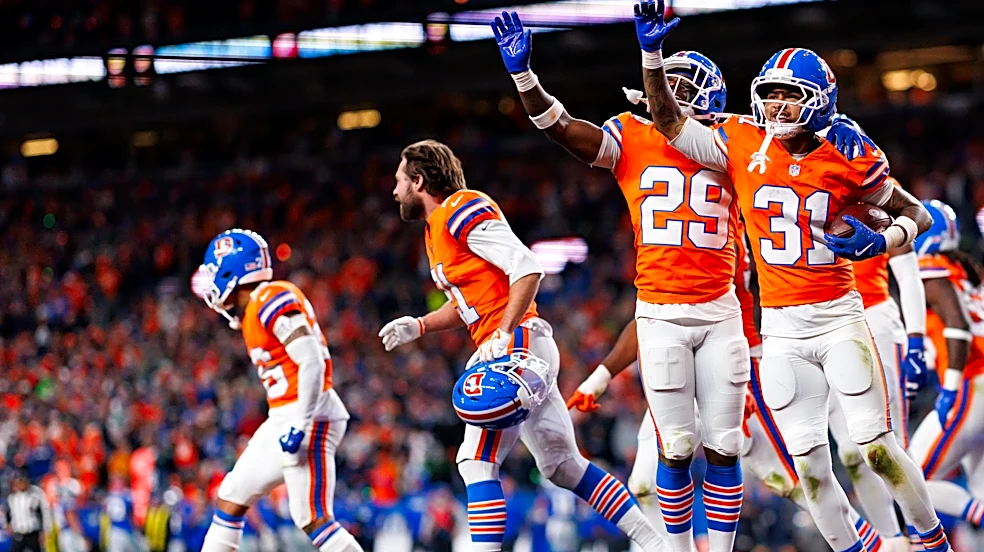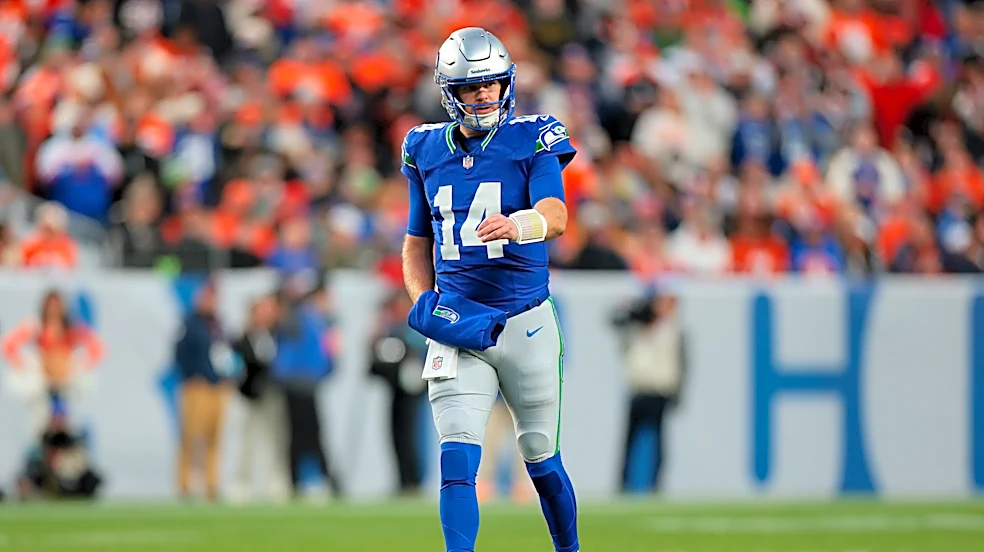


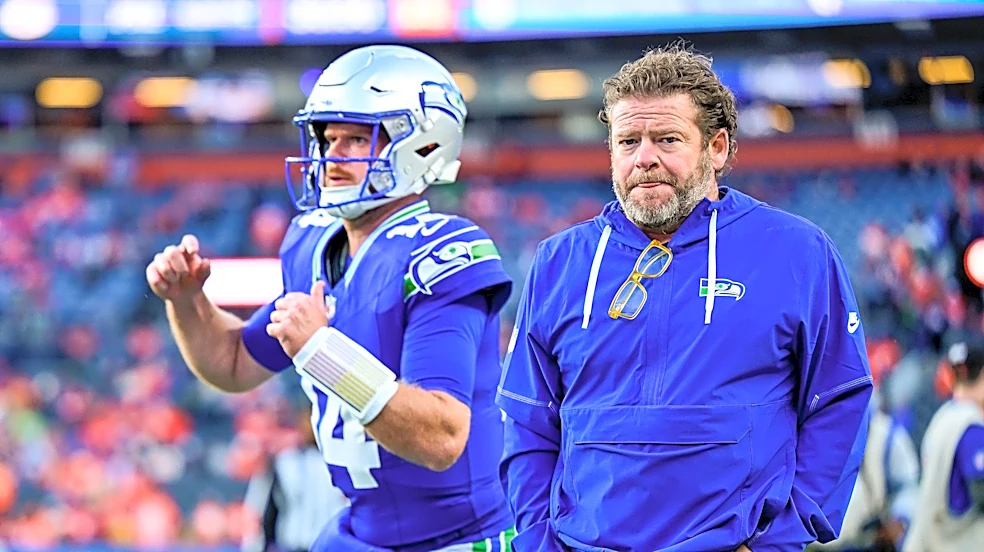
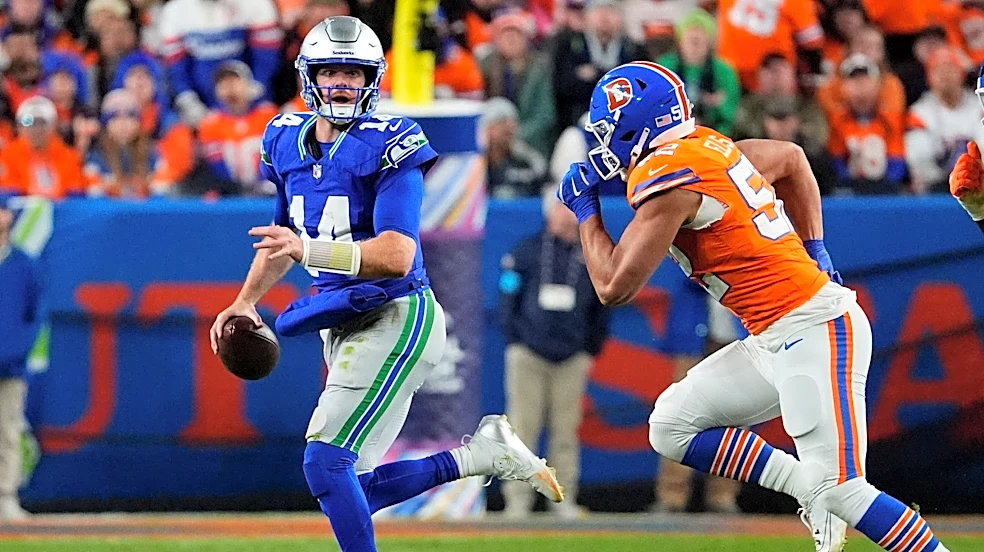

The Seattle Seahawks offense was so dysfunctional that it managed to lose to a Denver Broncos offense that was barely more productive. Denver put together two touchdown drives and then practically disappeared, managing just 30 yards in the second half and eight more on its lone overtime possession. Yet the Seahawks couldn’t take advantage. Their only touchdown came late in the fourth quarter, and even after rallying to force overtime, they couldn’t finish the job.
Sam Darnold threw two interceptions,
the offense struggled to sustain drives, and Seattle left crucial points on the field—including a missed Jason Myers field goal and a Rashid Shaheed fumble. The defense deserves credit for shutting Denver down after its two scoring drives, but the offensive mistakes proved too costly. At 3–3, with San Francisco already 6–0, Seattle has made its path through the NFC West and the playoff race considerably more difficult.
The Bad
1. The defensive blackout on two drives
Seattle’s defense is far from a bad unit this season, but it hasn’t consistently reached the level it showed last year. One concern has been its red-zone performance: opponents have too often turned scoring opportunities into touchdowns. That remains an issue worth monitoring, although the defense was not the main reason Seattle lost this game.
The problem against Denver was a breakdown on two drives, both of which ended in touchdowns and accounted for all 14 of the Broncos’ points in regulation. Denver’s offense had been struggling, and its approach relied heavily on the running game and short passes, particularly screens to RJ Harvey. Still, Seattle allowed those two possessions to become the difference between winning and losing.
The frustrating part is that the Seahawks had opportunities to end both drives. On a crucial fourth-and-three, Denver converted with a six-yard run by Tyler Badie. Seattle’s defensive alignment didn’t look well suited to defending the run: the interior gaps were open, and Byron Murphy was the only defensive tackle on the line, with Leonard Williams aligned as an edge defender. It’s unclear whether Seattle didn’t expect Denver to go for it, but the defense didn’t look fully prepared for the play.
On the second touchdown drive, Seattle again had chances to get off the field. On third-and-ten, Byron Murphy’s facemask penalty gave Denver a fresh set of downs after an eight-yard completion. Later, a defensive pass-interference penalty on Devon Witherspoon helped put the Broncos in position to score from the one-yard line.
Denver also found success with its screen game (nothing new), particularly when targeting Harvey on those two drives. Seattle looked overly aggressive and occasionally undisciplined in trying to shut those plays down. The defense seemed intent on attacking the ball carrier without consistently accounting for the space created by the offensive design.
There were also several uncharacteristic missed tackles and poor angles—technical mistakes that are unusual for this defense.
These weren’t simply two drives in which Denver executed brilliantly. Seattle had chances to make stops but let the Broncos off the hook through penalties, missed tackles and poor execution. The defense deserves criticism for those possessions, but context matters: after the touchdowns, Seattle adjusted and effectively shut Denver down. Two lapses proved costly, but they shouldn’t overshadow the defense’s response afterward.
2. Brian Fleury and the bad play calls
Seattle’s offensive dysfunction can’t be blamed on one person. The quarterback, offensive line, running game and overall execution have all contributed. Still, Brian Fleury is part of the problem, and his play-calling is one of the areas where I have the least confidence in a major turnaround.
There’s a difference between players failing to execute a good play and a coaching staff repeatedly putting them in difficult situations. Seattle has experienced both.
Take the run-action concepts, for example. The offense continues to use designs intended to sell the threat of a run before creating a passing opportunity. These concepts can work when defenses respect the ground game, but Seattle hasn’t established a consistent rushing threat. Opponents aren’t particularly worried about the Seahawks’ running attack, which makes it harder to manipulate defenders with those looks.
As a result, the offensive line is asked to execute complicated assignments without the benefit of a convincing rushing threat. Given how poorly the line has played, that increases the risk of communication errors, missed blocks and pressure reaching Darnold.
The two-point conversion against Denver was another example of questionable play design. Darnold was put in motion toward one side of the field, effectively narrowing the space the defense had to defend. My read is that Cooper Kupp’s route was intended to create access for Jaxon Smith-Njigba, a concept Seattle has used successfully before. Denver covered both receivers, however, leaving Darnold with limited alternatives.
The only other meaningful option was Rashid Shaheed, whose route developed from the opposite side. Darnold threw in his direction, and Shaheed made a good play to secure the catch. The conversion worked, but the design left very little margin for error once the primary options were covered.
Third-down play-calling has also been a persistent issue. Too often, the route concepts look predictable, with straightforward vertical routes and few complementary options designed to create separation. The offense doesn’t consistently force defenders to cover different areas or choose between competing threats.
One third-down play illustrates the problem. Smith-Njigba ran an option route that finished roughly six yards short of the line of scrimmage. Tory Horton’s route was near the first-down marker, while Kupp’s vertical route didn’t present much of a deep threat. The design didn’t appear to create an obvious advantage. Seattle converted because JSN is JSN: he escaped the initial tackle and gained the necessary yards after the catch. That’s a credit to the receiver, but it raises the question of whether the play design created the opportunity or whether Smith-Njigba simply rescued another uninspiring call.
Spacing is another recurring concern. Good route spacing forces defenders to cover different areas and makes it harder to defend multiple options at once. When receivers converge on the same area, defenders can close passing lanes more efficiently and sometimes account for multiple threats with fewer players. Seattle has repeatedly shown this problem even when the play works.
3. Sam Darnold: The biggest problem on offense
For me, Sam Darnold might be the biggest problem with this offense right now. He had another poor performance against Denver, throwing two interceptions and bringing his season total to seven. The most frustrating part is when those turnovers happen: both came at critical moments, and the overtime interception was particularly damaging.
Seattle had fought its way back into the game, erased an 11-point deficit in the fourth quarter and forced overtime. The defense then gave the offense an opportunity to win. Instead, Darnold threw an interception that gave Denver the ball at Seattle’s 43-yard line. The Broncos didn’t need a first down to set up Wil Lutz’s game-winning field goal.
Darnold has been inconsistent in his decision-making, playing too conservatively when he should take an opportunity and too aggressively when he should protect the ball. On one play, JSN was open downfield, but Darnold needed to hold the ball a little longer. Perhaps he was reluctant to take a hit behind an offensive line he doesn’t trust. Whatever the reason, he passed up the opportunity.
I’ve also been frustrated by how little Seattle has involved AJ Barner after his excellent season. On one play, the tight end quickly found space between zone defenders, but Darnold failed to see him—something that has happened repeatedly this season.
Before even getting to the interceptions, there were several throws that nearly became turnovers. On one, a linebacker did an excellent job taking away JSN, but Darnold forced the pass anyway. As he tried to escape the linebacker, the ball came dangerously close to being intercepted by a defensive back.
On another play, Darnold had plenty of room to hit Horton in front of him, but put the ball well behind the receiver despite Horton running a good route. The pass ended up much closer to Denver’s defenders than it should have.
There was also a play that showed what Fleury’s design can accomplish. On third-and-one, Cooper Kupp went in motion and found himself wide open against man coverage. Darnold saw the look but, for some reason, didn’t throw to him and moved to his second read. JSN’s route drew two defenders, creating space for Barner and Horton. Even with pressure arriving after George Holani’s poor blocking, Darnold had enough time to complete an easy pass to Horton. Instead, he held the ball long enough for Horton to abandon the route, and the play ended in an interception.
The second interception was a major processing error. Denver showed a Tampa 2 invert look, something it had already used two or three times, so it wasn’t a new picture for Darnold. The nickel defender became responsible for one half of the field while a safety rotated down. Darnold appeared to read it as a standard Cover 2 and tried to throw to Shaheed deep, but the ball was short. The flat defender nearly got a hand on it, and the pass was poor both in its decision-making and execution.
4. The Offensive Line: Processing and execution errors
Seattle doesn’t have just one offensive problem. It has several, and they feed into one another. The quarterback is struggling, the offensive line is inconsistent, the running game hasn’t provided a reliable foundation, and the play-calling has too often failed to compensate for those weaknesses. That makes the situation much harder to fix than a problem isolated to one position.
The offensive line is particularly frustrating because, on paper, this might be the most talented group Seattle has assembled in quite some time. Charles Cross was a first-round pick, as was Grey Zabel. Abraham Lucas is a well-paid starting tackle, and Jalen Sundell should be capable of providing competent play at center. Yet the unit continues to struggle to function as a cohesive group.
Seattle surrendered five sacks against Denver after allowing another five against San Francisco the previous week. That’s 10 sacks in two games, and the pressure has become a serious concern for an already struggling quarterback. Darnold finished with 278 passing yards, but needed 51 attempts to get there, threw two interceptions and failed to throw a touchdown pass.
The issues aren’t limited to pass protection. Communication errors, poor individual technique, missed assignments and inconsistent execution in the zone-blocking scheme have all contributed. The line hasn’t consistently created rushing lanes or provided the protection necessary for the passing game to function efficiently.
This is essentially the same offensive line as last season, with Anthony Bradford’s absence being one of the notable differences. Bradford’s absence matters, but his presence alone wouldn’t transform this unit. The problems are broader than one missing starter.
Lucas, in particular, has been disappointing in both pass protection and the running game, arriving late on assignments and making processing errors. On one play, Seattle uses a half-slide protection with the center sliding left, leaving the right side in a one-on-one situation and assigning Holani to pick up the blitzer. For some reason, Lucas steps inside and leaves a free rusher untouched for the sack.
On another play, both offensive tackles—players who are paid significantly to anchor the line—are beaten and allow pressure to reach Darnold.
Communication and execution errors have also been frequent. On one snap, Haynes abandons his assignment to block the same defender Wilson is already taking, leaving another rusher free to pressure the quarterback.
The running game has its own problems. Lucas arrives late and allows penetration, while Bonitto beats the tight end. Those two failures box in the running back, while another interior defensive lineman penetrates against a double-team. The back has virtually no chance to make the play work.
The Good
1. Mike Macdonald’s defensive adjustments
Despite the two touchdown drives that defined Denver’s scoring, Mike Macdonald and his defensive staff deserve credit for the adjustments they made afterward. The Broncos scored 14 points on those two drives, but their offense essentially disappeared for the rest of regulation. Denver managed just 30 yards and two first downs in the second half, going 0-for-6 on third down, before gaining only eight yards on its game-winning overtime possession.
The turnaround wasn’t accidental. Seattle became more disciplined, limited Denver’s ability to sustain drives and did a better job of forcing Bo Nix into uncomfortable situations. The defense also improved its handling of Nix’s mobility. He can extend plays with his legs and create opportunities when the initial passing concept breaks down, but Seattle increasingly made those situations difficult to exploit.
One excellent example came when pressure began to collapse the pocket. DeMarcus Lawrence couldn’t finish the sack, giving Nix a chance to escape and buy time. Ernest Jones recognized the developing situation and communicated effectively with Tyrice Knight, who was in position to make the play. Jones adjusted his own responsibility and attacked, allowing the defense to close down Nix before he could turn the scramble into a productive gain.
It’s the kind of play that doesn’t necessarily stand out in the box score, but it demonstrates the value of communication and collective awareness. Jones didn’t simply pursue the quarterback blindly. He recognized Knight’s position and adjusted accordingly.
Nick Emmanwori’s sack was another excellent example of Macdonald’s defensive design. Emmanwori was used as a spy, tasked with monitoring Nix and preventing him from escaping the pocket. Meanwhile, Leonard Williams and the rest of the defensive front worked to limit Nix’s escape routes.
Williams’ penetration helped push the pocket in one direction, while the opposite side of the defensive front maintained its responsibility and created a wall. That limited Nix’s options, leaving him with very few viable paths to escape. Emmanwori remained patient, read the situation and finished the play with the sack.
It was an excellent use of a defender’s role and an example of how a well-designed pressure can neutralize a mobile quarterback without simply sending everyone after him.
2. Contributions from the depth of the roster
Seattle calls its practice squad the “Ready Squad,” reflecting the importance of building a strong group beyond the starting lineup. Not every player discussed here came directly from the practice squad, but several players outside the usual spotlight made important contributions. Those plays deserve recognition, particularly in a game where the final result was so disappointing.
Tyrice Knight stepped into a starting role after spending considerable time behind Drake Thomas. His first few snaps weren’t perfect, and there was some understandable rust as he adjusted to the increased workload. However, Knight settled into the game and began to look much more like the player Seattle saw during his rookie season.
He finished with eight tackles and showed the physicality, quick reactions and ability to attack open spaces that made him intriguing in the first place. His performance wasn’t flawless, but his recovery after an uneven start was encouraging. Seattle needs players who can step into larger roles without the entire defense suffering, and Knight showed signs that he can do exactly that.
Trevon Diggs had a much smaller role at CB. He is still trying to find his place after recently joining the active roster. Still, he made a useful play in an important third-down situation. Diggs recognized the route and reacted well enough to disrupt the intended passing opportunity, forcing Denver into fourth down. At his best, he might have anticipated the route even earlier and potentially created an interception, but the play was still a positive sign.
Uchenna Nwosu also deserves credit for a play that won’t show up in the box score. Denver frequently uses short passes to running backs as a safety valve for Nix, giving him an easy alternative when the primary passing concepts are covered. On this particular play, Nwosu disrupted the tight end and forced him into the running back’s path, effectively eliminating the checkdown option.
That forced Nix to move on to another read and buy additional time. He eventually released the ball, but Devon Witherspoon was in position to make an excellent defensive play. Witherspoon deserves credit for the finish, but Nwosu’s initial disruption helped create the opportunity. Defensive plays often depend on contributions that never appear in the official statistics.
Finally, Irvin Charles provided useful contributions in the return game and on special teams. He improved Seattle’s return coverage, lined up as a gunner alongside Tory Horton in certain situations and contributed on kickoff coverage. On one play, he got through the middle and made the tackle, helping limit the return.
Special teams were a major strength for Seattle last season, but the unit hasn’t consistently rediscovered that form. There have been encouraging moments, including some good returns from Rashid Shaheed against Denver, but the overall performance remains inconsistent. Charles’ contributions are therefore valuable as Seattle looks for additional options and greater reliability throughout the roster.
Final Thoughts
This was a particularly damaging loss given the difficulty of Seattle’s schedule. The Seahawks faced the 49ers, Chiefs, Broncos and Bears in that order, and while none of those matchups was easy, Denver arguably represented one of the more winnable opportunities. The Broncos’ offense had been struggling, and Bo Nix faced plenty of criticism for his performance. Seattle’s defense exposed those problems, but the offense couldn’t take advantage. Instead, the Seahawks allowed two touchdown drives to define the game and failed to capitalize on the opportunities that followed.
At 3–3, Seattle now finds itself in a difficult position. The 49ers have surged to 6–0, opening up a significant gap in the NFC West, while the Seahawks have already lost to Denver, Washington, and San Francisco. The Washington loss was particularly frustrating because the Commanders were playing with a backup quarterback. The upcoming game against the Chiefs looks especially challenging, and we’ll discuss that matchup in more detail when the time comes. For now, the bigger concern is how much ground Seattle has already lost in the division.
If the projected Wild Card threshold ends up around 11 wins, the Seahawks would need to win eight of their remaining 11 games to reach that mark. That leaves very little room for error, especially with the Chiefs, two games against the Rams and another matchup against the 49ers still on the schedule. Seattle has time to turn things around, but this was a game it desperately needed to win. Between the turnovers, the missed field goal, the offensive line’s struggles and another inconsistent offensive performance, the Seahawks have made their path to the playoffs considerably harder.
The talent is there in several areas, but until the offense becomes more reliable and the team eliminates these self-inflicted mistakes, the road ahead will remain difficult.
Go Hawks!