



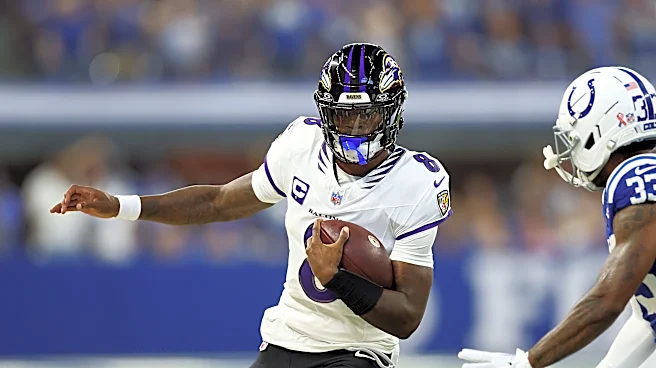
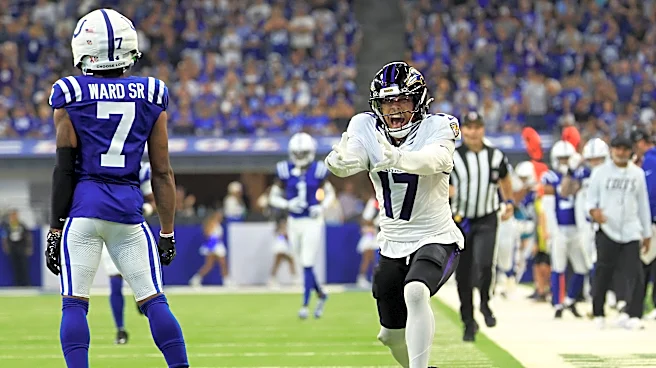
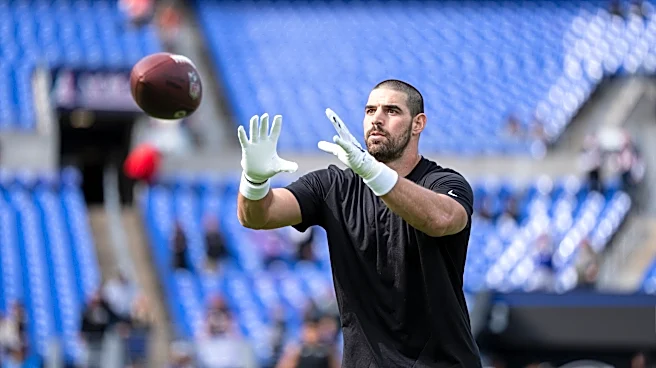
Baltimore’s season opener gave us our first real look at the starting units on both sides of the football, and several players immediately stood out in the Ravens’ 41-23 victory over Indianapolis.
Zay Flowers wasted little time reminding everyone why Baltimore committed to him with a massive contract extension this offseason, turning five receptions into 150 yards and a touchdown in only one half of football. Defensively, Tavius Robinson showed an intriguing combination of power and athleticism while
generating seven pressures, and Trey Hendrickson’s Ravens debut provided an immediate example of how much his presence can change Baltimore’s pass rush.
Here’s what stood out from that trio in Baltimore’s season-opening victory:
WR Zay Flowers
20 snaps (11 slot, 7 wide, 2 backfield) | 5 catches (6 targets) | 150 yards | 1 touchdown
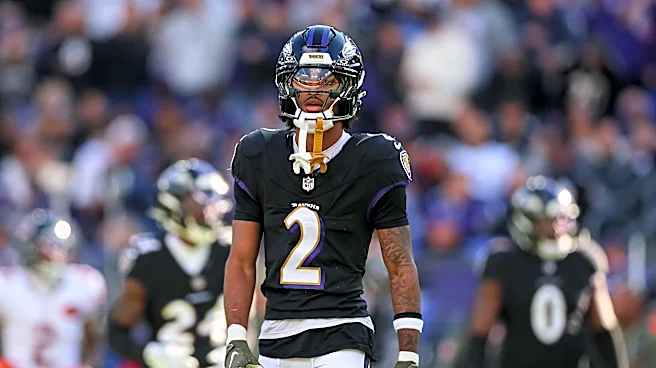
Flowers opened the season with a statement performance, producing 150 receiving yards and a touchdown despite playing only one half of football.
The efficiency of his performance was remarkable. Flowers averaged 13.64 yards per route run and Lamar Jackson posted a perfect 158.3 passer rating when targeting him. But the numbers only tell part of the story. Flowers consistently showed the traits that make him such a difficult matchup within Baltimore’s passing game.
His spatial awareness stood out against zone coverage. On one reception, Flowers recognized two defenders closing around him and intelligently settled into the open window rather than continuing his route into coverage. That ability to understand spacing and make himself available to Jackson is an important part of his development beyond simply being an explosive athlete.
Against man coverage, his release quickness continued to create problems. Flowers consistently got off the line of scrimmage in a flash and generated separation multiple times by forcing defensive backs to immediately react to his acceleration. Once he got into space, there was another gear available. Flowers’ ability to transition from receiver to runner almost instantly remains one of the most dangerous elements of his game.
That combination of route awareness, release quickness and open-field acceleration made him extremely difficult for Indianapolis to contain.
Postgame takeaway: Flowers couldn’t have provided a much better opening statement after signing his extension this offseason. The 150 yards and touchdown will grab the attention, but the underlying performance was just as encouraging. His ability to manipulate space against zone coverage, separate against man and immediately accelerate after the catch gives Baltimore multiple ways to manufacture explosive plays through him. If Week 1 was any indication, Flowers looks ready to take another step as the centerpiece of Baltimore’s passing attack.
EDGE Tavius Robinson
44 snaps | 14 run defense | 25 pass rush | 5 coverage | 7 pressures | 1 sack
Robinson entered the season primarily known for his ability to defend the run and create pressure through power, but his performance against Indianapolis showed there may be more to his game.
The biggest surprise was his athleticism in space. Robinson showed impressive pursuit ability for a player with his frame, chasing plays from the backside and covering considerably more ground than you would typically expect from a power-oriented defensive lineman. There were moments where the combination of size, length and pursuit was reminiscent of what Baltimore has gotten from Justin Madubuike when chasing plays outside the structure of the defense.
His pass rushing was still built around his power. Robinson generated seven pressures, and on three of them he effectively converted speed to power. He used the distance between himself and the offensive tackle as a momentum amplifier, building speed into contact before using his long frame to transfer that momentum through the blocker and collapse the pocket.
That ability becomes especially valuable when Robinson can force tackles to respect his athleticism around the edge.
We also saw his value within Baltimore’s pressure designs. On one rep, Robinson effectively created a pick that helped collapse the interior and opened a path for another defender. It wasn’t a pressure that necessarily shows up entirely in his individual statistics, but it demonstrated how his size and physicality can create opportunities for the rushers around him.
His sack came from another encouraging trait: patience. Robinson stayed disciplined on the backside of play action rather than immediately chasing the initial action. Once the quarterback became available, Robinson was left unblocked and finished the play.
Postgame takeaway: Robinson’s seven pressures were impressive, but the athleticism he displayed may have been the more important development. His power has always been the foundation of his game, and his ability to convert speed to power remains his most reliable path to the quarterback. Adding better pursuit ability and functional athleticism to that profile makes him a considerably more versatile defender. With Robinson approaching an important contract decision this offseason, performances like this could make his future in Baltimore increasingly interesting.
EDGE Trey Hendrickson
40 snaps | 10 run defense | 26 pass rush | 4 coverage | 8 pressures
Baltimore brought Hendrickson in to change the complexion of its pass rush, and his first regular-season performance showed exactly why.
Hendrickson generated eight pressures in his Ravens debut, but his impact extended beyond his individual production. With the four-time Pro Bowler on the field, Baltimore generated pressure on 58.6% of its opportunities. Without him, that number fell to 20%.
That is the definition of a force multiplier.
Indianapolis couldn’t consistently afford to give Hendrickson favorable one-on-one opportunities, and when those opportunities appeared, he repeatedly took advantage. His speed-to-power conversion was particularly effective.
Hendrickson threatened offensive tackles with his get-off before transitioning into power and driving them backward toward the quarterback. Rather than simply trying to run through the tackle from the beginning of the rep, Hendrickson forced blockers to account for his speed before converting that momentum into contact.
We also saw the depth of his pass-rush toolbox. Hendrickson flashed an effective dip-and-rip when attacking around the edge, giving tackles a completely different problem than his speed-to-power rush. More impressive was the consistency of his hands. His punch timing and hand fighting were exceptionally polished, allowing him to attack the tackle’s hands, prevent blockers from establishing control and transition between moves without wasting much movement.
At times, the hand usage looked almost black-belt-like. That technical refinement is what separates Hendrickson from rushers who rely primarily on athleticism. He has multiple answers depending on how the offensive tackle sets against him, and that makes it extremely difficult for blockers to anticipate where the rush is coming from. More importantly, his presence appears capable of making everyone around him better.
Postgame takeaway: Hendrickson looked exactly like the player Baltimore hoped it was acquiring. Eight pressures on 26 pass-rush snaps is impressive by itself, but the dramatic difference in Baltimore’s pressure rate with him on and off the field illustrates his broader impact. His combination of speed-to-power, edge-rushing ability and elite hand usage forces protections to account for him on every passing down. Week 1 offered an early glimpse of what Baltimore’s pass rush can become when Hendrickson is functioning as its force multiplier.