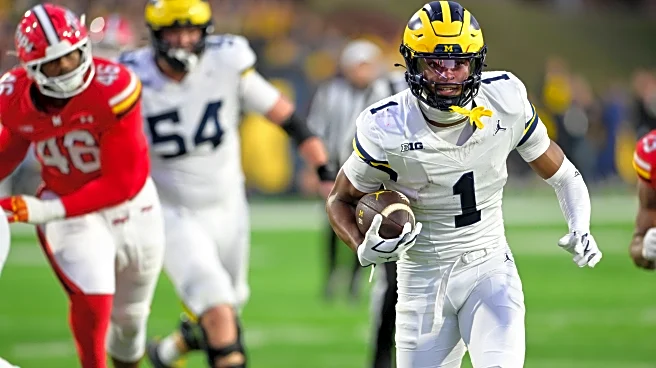


The latest wrinkle in the post-NIL era of college football was revealed Tuesday afternoon, as FBS coaches voted unanimously to adjust the redshirt rule to allow players to participate in up to nine games while preserving a full year of eligibility.
The rule of redshirting has taken many forms over the years, starting with the NCAA allowing freshmen to play varsity football beginning in the 1972 season. Then, players were given five years to play in four seasons, with exceptions made only for seasons cut
short for medical reasons. And then finally, in 2017, the rule changed to allow any player who participates in four or fewer games to maintain their redshirt year.
While the four-game rule was rarely discussed or criticized for a few years, many players started to use the redshirt rule to their advantage by opting out after playing three games to preserve a full season of eligibility.
Take Michigan wide receiver Donoven McCulley as an example. The former Indiana quarterback and wide receiver caught 48 passes for 644 yards with six touchdowns in his junior season with the Hoosiers. Despite being the top returning receiver in 2024, he elected to opt-out after four games to preserve a year of eligibility, which he used to play at Michigan in 2025.
The same thing could be said for incoming transfer quarterback Brayden Fowler-Nicolosi. The former Colorado State passer started the first three games in 2025, completing 44-of-82 passes for 488 yards, one touchdown and two interceptions. However, after Jay Norvell was fired and Fowler-Nicolosi was replaced by Jackson Brousseau, he elected to leave the program to preserve a year of eligibility.
There is no question the redshirt rule has been used by coaches as a tactic for years, but it has been running rampant in recent seasons by the players not just to gain more years, but for some, to secure another paycheck.
According to ESPN, “A number of coaches pushed for a more expansive approach — a full five years of playing time in a five-year window. However, concerns about potential litigation in the wake of some controversial eligibility rulings, chief among them Ole Miss quarterback Trinidad Chambliss — led the group to the nine-game compromise.”
Now, the proposed rule change will go to the NCAA Division I committee, which must approve any rule change to make it reality.
“The changes to the redshirt rule are intended as a way to keep more players engaged and disincentivize midyear opt-outs,” Clemson’s Dabo Swinney said during the annual convention of the American Football Coaches Association.
With pending lawsuits, and the potential for even more if the redshirt rule is modified, the NCAA is working in very muddied water. Every decision impacts thousands of players, and it will impact even more in the future.
For reference, Michigan had eight true freshmen preserve their redshirt in 2025 with the current four-game rule. If the nine-game rule were to be implemented, that number would jump up to 14 players. That trend can be expected to make waves across all of college football.
It will be fascinating to see how the NCAA handles the redshirt rule going forward, but with every FBS coach already on board, we can expect some major changes this offseason.
What do you think about the new redshirt proposal? Drop a comment below!




