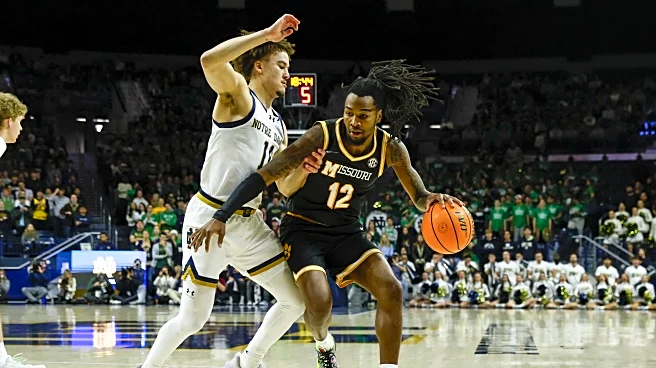

Sebastian Mack’s night was already going poorly as he waited on Jacob Crews to set a high ball screen midway through the second half against Notre Dame.
The UCLA transfer had clanked a pair of three-balls,
and stepping in front of an errant Brady Koehler pass produced a fastbreak that saw his layup attempt swatted at the other end. After that sluggish start, the junior spent the next 25 minutes as a spectator watching the Missouri build and squander a 12-point lead.
When Mack checked in at the 12:14 mark, the Tigers trailed by seven and desperately needed to stanch the bleeding. He didn’t get much of a chance to help the cause. Crews’ ghost screen didn’t produce an advantage, and Cole Certa raked the ball loose to snuff out Mack’s drive. Fourteen seconds later, coach Dennis Gates gave Mack the hook.
The six minutes Mack logged, scoring two points on 1 of 4 shooting, in MU’s 76-71 loss, encapsulate a stilted start to his time in Columbia.
On paper, Mack’s 9.6 points and 2.1 rebounds closely mirror the production he supplied last season for the Bruins. Yet through nine games, his raw efficiency is underwater. Meanwhile, the Tigers’ net rating drops by 13.7 points per 100 possessions when he’s on the floor, per EvanMiya.com. Along the way, Mack’s watched his volume of on-ball touches – pick-and-rolls, handoffs, and isolations – erode.
Those early trends are ominous for a combo guard whose downhill mentality – and knack for earning free throws – was meant to backfill for Tamar Bates’ lost production.
So, what’s behind them?
The answer might be simple – a lack of space. Understanding why starts with looking at who surrounds Mack in MU’s rotation. Below, you can see the Tigers’ top lineups featuring Mack, who logs almost 96 percent of his minutes as a combo guard.

One observation jumps out. To my eyes, lineups featuring Mark Mitchell at the four and Luke Northweather or Jevon Porter as stretch fives reap better returns. But we can also drill down and isolate those relationships. For example, here are scoring margins and net ratings for the frontcourts in those common lineups.

The Tigers’ jumbo starting five has fared well, posting a plus-27 scoring margin and 36.3 net rating. Swapping in Northweather, however, doesn’t result in a dramatic dip in efficiency. Next, sliding Mitchell down the four – his most natural position – allows MU to insert Crews as a floor spacer. But we can go a step further and look at player tandems.

There’s not much difference in shifting Mitchell around, using Porter as a hybrid forward, or adding Crews’ shooting stroke to the mix. Instead, the most significant contrast in net ratings should be obvious. When Mack’s part of lineups with Phillips, MU’s net rating is 18.8. Subbing in Northweather sees it jump to 40.2.
Now, I could spend a couple of paragraphs offering a granular explanation about why that might be. Instead, I’ll call on a couple of visual aids that should crystalize the difference in personnel.
Let’s start with the image below. Northweather and Annor Boateng are stationed in the corners while Crews fills the right slot. At the top of the key, Mitchell and Anthony Robinson II run a high pick-and-roll. Look at the middle of the floor below the foul line. It’s wide open.

Next, we’ll compare that to Mizzou’s jumbo package. Phillips hangs out in the dunker spot. Porter spaces out to the weak-side corner, while Mack occupies the strong-side wing.

Again, look at the middle of the floor below the free-throw line. It’s congested. Phillips’ positioning brings Carson Towt into the mix as a back-line anchor. Mack’s struggles shooting the ball give Braeden Shrewsberry license to sag off and help at the nail, whether it’s Robinson attacking the middle gap or feeding Mitchell as a roller.
Put simply, the Irish easily shrink the floor and dare the Tigers to can jumpers.
Going back through the film allows us to see the downstream consequences for Mack. He’s logged 15 touches in the half-court with the jumbo crew. Only four of them have resulted in rim attempts.
You’re probably tired of this request, but I’ll make it again: look at the middle of the floor. It hasn’t taken opponents long to settle on an approach: sag into gaps, roll hard doubles to Phillips posting up, and send early help when Mitchell tries to attack on an empty side of the floor. It’s also how you turn Mack from a dynamo off the bounce into an inert shooter.
So far, Mack has made just 21.1 percent of three-pointers taken off the catch against a set defense, including 2 of 10 open attempts. Next, compare those results to the return he gets when attacking the cup.

Admittedly, the returns from isolations are meager, but Mack generates 1.188 points per possession when driving the ball from a ball screen or handoff. That’s almost double what he’s yielding a spot-up option. Moreover, if you scroll all the way back up and look at lineup data, groups that make those touches easier are also performing better overall for the Tigers.
Admittedly, the returns from isolations are meager, but Mack generates 1.188 points per possession when driving the ball from a ball screen or handoff. That’s almost double what he’s yielding a spot-up option. Moreover, if you scroll all the way back up and look at lineup data, groups that make those touches easier are also performing better overall for the Tigers.
The contrast shows up in video clips, too.
In almost all these possessions, the defense vacates the middle of the floor, and it’s further helped when Northweather or Porter serves as a screener. (To be fair, too, there are a couple of snippets where Phillips is on the floor.) Moreover, the Tigers can diversify their playcalling and use more triangle-based sets — like we saw against South Dakota ($) — that use mobile big men as readers and connectors. Those big men can still apply rim pressure of their own, but as rollers or by making delayed cuts after setting off-ball screens.
There are other downstream consequences, too. Tweaking the floor’s geometry makes it easier for Mark Mitchell to isolate and attack mismatches ($), as we saw against Minnesota. Robinson, who has recently struggled to scale up his usage, would also benefit from more airspace.
Early on, Mizzou has seemingly prioritized Phillips in the mix. Some possessions use high ball screens as an excuse to flow Phillips into post-ups. Others see Mitchell loft lobs to the Arizona State transfer if his defender helps up the lane.
However, lineup data tells us that MU’s jumbo group has a minus-8 scoring margin in 8:18 of action against Minnesota and Notre Dame. While Phillips carries a modest individual net rating (+4.8), his presence also tends to act as ballast on Mizzou, which sees its net rating drop by 20.7 points per 100 possessions when he’s in the game.

So, the nagging question is whether optimizing Phillips – especially early in games – is the right long-term approach?
It certainly didn’t look like the plan when MU exited the spring. Adding Mack accentuated a central facet of MU’s identity: getting two feet in the paint and drawing fouls. Once Mack arrived, the Tigers had two of the nation’s better pick-and-roll scorers on their roster.

Somewhere along the line, though, Phillips became more than a mere replacement for Josh Gray. His usage rate is pushing 25.3 percent, and his volume of post-up touches has doubled. While his efficiency has inched up, reaching 0.905 PPP, that still lags behind what Mack and Robinson might offer attacking off the bounce.
To be clear, none of this is about pinning blame on Phillips. It’s about acknowledging the tradeoffs that come with certain lineup choices — and asking whether they deliver what Missouri needs right now.
The fix isn’t dramatic. There’s no grand schematic reboot lurking here. It’s simply a matter of being a little more intentional with lineup construction and the geometry that flows from it.
Tend to that detail, and you’re not clearing the runway for Mack. It’s giving the entire rotation a little more room to breathe — and maybe nudging Missouri a step closer to the best version of itself.