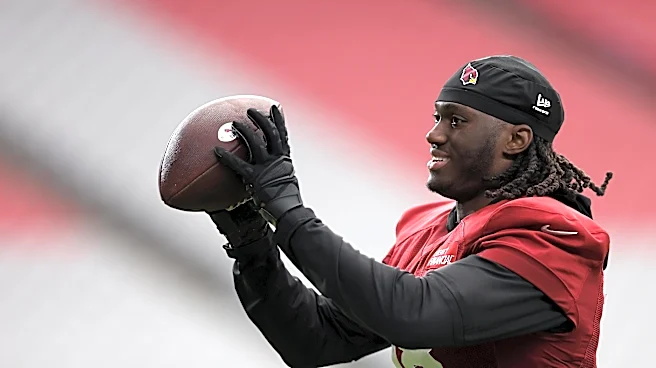





Marvin Harrison Jr. to Indianapolis sounds like fan fiction the first time you say it, mostly because of the last name on the jersey. The Colts drafting or trading for Marvin Harrison’s son would be one of those stories that feels almost too neat, the kind of full-circle reunion that writes itself before you even get to the football part.
The connection is obvious. Marvin Harrison Sr. is one of the greatest players in Colts history and one of the best receivers to ever play the position. His son wearing
that same horseshoe would be an easy story to sell.
Harrison’s start in Arizona has not gone the way many expected. His second season was described by many Cardinals analysts as “incomplete” and “unfortunate,” and the production matched that sentiment: 41 catches, 608 yards and four touchdowns, finishing behind Trey McBride and Michael Wilson in the passing game. Wilson, meanwhile, broke out for over 1,000 yards and has kept building momentum as a major piece of Arizona’s offense.
That does not mean the Cards are shopping Harrison, and it does not mean they should be in a rush to do it. He was the No. 4 pick in 2024, he had elite college production, and the traits that made him one of the safest receiver prospects in recent memory did not just disappear. Teams do not usually give up on that kind of player quickly, especially when the cheaper and more logical answer is to try to fix it first.
If the situation keeps trending in the wrong direction, though, the Colts should be paying attention.
The Cardinals may have a big decision coming
The Cardinals drafted Harrison to become their No. 1 receiver, and that door is not closed. The talent is still there. The size, body control, pedigree and route-running foundation did not vanish after two uneven seasons, which is why Arizona is far more likely to keep trying to fix the situation than admit defeat this early.
The problem is that the NFL does not usually wait around forever, especially when other players start taking the role you were supposed to own.
Wilson’s emergence is big, and McBride is already one of the best tight ends in football and a major piece of the passing game. If Wilson is becoming Arizona’s top outside presence while Harrison continues to look unsure, banged up, inconsistent or low on confidence, then at some point the Cardinals have to ask what his role actually is.
His value is not what it was on draft night, because it can’t be. A former top-five pick who has not produced like a top-five pick does not carry the same value he had before playing an NFL snap. Arizona may still view him as part of its future, but if his role keeps shrinking and the confidence does not come back, there is at least a scenario where a reset starts making sense for both sides. The Colts should be ready if that scenario ever becomes real.
The fit in Indianapolis is clear
The Colts also have a real need at receiver, which is what makes this more than a fun last-name story.
Michael Pittman Jr. is gone after being traded to Pittsburgh, leaving the receiver room in a different place. Alec Pierce is still the vertical outside threat, Josh Downs is the slot, and Tyler Warren is entering his second season as a major weapon at tight end. That is not a bad group, but it is missing a clean Pittman replacement at Z receiver, and that is exactly where Harrison could fit.
He would not have to come in and be a finished superstar on Day 1. The appeal is that he gives the Colts a young outside receiver with WR1 traits, even if he has not become that player yet. Indianapolis does not just need another body in the receiver room. It needs someone with the talent to grow into a top target, win outside, draw coverage and become part of the long-term core no matter who is playing quarterback.
That is why Harrison is so appealing as this would not be a nostalgia trade, even though the family connection would make the story louder and probably make Indianapolis more attractive if Harrison ever wanted a fresh start. The football case is strong enough on its own. The Colts need a young outside receiver with high-end talent, and Harrison may eventually need a place where his confidence, role and development can reset.
The price should not be a first-round pick
There is a reason Arizona would hesitate, and there is also a reason the Colts would need to be careful. Harrison has not proven he is a star yet, which is the entire reason this conversation exists in the first place. Trading for him would mean betting on talent, pedigree and fit more than proven NFL production, and that type of bet can absolutely go wrong. A change of scenery can unlock a player, but it can also expose that the problems were bigger than the situation.
The confidence piece is probably the most important part. If Harrison is struggling because the role has been messy, the quarterback fit has been inconsistent, or Arizona has not found the right way to feature him, then the Colts should be interested. If the issue is that the separation, physicality and reliability are not translating cleanly to the NFL, then the risk becomes much harder to ignore. That is why this should be viewed as a situation to monitor, not a move to force at any cost.
The Colts should not act desperate, and they should not pay like they are acquiring a proven top-10 receiver. Harrison should be viewed as a distressed, high-upside asset, which is exactly the kind of player worth checking on when a team has a clear need and the price may be lower than the name suggests.
Why the Colts should be aggressive if Arizona listens
The Colts have spent too many years patching holes instead of attacking them, and receiver is one of the spots where that approach has shown up. Pierce has value, Downs is a good player, and Warren could become a special weapon at tight end, but that still does not give Indianapolis the long-term outside receiver group it needs. The Colts traded Pittman, and while they have pieces, they do not have a clear replacement with the size, pedigree and upside to grow into that role.
That is what makes Harrison worth the swing. A 2027 second-round pick is not nothing, but it should not scare the Colts away from adding a young receiver with this kind of talent at a clear position of need. The best version of Harrison in Indianapolis is easy to see: he steps into the Pittman role, Pierce keeps stretching the field, Downs works inside, Warren becomes the matchup problem at tight end, and the offense suddenly has a much more balanced group of weapons. That kind of receiver room would make life easier for Daniel Jones now and for whoever leads the offense beyond him.
The family connection only adds to the appeal. There would be pressure, obviously, because playing in the same city where his father became a legend would not be simple. There could also be comfort in it, though. Indianapolis would embrace him quickly, the organization understands what the Harrison name means, and the move would give him a fresh start with a franchise that has every reason to want it to work.
Final thought
The Colts should call if Marvin Harrison Jr.’s situation in Arizona keeps slipping, even if that does not mean the Cardinals are anywhere close to trading him right now. They probably are not. A former No. 4 pick with that kind of talent is not the type of player teams move quickly, and Arizona’s first choice will almost certainly be to rebuild his confidence, settle his role and make the Wilson-Harrison-McBride trio work.
Indianapolis should still be paying attention. If Wilson continues taking over as Arizona’s top receiver, Harrison’s role keeps shrinking, or the Cardinals eventually decide a reset is better than forcing the fit, the Colts should be one of the first teams in line. A 2027 second-round pick would be a fair, aggressive offer for a young receiver whose value has dropped but whose ceiling still fits exactly what Indianapolis needs.
For now, it is unlikely, which is why it is worth monitoring before it becomes obvious.