

Special thanks to Max Oelerking of Ski U Pod for joining me on this week’s podcast to discuss Minnesota’s roster:
Minnesota’s 2025 season was full of paradoxes which Max and I talked through before the Golden Gophers’ late Fall game against the Ducks last year. The team had more talent but a much tougher schedule than in 2024. Both head coach Fleck and new DC Collins were far more aggressive, which in some key moments prevented winnable games from slipping away as had happened in the past, but backfired
spectacularly for the defense to make other games completely unwinnable. And the team enjoyed the benefits of one of the most stable, loyal, and long-tenured staffs in the conference … but at quite a few spots I think it’s fair to question if complacency had set in.
After the Oregon game – which proceeded as expected – Minnesota played just three more games in the 2025 season, against Northwestern, Wisconsin, and New Mexico (interestingly, the Lobos have largely transplanted Coach Eck’s staff and roster from the Idaho team Oregon faced in the 2024 opener) which I’d mapped out previously and those games went as my algorithmic model anticipated. With one or two small exceptions, there’s nothing notable to update on the conclusion to the Gophers’ 2025 season prior to the offseason changes that this article is concerned with, so readers looking for a refresher on Minnesota’s performance and style of play can find it in the in-season preview linked above. I’ll give some brief reminders herein as necessary but otherwise will save the time.
Offense

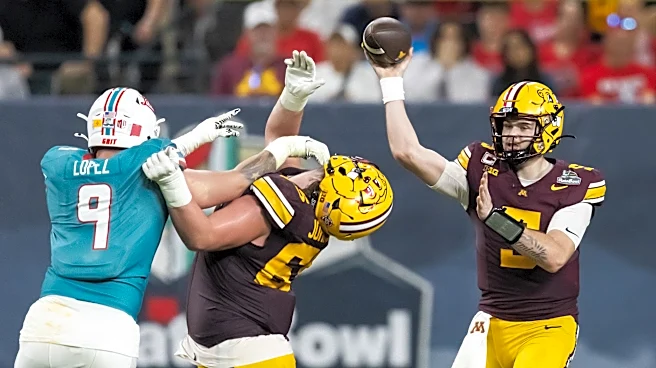
Young starter – and hopefully on the four-year plan – #5 QB Lindsey had an encouraging debut season, all things considered. He finished with a 126.9 NCAA passer rating, a little less than one standard deviation below median, though on what was a highly excessive volume of short passing playcalls, an unproductive receiver corps, and shaky protection especially on the right side of the line.
Reviewing the factors actually under Lindsey’s control, his QB error rate on my tally sheet is well on schedule for a redshirt freshman, in turnovers and interceptable balls per pass attempt he was far more advanced than expected for his age and exceeded almost all Big Ten QBs, and on film he’s got great size, clearly capable of throwing deep with accuracy and has an unproblematic throwing motion. The only real limitation – other than the offense he’s operating in – is that he doesn’t have top level escapability and isn’t a serious threat in the designed run game, though he’s not a complete statue.
Max told me the main backup will probably be former walk-on redshirt junior #6 QB Shikenjanski – he got some play last year, evidently beating out the Virginia Tech transfer of the same age, #14 QB Wittke, and was taking lead reps on the opposite team to Lindsey’s in the 2026 Spring game, though Wittke sat it out. I think Shikenjanksi can operate the short passing offense fine and might even have a mobility advantage Lindsey lacks, but his deep ball accuracy is essentially non-existent with a big throwing motion windup and hitch.
I’m curious if, in the event of a protracted absence, they might go with the Liberty transfer #12 QB Merdinger, who has some backup experience there and at UNC as a freshman and showed a bigger arm in the Spring game, or even the true freshman #15 QB Lansu who to my eyes had the most natural and effortless deep ball of any QB. As we also saw in 2024 with FCS transfer Max Brosmer at the helm who really only threw it short, the Gophers’ opponents learn to lock that down if they never stretch the field and they’d face a strategic limitation if Lindsey is out for extended play. On the podcast, we discussed whether Fleck’s staff thinks about questions like this in terms of strategic utility, and Max made the case that they’d stick with Shikenjanski because he’d earned the job with his loyalty.
In my opinion the best asset and the main concern for Minnesota’s offense are one in the same: returning starter #1 RB Taylor’s production since 2023. He had one of the most impressive debuts I’ve seen of any Big Ten back in the five years I have this league charted, but facing comparable defenses, in the same system, with the same playcaller OC Harbaugh (unrelated to the other Harbaugh football clan), and an offensive line assembled by the same OL coach Callahan, Taylor has seen stunning declines in per-carry output each year:

In my opinion, while Taylor has dealt with injuries, he hasn’t lost a step when he’s returned or been rushed back into action early, if anything he’s been underworked. He also isn’t taking a backseat to other RBs, as his per-carry numbers have outperformed, in almost all cases by wide margins, everyone else in the room each year. From watching tape it seems clear to me that the culprit is the collapse after the 2023 peak in the quality of the offensive line: starting in the 2024 offseason and continuing through the 2025 season, Callahan made a series of unforced managerial errors.
There are eight other running backs beyond Taylor. Three are prep recruits who are late enrollees, and three more are redshirt freshmen who got essentially no play beyond an FCS game last year – one comes in from Purdue, #22 RB Ja. Thomas, the other two were at Minnesota, #9 RB Ford and #21 RB Washington.
FCS transfer #23 RB TJ Thomas has been a productive two-year starter, though there’s always the question if it’ll translate at the Power conference level. The most experienced in Minnesota’s system is #2 RB Turner, though he’s constantly battled health problems, missing the last two Spring trainings and playing only the first couple weeks in 2025 before missing the rest of the season with an injury.
It’s difficult to call who’ll get the other carries because of the range of those issues. Still, with that many bites at the apple, new RB coach Ibrahim (a former standout Minnesota back himself; Max joked Ibrahim looks ready to get some carries again) will certainly find at least one playable guy.
So as I see it, the good news for Taylor and the rest of the running backs is that the room itself is in good shape – Taylor has demonstrated he’s an exceptional ballcarrier who can handle a big workload with the right blocking in front of him, and he should have adequate relief.
The bad news is that whether the run game lives up to their potential isn’t in this unit’s control – it requires Harbaugh changing the playcalling mix to be much more balanced instead of nearly two-thirds passing on 1st down, and it requires Callahan getting the o-line back to where it should have been on its 2021-23 trajectory.
Minnesota used four tight ends in 2025: Jameson Geers, Purdue transfer Drew Biber, and #19 TE Walsh in similar roles with Geers as the first TE in, Biber rotating or the second in for 12-personnel sets, and Walsh as the backup who got a bit of meaningful play, plus Frank Bierman as a hybrid H-back / fullback.
Geers and Biber had 60 meaningful targets between them (2:1 split) and these were generally the most efficient plays in the playbook with a cumulative 55% per-target success rate, but for an anemic 5.5 adjusted YPT as they were basically just catching short and falling forward to keep the chains crawling ahead. Somewhat problematically, Geers was also the highest graded blocker on the team – including the o-line – and the offense faced a Gift-of-the-Magi choice whether to have him blocking or in the pattern for passing plays.
Geers, Biber, and Bierman have graduated. Walsh returns, but during the Spring game I saw three other returners much earlier and more often who didn’t get playing time in 2025: redshirt sophomores #82 TE J. Johnson and #88 TE J. Simpson, and redshirt junior #83 TE Peters. Oklahoma transfer #87 TE Helms, a former low 4-star from the 2022 class whose been working up the backup order but missed 2023, got the primary reps in the Spring game.
It was tough to make a call on this unit; on the podcast Max called this a big offseason for the tight ends both because they’re clearly going after more and a higher caliber of recruits (they won a big battle against Alabama), and because getting the choice right out of so many inexperienced options is going to be crucial with how much of the offense goes through TE blocking and receiving. I think they got Helms for being a bit older with some experience and a higher talent rating, and Max said the staff previously given Johnson some praise so that was his guess – both were playing with the first units in the Spring game.
The biggest news of the offseason was Minnesota moving on from longtime wide receivers coach Matt Simon, who’d been with Fleck since coming over from Western Michigan in 2017. A couple of developmental bright spots aside (I thought Daniel Jackson and Elijah Spencer were highly underrated), in my opinion Simon’s tenure has been very underwhelming and particularly stubborn in not letting guys go and identifying better producers to bring in. His replacement, WR coach Fruechte, is a former Minnesota receiver and has been working up the FCS coaching ranks, most recently at North Dakota.
Most of last year’s receiving corps has cleared out, though with a couple of key returners. Top target Le’Meke Brockington signed a UDFA with the Falcons – I wrote last year I thought he was more talented than his numbers indicated but the offense had him stuck at mediocre 53% efficiency and 7.55 YPT – while UCLA transfer Logan Loya was criminally misused and graduated with pitiful production after an excellent career with the Bruins. Malachi Coleman, Cristian Driver, Kenric Lanier, and Legend Lyons – all bluechips or high 3-stars – transferred out without enough individual targets for statistical analysis, as did safety Koi Perich who was used at times as a wideout and sweep man.
The two returners from last year’s rotation are senior #11 WR Tracy, who’d come in from Miami of Ohio, and redshirt sophomore #8 WR J. Smith. Tracy was Minnesota’s catch-and-run receiver last year, and had several explosive plays that way, but his success rate and YPT still wound up well below average due to how many screens and dumpoffs were just immediately killed with no room to run, so the yardage was minimal or even a loss despite the completed pass – a 44.4% success rate for only 6.3 adjusted YPT. Smith was a classic boom-or-bust receiver with a very poor 41.5% success rate but 8.2 adjusted YPT – a big play if he caught it, but not great odds that he would (when Max and I talked in November his success rate was the same but his YPT was only 6.8, it climbed due to the same pattern obtaining, just for bigger big passes, mostly in the bowl game).
The most intriguing transfers are #13 WR Jennings from Cincinnati and #25 WR Steptoe from Tulsa. Both were playing with the first unit on Lindsey’s team in the Spring game, Jennings on the outside and Steptoe in the slot, and seemed to be preferred targets. I also thought it was interesting to see a couple of freshmen, #7 WR Martino who redshirted last year and prep recruit #84 WR H. Moore, playing ahead of former high 4-star Auburn transfer #3 WR P. Thompson.
All indications are that the staff is all-in on Jennings, but it’s murkier on the other two transfers, Steptoe and Thompson. We joked around about how jaded Max has become about big-bodied, highly talented transfer receivers who fit Thompson’s profile who transfer in or are recruited to Minnesota then wash out, but I seriously question whether that’s a Harbaugh thing and will persist or if it was a Simon thing and they’ll be free of it. I don’t blame Max for being twice-shy on this, I probably would feel the same way, but I’d like to get some data.
I think Max is probably right about Smith keeping his job, since the connection with Lindsey is already there and the only thing left for him to unlock explosive playmaking is technical refinement in route-running on a consistent basis, which can be coached – and at least, every coach thinks they can unlock that.
I’m less convinced than Max is that Tracy’s job is secure from the threat posed by Steptoe. Both are transfers, and Tracy was Simon’s transfer so I’m not sure what loyalty Fruechte owes him, and the per-target numbers from Tracy were very poor last year. Since Steptoe only has one year of eligibility remaining, and they have several other options at Tracy’s size who can back him up if necessary (Max brought one up on the podcast, longtime bench player #18 WR Hayes), there doesn’t seem any other reason to bring Steptoe in except for direct competition.
Offensive Skill Player Summary:
- QB: 1-year starter, subpar passer rating but poised for growth, not the problem
- RB: 3-year starter, great talent, held back by poor OL last two years, full backup room
- TE: All new, plenty of options but not much experience
- WR: New WR coach, big shakeup, one sure transfer, potential battles and unknowns
The 2024 and 2025 position shuffling, superfluous transfers, and midseason rotations at the offensive line left me completely baffled as none of these things were necessary, much less advisable, and what’s more I could find nothing in OL coach Callahan’s history that would suggest such a leave from his senses.
Fortunately in 2026 there doesn’t seem to be any other choice than to return to the straight and narrow – they return three (arguably four) starters at the positions they should be playing at, have taken one and only one transfer and judging from the Spring game will plug him in where he ought to go, and just need to make a choice at right guard between last year’s backup and a couple other developmental options who are all appropriately sized returners.
There’s still something of a concern that these guys are just pussycats – that is, even if they’re all in the right spots and not being messed with managerially, they simply don’t have the raw hitting power to block well – but if so the solution is the same regardless, put them in place and let them develop with time.
The clear returners are #50 LT Roy, #65 LG G. Johnson, and #78 C Beers. Roy was a former mid 4-star and got the start as a redshirt freshman last year, Max and I talked about how he was talented but pretty raw (and it would have been nice if he’d gotten some more experience with developmental time as a true freshman in 2024, but Fleck and Callahan didn’t give him that opportunity).
Johnson and Beers had both been backups in the past and effectively switched positions when they became starters last year, which was the right move – Johnson was something of a disaster snapping the ball in 2023 and 2024, and moving him to guard and having Beers take over solved that – though it didn’t really change the lack of push up the middle which had caused the running backs’ numbers to collapse.
The bigger issue was the goofball moves Callahan made on the right side of the line. The 2025 ones are recounted fully on the podcast, including a maddening game of musical chairs for two games in the middle of the season for no reason whatsoever (which Max and his wife got to witness in person, as he relayed, to his shock and her amusement). Suffice it to say he brought in two transfers he didn’t need to given plenty of developmental options, played both of them out of position – longtime left tackle Marcellus Marshall at RG and longtime guard Dylan Ray at RT – and the entirely predictable constant collapses and assignment errors on the right side doomed pocket protection and about half the run game.
Marshall and Ray have both graduated. Marshall seems to have taken off two games early, because #59 OL Nelson closed out the season at RG against Wisconsin and in the bowl game (he also finished out the previous year’s bowl game in replacement at LG due to an injury). Max told me that probably puts him ahead for the starting spot in 2026, with the main competition being redshirt junior #55 OL J. Williams.
They’ve only brought in one transfer this year, #68 OL Warren, who was a mid 4-star in the 2024 cycle and got some developmental garbage time play each week with Tennessee last year. He was at RT in the Spring game and since the only competition at tackle appears to be a couple of redshirt freshmen, #60 OL K. Lee and #51 OL Shipp, it’s likely they simply plug Warren in and are done. Max said Shipp is the likely backup; he was at RT with the other team in the Spring game.
I’m cautiously optimistic that Callahan has gotten the madness out of his system, and Max mentioned hiring assistant OL coach Limegrover, a former Minnesota and Penn State coach, as a steadying influence. They’ve taken nine preps in the last two cycles and just the one transfer for a very specific purpose, and seem like they’re done fooling around and are getting back to best practices which got them to one of the best lines in the conference in 2023. They can’t screw this up, right?
Offensive line summary:
- LT: 1-year starter, bluechip, raw but could get better
- LG: 2.5-year starter (former center/backup), not impressed but in correct spot now
- C: 1-year starter, better snapper than LG but no push last year, could be better
- RG: Probably last year’s backup, few games’ starting experience
- RT: Transfer from Tennessee, bluechip, no meaningful play but garbage time reps
- Depth: No backups have meaningful reps, returned to homegrown model, RS-freshmen/sophs
Defense

In keeping with the theme of Minnesota paradoxes, I expressed one of my own on the podcast: I think the Gophers have done A-plus roster management in setting themselves up to replace lost production and replicate the 2025 defense … but I wouldn’t want to replicate that defense.
I’ve written extensively in the above-linked previews about the last three defensive coordinators Minnesota has had: the conservative 4-3 under Joe Rossi from 2019-23, the stunts and simulated pressures in the single year with Corey Hetherman before he left for Miami, and DC Collins, Fleck’s longtime safeties coach, who took up the job last year and dialed up the aggression even farther but without the balancing factors Hetherman used to keep offenses from exploiting it for super-explosive gains.
Max and I recapped these issues on the podcast; for a longer treatment with extensive video documentation on the contrast between Hetherman and Collins the reader can see my film study on 2024-25 safety starter Koi Perich, who transferred to Oregon this cycle.
The strength of the 4-2-5 defense has been the d-line. They’ve lost the excellent developer Dennis Dottin-Carter, hired away by Rutgers (the two staffs have been swapping coaches for a while, Hetherman, coordinators Kirk Ciarrocca and Joe Harysimiak, and more). But the line has two coaches and they’ve kept the second one, DL coach Robbins, and added DE coach Stanard who’s a 30-year pro and spent the last six at Kansas State – I’m sure they’ll be fine.
There’s a big disparity in turnover between the tackle and end units within the line – the former lost everybody and the latter brings everybody back. The four DTs in last years rotation were all redshirt seniors: Deven Eastern and Jalen Logan-Redding were longtime starters, Rushawn Lawrence was an FCS transfer last season, and the big surprise was former walk-on Nate Becker. Eastern was drafted in the 7th round by the Seahawks and Logan-Redding signed a UDFA with the Rams, Lawrence and Becker have graduated.
There look like five returners in the defensive tackle unit from last year (there was one other playing in the Spring game, but Max and I think he might have been a DE pressed into it because they were temporarily shorthanded), but none have seen really any meaningful play with Minnesota because everything was going to the seniors previously.
I think the most likely returners to join the rotation in 2026 are #55 DT Hicks and #93 Sunram – they got a little garbage time run last year unlike the others, looked playable in the Spring game, and as the reshirt sophomores are in the sweet spot. The rest are #96 DT Tarawallie, too young, and #50 DT Omonode and #99 DT Randle, upperclassmen who got beat out by Lawrence and Becker last year (I also watched Omonode at Purdue previously and wasn’t impressed).
There are three transfers into the room, and I think all three will be given a shot, though with varying degrees of certainty. I’m most sure about #70 DT Crowder from Marshall, a redshirt junior playing 1-tech (though he looked big enough to play head-up nose in a 3-down front) with the ones in the Spring game. I think his Marshall teammate, #92 DT Kaba, will also play, though he came in later on in the Spring game, after Sunram did on the same team. We didn’t get to see #90 DT Chapman from FIU, who was held out – he was rated highly as a transfer but was less productive statistically, so I really wanted to get some eyes on him and am unsure how exactly this will shake out.
At any rate, five playable guys, three with experience, plus three bench guys (and a half-dozen ends who could be pressed in) for a typical four-man rotation is perfectly workable math.
The rotation at ends was typical for a four-man rota, with the caveat that the fourth spot was split between two people. They return the three fulltime rotational ends and one of the two guys who were splitting time. Furthermore, that split spot was between a covid super senior, Lucas Finnessy who was aging out, and a young guy, #98 DE Kissayi who was just coming online and missed the last four games, but I thought looked like he was playing possessed in the Spring game.
The other returners are #0 DE A. Smith, the biggest of the ends at 285 lbs and plays on the strongside, #11 DE Menz who’s at 240 lbs and plays off the weakside, and former LSU mid 4-star #1 DE Howard who switches off. They’ve also added #3 DE Bush, a three-year starter first at Liberty then at Cal (a peculiar combination, almost as odd as the fact that I’ve watched him at both schools) who I was very impressed with even as a true freshman.
Max and I have been in a bit of a debate for a while about Howard living up to potential, I made something of a side bet that he could lose his job to Kissayi by the end of 2026. At any rate, I expect a five-man rotation which perhaps narrows to four, or finds situational roles for the extra. Beyond these five there are a half-dozen redshirt freshman and sophomores and another five preps who I think are ends due to their current measurements (some will probably be tackles down the line but they aren’t big enough for it yet), so the depth is incredible.
This group should be highly productive. The question for me will be whether Collins will realize it and let them do their jobs without constant blitzing or safeties in the box, so the front can help the back end instead of having DBs make pointless and counterproductive sacrifices. The same was true in 2025 and he didn’t figure it out that time, so I’m not betting on it this time, but then again it was his first year as DC.
The unbroken braid of Minnesota linebackers continues: LB coach Sori-Marin looks set to replace graduating starter Devon Williams with main backup #49 LB Kingsbury, alongside returning starter #6 LB Baranowski. Williams was the main backup in 2024 to Baranowski and Minnesota folk hero Cody Lindenberg; in 2023 Baranowski and Williams played most of the year when Lindenberg only played four games due to injury; in 2022 Baranowski and Williams were backups to starters Lindenberg and … Sori-Marin. I assume at some point a thousand years ago their ancestors all got off Viking longships together and started form-tackling Native Americans.
I thought the most remarkable thing about the Spring game was that one of the two teams played the entire game in a 4-3 structure instead of their typical 4-2-5, and this was with Baranowski taking the game off and one of the more experienced backups, #19 LB Gerlach, held out with injury. All five of the remaining returners played extensively, and triggered identically – for better or worse – on the exact same run and pass keys. Beyond Kingsbury those were junior #46 LB Carrier and sophomores #2 LB Karmo, #53 LB Cleveland, and #44 LB Stendel. I thought it was interesting that I didn’t really see the Eastern Michigan transfer and very experienced starter #29 LB Marshall.
Stendel was playing the SAM role that didn’t really exist in 2025, since they used a box safety and blitzing from depth so much. Max told me that Karmo has a bit more speed than the rest, but that this is more likely to be used for more pass rushing – which they don’t need – rather than pass coverage, which they do.
My criticism for this unit isn’t really for this unit, as with the ends it’s a structural matter – they’re built to plug run gaps and always bite hard on play action, and as intermediate-to-deep pass coverage or against the RPO they might as well not be on the field. They’ve done a great job ensuring depth in the sense that they have a lot of copies of the same body type, but no one I can see who might play differently, and be suited to take on offenses other than the Wing-T.
Defensive Front Summary:
- DT: All new, probably 3 experienced G5 transfers and 2 homegrown redshirt sophomores
- DE: All 4 plus great transfer, should be even better, maybe DC quits unnecessary blitzes
- LB: 3-year starter and main backup, plenty of depth, identical run-pluggers, needs trait variety
On a minority of defensive reps over the last two seasons Minnesota has played zone coverage (about 9%) or man coverage with two high safeties (about 17%). The remaining three-quarters or so of plays they’ve been in cover-1: a single deep safety with the nickel and both corners in man coverage and the other safety close to the line of scrimmage lined up on a tight end or Y-receiver (although about a third of these reps that safety would blitz).
This is a very high stress posture that demands the pass rush gets home fast and the coverage holds up on islands, preferably both, because there’s effectively no over-the-top safety support – at most he can help chase down a play once it’s already gone big. There’s a reason that this kind of approach is most often fielded by teams confident in a talent pipeline of future professional DBs – not just one, but across the backfield, in any given year – while teams with other talent profiles often take a conservative, layered zone approach without such stresses.
Over the last two offseasons, the players Minnesota’s secondary has lost to attrition have been, on my tally sheet, at the top and bottom ends of the grade. At the end of 2024, they lost both starting corners, Justin Walley who was drafted in the 3rd round by the Colts and Ethan Robinson who also enjoyed football. At nickel Jack Henderson graduated who was a dynamic athlete at 6’2” essential to making Hetherman’s defense work. At safety one starter then the other got hurt during the year, so the backup Coleman Bryson started competing with then-true freshman Koi Perich for their reps; it was a decisive win for Perich so Bryson transferred to UNC (where I was forced to watch him again this offseason).
In 2025, the corners were replaced by returners Za’Quan Bryan and Jai’Onte’ McMillan plus Iowa transfer #17 CB Nestor. Bryan and McMillan are both pretty short and I didn’t think they were very good fits for a man coverage scheme that left them alone on the sidelines with tall outside receivers; Bryan has transferred out and McMillan graduated.
Darius Green, who I thought was a pretty good when I watched him at safety in 2023, was hurt at the end of that year and missed most of 2024, but came back and rotated at the nickel and one of the safety spots in 2025; he’s graduated. Perich transferred out as mentioned above.
That leaves for 2026 almost exclusively multiple-year starters in the middle of the grading curve, some longtime bench guys, and just a couple question marks due to injuries and transfers. Collins should have no trouble at all in replicating the qualities of the 2025 defense, indeed it should look even more consistently so since it appears the secondary is farther along in removing outliers. The wisdom of such an approach is another matter.
Max and I are both sure that #14 DB Brown and #7 DB Gousby have jobs somewhere in the backfield rotation, though we don’t know where exactly since they both sat out the Spring game. They’re upperclassmen who’ve been playing since 2023 but both effectively got out-talented by Green, didn’t fit the role Henderson did for Hetherman’s defense, and were surpassed by Perich’s emergence, but Green’s frequent injuries and Perich being a true freshman gave them starting roles anyway. Brown filled in at nickel at the beginning of 2025 when Green was still out; Gousby for much of 2025 only came in for the dime package.
It looked like the strongest candidates to join the safety and nickel rotation are sophomore #4 DB Harden, who got some garbage time play last year, and #20 DB Knutson, a Division-II transfer who looked up to snuff in the Spring game. Redshirt sophomore #13 DB Rainer who I hadn’t seen before was the only player at nickel in the Spring game since Brown and Gousby were out and the other team was in a 4-3, and Max said to keep an eye out for redshirt junior #9 DB Monroe who missed most of last year with an injury.
Max and I were both a bit surprised that Nestor turned out to be the strongest of the corners, at least relative to Bryan and McMillan, since he was a bit shaky at the beginning of the year and his Iowa career wasn’t anything to write home about. I think I mainly attribute it to his size at 6’1”. He looks to be a lock to continue at the job.
Barring one of the freshmen grabbing the job – redshirt freshman #21 CB Parrish or either of the high 3-star prep recruits, though I neither played much Spring game and I kind of doubt it for all three since they’re each listed at 5’10” or a generous 5’11” – it seems clear the other spot is going to sophomore transfer #5 CB A. West, a mid 3-star from Michigan State. The other three corners in the room have seen something like six transfers come in and get starting jobs in their time without them so much as seeing the field during meaningful play – I think the ship has sailed.
West (who shouldn’t be confused with his older brother #26 CB E. West, also transferring in from MSU but who didn’t get meaningful play for the Spartans and redshirted in 2024 at FCS Merrimack) was a backup who saw limited meaningful time. I don’t have enough tape on him for good statistical analysis but I didn’t think he looked bad when I did see him, and he seemed on the longer side of 5’11” rather than a short guy the roster was fibbing about. MSU also played a surprising amount of man and their CB coach, Blue Adams, has done some good work in the past so I can see why Minnesota got West, but given the defensive structure there’s a lot of faith involved.
Defensive Secondary Summary:
- DB: 2 returners, Div-II diamond in the rough, couple developmentals, middle of the curve
- NB: See above, shared pool and can’t tell who goes where yet
- CB: 1 returner, 1 transfer (limited MSU backup), exhaustive cover-1 risky without more talent