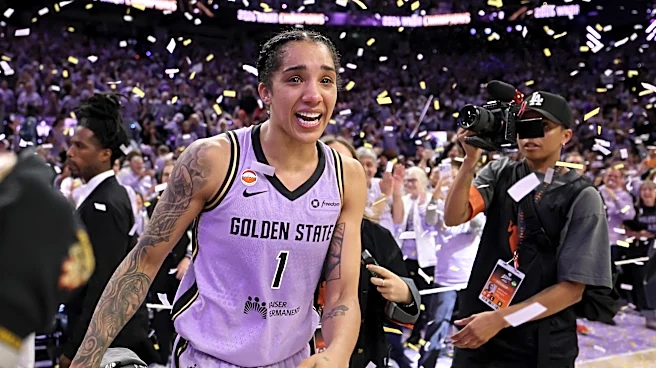


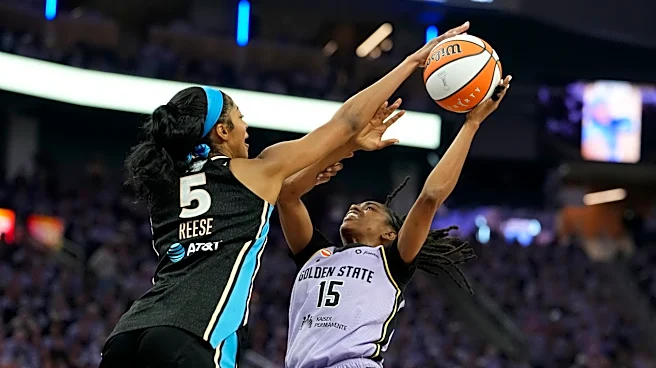
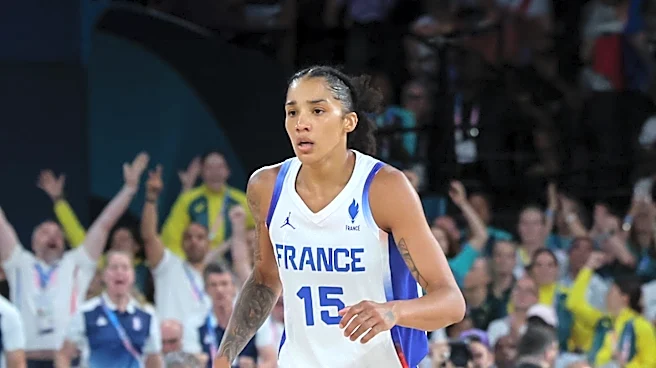
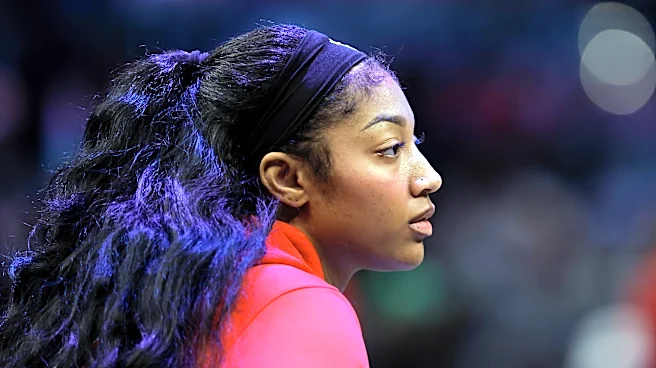

WNBA Finals MVP in hand, Gabby Williams’ name has ascended far past it’s previous heights.
She’s stood under brief spotlights as a two-time NCAA national champion at UConn and Olympic silver medal winner for France, but her reputation had always come short of her potential.
Now, at the pinacle of women’s basketball success, her career deserves a double-take. Were there ever signs that Gabby Williams could become a Finals-winning No. 1 option?
The Gabby Williams WNBA story, in brief

Williams was drafted out of UConn in the 2018 WNBA Draft,
which should make her a nine-year veteran. If only her career were that simple.
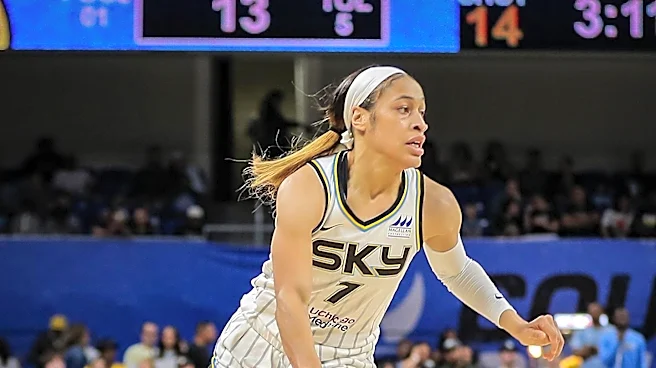
She was picked No. 4 overall by the Chicago Sky, where she would suit up for from 2018 to 2020. In 2021, her commitment to the French Olympic team caused her to miss training camp in Chicago. Williams was suspended for missing training camp, which became the the beginning of a well-documented rift between her and the Sky organization—and ultimately the end of her time in Chicago. She went on to compete for France in the Olympics, missing the entire 2021 WNBA season.
Williams found a new home with the Seattle Storm the following year, starting the entire season for the Storm and making her first WNBA All-Defense team at the end of the year. She looked to reprise that role in 2023, but suffered both a concussion and a left foot injury that sidelined her for all but 10 games.
In 2024, Williams was once again held back from the WNBA due to Olympic commitments. Her international stint saw France nearly take down Team USA in the gold medal game, and gave the world it’s first real look at first-option Gabby. At the conclusion of the Olympic break, she once again signed with Seattle, playing out the remainder of the season and the entirety of the 2025 season for the Storm.
In April of this year, she signed with the Golden State Valkyries. You know the rest.
Gabby seemed destined to be a role player

Williams has played on many different stages, donning many different jerseys, but many of her roles looked the same.
Between her four years at Uconn, three in Chicago and four in Seattle, Gabby Williams never led a team’s offense. She never finished a season as a leading scorer. In fact, she never even averaged double-digit points in a WNBA season until 2025.
Before the world knew her as a Finals MVP and 30-piece scoring phenom, Williams was known as a defensive menace and an ancillary slasher, with no real ability to shoot the ball. Famously, her 12 career 3-point attempts at UConn only netted one make, having slotted in as an undersized power forward for Geno Auriemma. Very few could have projected her as a future guard in the WNBA.
While her shooting volume steadily rose through her first couple of WNBA seasons, she only shot 24 percent from deep between 2018 and 2023. Even representing France, in which she played a dominant scoring role through two Olympic berths, she never shot above 30 percent in a group stage. She broke the 30 percent threshold for the first time in 2025 (not counting a 12-game sample size in 2024), attempting a career high four threes per game.
To be clear, Williams projection as a championship-winning No. 1 option isn’t all about shooting, but it’s a very important piece. You don’t see many sub-6-foot-0 ball-dominant players succeed without demanding attention on the 3-point line. We can also look at her usage rate, which never rose above 20 percent in the WNBA from 2018 to 2025.
Were there signs that Williams would become a star?

After the Valkyries took down Las Vegas in Game 1 of the semifinals, owner Joe Lacob told ESPN, “Print this: Gabby Williams is the best player in the world.”
Lacob wasn’t being reactionary. It was very clear throughout the entire season that the Golden State organization saw Williams as someone who could lead them to a championship, regardless of her past roles. So if not through traditional points-per-game or shooting splits, where could we have justified Williams as a Finals-winning leading scorer?
Obviously, the eye test spoke for itself in the 2024 Olympics. Williams was the best player on the court against Team USA, and international competition has fewer differences from WNBA play than some claim. That Olympic run was pivitol for Williams’ candidacy as the Valkyries future.
Although her usage rate remained relatively low throughout her WNBA career, there were a few stats that pointed to an untapped potential. After her rookie season, Williams has had a high percentage of self-created offense, or unassisted points. That percentage has fluctuated above the 40 percent mark, peaking as high as 55 percent in 2019. Having over half of your points come unassisted as a player with a sub-20 percent usage rate is rare. Essentially, Williams didn’t have the ball a lot, but when she did, she was creating her own offense.
Another stand-out metric for Williams was her rim attampts. Throughout her time in Seattle, she got to the rim at an average rate, but finished at the rim well above league average. She shot over 70 percent at the rim during her second stint with the Storm, while league average sits slightly above 60.
Finally, while Williams shooting was never consistent, she had a knack for hitting shots when it mattered. I mentioned her sub-30 percent group stage Olympic 3-point percentage, but what I didn’t reference was the fact that she shot 46 percent from 3 through both knockout stages in 2021 and 2024. Williams rose to the occasion as a shooter when it mattered.
From a statistical and eye-test perspective, there was enough there for the Valkyries to take a bet on Gabby.
She was already a talented on-ball scorer, and all that Natalie Nakase had to do was scale up her usage to lead a collective scoring effort. She was able to put pressure on the rim, get to her midrange in times of need and most notably, knock down 3s in clutch moments. Williams is an important reminder that there is so much talent in the WNBA, and oftentimes situation stands as the limiting factor for players production, not skill. WNBA teams will always be searching for underrated talent, and some will be successful in scaling to No. 1 options.
But when we look at Gabby Williams, who went from a complete non-shooter and ancillary role player at the beginning of her career to an unstoppable Game 7 force and Finals MVP, we may never see that again.