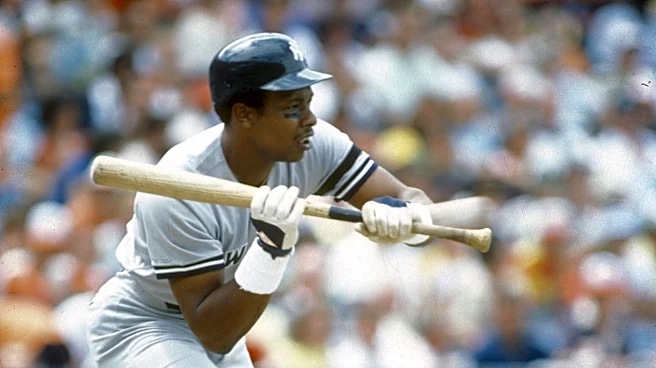


The New York Yankees have had over 1,700 players play for the organization since its first season in 1901. Oddly enough, one of the repeated names in that history is Bobby Brown. You are never the other Bobby on your birthday, so to get that out of the way early this is not about Dr. Bobby Brown, the late dynasty Yankees infielder, physician, and former American League president (or the “My Prerogative” singer, for that matter). Today belongs to Rogers Lee “Bobby” Brown, the switch-hitting outfielder
who spent parts of three seasons in the Bronx during the late 1970s and early 1980s.
“Uptown” Bobby Brown’s Yankees tenure came during a strange transitional window for the franchise. The late-1970s championship group was beginning to change, George Steinbrenner’s Yankees were still chasing big names and roster fixes, and plenty of players passed through the Bronx trying to carve out a role. Brown became one of those players, bringing speed, outfield versatility, and enough pop to earn some playing time.
Rogers Lee “Bobby” Brown
Born: May 24, 1954 (Norfolk, VA)
Yankees Tenure: 1978-1981
A native of Virginia’s Eastern Shore, Brown attended Northampton High School in Eastville, Virginia. The Baltimore Orioles selected him in the 11th round of the 1972 amateur draft, and Brown agreed to sign a contract to begin his professional career.
Brown spent several years in the minor leagues but was released by the Orioles in April of 1976. A few weeks later he signed with the Philadelphia Phillies and would be in their minor leagues until he and Jay Johnstone were sent from the Phillies to the Yankees for disappointing free-agent signing Rawly Eastwick in June 1978.
The “first stint” Brown had as a Yankee ended that December, after only a few months, when he was selected as a Rule 5 Draft pick by the New York Mets at the end of 1978. The Mets, however, eventually placed Brown on waivers and he was selected by the Toronto Blue Jays the following March. That marked Brown’s fourth team in less than a year.
Toronto kept the 25-year-old on their roster long enough for Brown to make his MLB debut. During the first month of the season Brown appeared in four games and did not record a hit in his 10 at-bats. On April 19th of the 1979 season Brown was purchased from the Blue Jays by the Yankees. Just in case you lost track this is the run of clubs starting in June of 1978, until the next May: Phillies, Yankees, Mets, Blue Jays, Yankees.
Following that crazy shuffle that must have felt like a real-life version of the hat shuffle jumbotron game, Brown would spend the next two complete seasons in the Bronx. After returning to the Yankees Brown was given the choice of the numbers 31 or 13 for the Columbus farm team. Brown allegedly stated “Things can’t get any worse, give me 13.”

Brown appeared in 30 games for the 1979 Yankees and hit .250, with skipper Billy Martin often deploying him in the outfield. However, most of the season was spent in Columbus where Brown hit .371 and stole 22 bases. His work ethic and speed was enough to impress Steinbrenner and scouting guru Gene Michael, who decided Brown belonged on the Yankees.
The 1980 season became the best year of Brown’s MLB career. Given a much larger role under new manager Dick Howser, he appeared in 137 games for the Yankees and spent most of his time in center field while also moving around both corner spots. Brown hit .260 with 14 home runs, 47 RBI, 65 runs scored, and 27 stolen bases. When lined up in center field Brown was flanked by Lou Piniella and Reggie Jackson. Brown’s ability to cover ground kept the outfield defense respectable.
That year was also the clearest example of what Brown could bring to a roster. He was not a star, but he gave the Yankees athleticism in the outfield, switch-hitting balance in the lineup, and speed on the basepaths during a season in which New York won 103 games before falling to the Royals in the ALCS sweep — a hitless series for Brown.
By the start of 1981, Steinbrenner’s game of managerial musical chairs continued, with Howser out, Michael in, and Bob Lemon eventually replacing Michael that September as well. Regardless, Brown’s role significantly shrank, as he appeared in 31 games during the strike-shortened season and hit .226 while bouncing between all three outfield spots. The Yankees returned to the World Series that year, but taking the first two games in New York, the Yanks fell to the Dodgers in six games.

The bench role in the 1981 Fall Classic represented the end of Brown’s Yankees career. The Yankees had made a trade with the Seattle Mariners to acquire lefty pitcher Shane Rawley, and Brown became a player to be named later in the deal. That year, he appeared in 79 games and stole 28 bases while continuing to add value as an athletic defensive outfielder.
The Mariners would release Brown in March of 1983, and he signed the following month with the San Diego Padres, with whom he spent the final three seasons of his MLB career.

Brown’s time in San Diego included another trip to the World Series. In 1984, he appeared in 85 games for the Padres as they won their first National League pennant in franchise history before falling to an overpowering Detroit Tigers team. That made Brown part of two World Series teams, in two different leagues, both of which fell in the Fall Classic. His career ended after an ugly showing in the 1985 season, and the 31-year-old never played pro ball again.
Across seven major league seasons, Brown appeared in 502 games and finished with 313 hits, 26 home runs, 130 RBI, and 110 stolen bases. A Hall of Fame writeup from a few years back noted that after asking for his release from the Padres, he teamed up with fellow 1981 Yankees outfielder Jerry Mumphrey to co-found company called Major League Dairies, distributing milk and dairy products nationwide.
For Yankees fans, Brown may not be one the first person people think about when they hear his name, but he had a nice run in the big leagues and earned a spot in the Eastern Shore Baseball Foundation Hall of Fame. Happy birthday, Bobby!
See more of the “Yankees Birthday of the Day” series here.