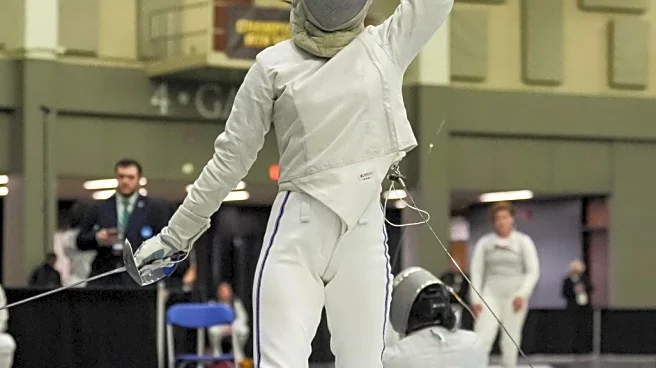

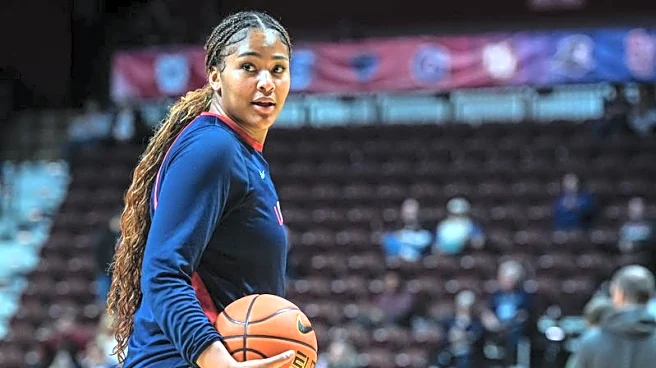


For the first time since 1989, Northwestern fencing was mathematically capable of winning a national championship.
After 36 years of Northwestern competing in a co-ed NCAA fencing championship with a women-only team, the NCAA reverted to separate gender championships this past season. That meant men’s and women’s scores were no longer combined to determine a sole title winner, a process that significantly disadvantaged the Wildcats.
At the 2026 NCAA women’s fencing championships, Northwestern placed
sixth overall with 54 points, tying fifth-place finisher Pennsylvania (which beat the Wildcats in the tiebreak of total touches scored). The top four teams, in ascending order, were Harvard (69), Princeton (71), Columbia/Barnard (99) and Notre Dame (102). NU finished better than its 10th-place finish from last season, when it scored 62 in a co-ed championships.
At NCAAs, a pool of 24 fencers in the sabre, foil and épée categories compete in a 23-bout round robin competition, with the number of bout wins counting toward a team’s score. The top four finishers in the round robin advance to a semi-final and final elimination bracket, which determines the individual champion but doesn’t count towards team scoring.
Northwestern, alongside Notre Dame and Columbia, was one of three teams that sent a maximum of six fencers, with two in each category. Its highest finisher was first-year Elaine Lu, who placed seventh in sabre and earned All-American distinctions.
Lu recorded 15 round-robin bout wins and a touch differential of +5. Her best wins came against Princeton’s Alexandra Lee and Notre Dame’s Siobhan Sullivan, as those fencers tied for third and advanced to the semi-finals. Lu is Northwestern’s highest first-year finisher since Sky Miller made her legendary second-place sabre run in 2021.
Also competing in sabre was Natalie Shearer, who placed 22nd in her second NCAAs. Last season, she finished 11th in the same category.
Northwestern’s next-highest finisher was Anna Damratoski in the épée. In her final collegiate competition, but her first NCAAs, she placed 13th overall with 11 overall wins. She also narrowly lost three bouts 5-4, in a field where sixth through 14th were separated by just four points. Damaratoski’s teammate, first-year Natasha Lee, was 19th with eight wins in her own NCAAs debut.
Damratoski and Lee’s bout against each other was one of the closer ones, with Damratoski ekking out a 5-4 win. Damratoski also lost to eventual runner-up, Princeton’s Hadley Husisian, by the same scoreline.
Northwestern saw similar results in foil, with Yukari Takamizawa leading the way with a 14th-place finish and nine wins. Her touch differential was just -9, considerably fewer than that of 13th-place finisher Ruoxi Sun (who had 11 wins with a -16 differential). Takamizawa did beat third-place finisher Zander Rhodes (Columbia) while just falling to eventual champion Jessica Guo (Harvard) 5-4. The Northwestern sophomore improved considerably from her 2025 finish of 20th overall.
The Wildcats’ other representative in foil was Brianna Ho, who finished 24th with four wins in her NCAA championship debut.
Northwestern’s NCAAs wrap up another mostly dominant season for the team, which recorded a 33-4 record with the only losses being to Harvard, Columbia and Notre Dame twice. Team competition will not resume until the fall of 2026, but select individual fencers will next compete at the April NAC in Richmond, Virginia, from April 24 to 27.