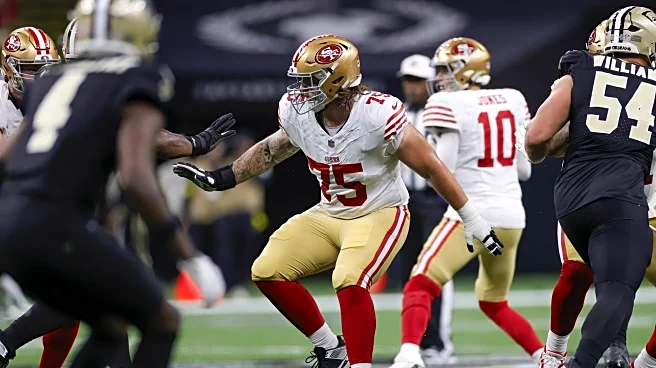


The San Francisco 49ers have plenty of moving parts on offense during 2025. Trent Williams began the season playing next to Ben Bartch, but that only lasted a game and nine snaps. From Connor Colby back to Bartch, splitting time with Spencer Burford, the Niners couldn’t find any consistency at left guard until the final month of the season.
The offensive line also needed to adjust to life without George Kittle early in the season, and that wasn’t even the biggest adjustment. After a summer of getting
used to hearing Brock Purdy’s cadence, Mac Jones started the second game of the season and the majority of the first half.
All in all, especially factoring in expectations, you could argue that the 49ers’ offensive line overachieved and was a strength in 2025. After it became routine during games for fans to shout, “Bench Jake Brendel!” or “Take Colton McKivitz out!”, those two had arguably their best seasons as pros.
That’s not to say changes are needed. Age is becoming a concern for a couple of starters. That could be addressed either during the upcoming NFL Draft or through free agency. Before we look ahead, let’s discuss some of the strengths and weaknesses of the offensive line.
Strengths
It’s tricky when you play with one quarterback who wants to get the ball out quickly, while the other quarterback has zero issues holding the ball in hopes of making a play. The 49ers’ scheme and quarterback play affect some of these numbers. Still, giving your quarterback, on average, the sixth-longest time to throw in 2025 is a sign that things are going well up front. San Francisco also finished 11th in sack percentage allowed and was 13th in time to pressure.
Individually, the 49ers had some stellar performances that are worthy of being highlighted.
Second-year pro Dominick Puni was battling an injury that kept him out for the first month and a half of the season. But from Week 7 on, Puni pitched multiple shutouts and really had one “bad” game.
Center Jake Brendel finished 19th among all offensive linemen in blown block rate as a pass protector.
The scheme helped protect everybody else thanks to the 37-year-old left tackle playing on an island. It wasn’t Trent Williams’ best year, but he was asked to do far more than anybody else, and the 49ers’ identity up front still revolves around its left tackle.
Brendel, Puni, and Colton McKivitz were all top 23 in Sports Info Solutions’ “run block points earned” stat. Only four linemen in the league had a lower blown block rate than McKivitz did. Williams finished in the top 30 in that same stat.
Weaknesses
The offensive line is all about cohesion, and if one position is off, it ruins it for the entire unit. You’ll notice everybody above was highlighted outside of left guard. It’s tough to fault Connor Colby for struggling. He was a seventh-round rookie thrown into the fire. The same is true for Spencer Burford, who had some intriguing moments late in the year but was far from consistent.
So, despite having quality run blockers up and down the line, the Niners finished middle of the pack in “stuffed percentage,” or a run results in zero or negative yardage, rushing success rate, and allowed the fourth-worst yards before contact in the NFL.
During the first couple of months of the season, you could see how the revolving door at left guard impacted the running game. Run plays to the left with Williams not knowing who to block were a sign that somebody messed up. We can probably throw the tight ends in the mix here, too.
Colby and Burford both had blown block rates of 6.3 in pass pro. Aaron Banks had his worst season in 2024, with a 3.3 blown-block rate in pass protection. The 49ers made the mistake of thinking they could replace Banks with a veteran who hadn’t stayed healthy throughout his career, and paid for it by having to play players they had no intention of playing once Bartch went down.
How does the offensive line look in 2026?
Trent Williams is under contract for one more season. An extension will give the 49ers an extra $16.8 million in 2026, making the move a no-brainer, despite him being 38 come 2026.
Brendel’s contract is also up after next year, so the center position becomes a priority in this draft. Brendel will turn 34, and his backup, Matt Hennessy, is an unrestricted free agent.
Puni’s rookie deal runs through 2027, while McKivitz is under contract through the 2028 season.
Bartch and Burford are unrestricted free agents, meaning left guard is near the top of the list of needs.
- LT Trent Williams
- LG Rookie?
- C Jake Brendel
- RG Dominick Puni
- RT Colton McKivitz
Banks was the highest pick the team used on an offensive lineman since Mike McGlinchey. Puni was a third-rounder. That might be the ceiling when it comes to adding an offensive lineman.
The 49ers should go back to the Iowa well. Beau Stephens would be an upgrade at left guard and could even potentially slide over to center if need be. At his size, Stephens should be available on Day 3.
If the 49ers want to convert a tackle to guard on Day 3 as they did with Puni, Duke’s Brian Parker fits the bill. He’s been Duke’s right tackle for the previous two seasons. He started at left tackle a handful of times. That experience, as well as being a first-team all-conference player, should attract the 49ers. Parker’s competitiveness stands out, as does his first couple of steps out of his stance. Parker played guard and center at the Shrine Bowl, so the transition has already begun.
The biggest issue with Burford and Colby was their inaccurate strike timing. That’s a strength for Parker, who is disciplined and strong enough to anchor against a bull rush.
The 49ers should use multiple Day 3 picks on the offensive line with the hopes of finding a starter, but at worst, upgrading their depth.