




It’s not often that an undrafted rookie plays meaningful minutes early in their first WNBA season. It’s almost unheard of that that same player becomes their team’s go-to scorer two months into their career.
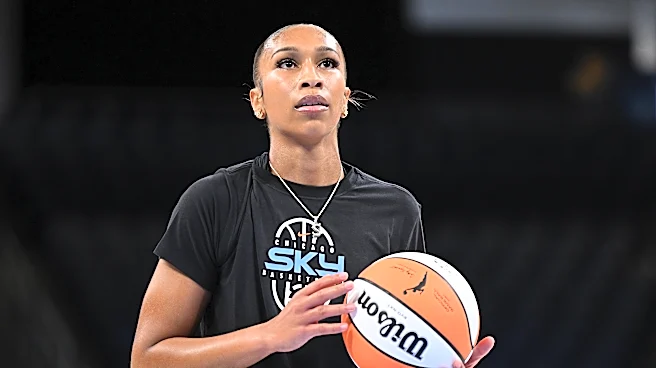
As fate would have it, that’s exactly what’s happened for the Chicago Sky’s Sydney Taylor.
Signed by the Sky as a free agent prior to the 2026 WNBA season, Taylor has gone from a training camp invitee to one of Chicago’s most important players in the blink of an eye. A dynamic athlete with a deep
bag of offensive skills, she’s managed to stand out in a rookie class full of big names, ranking second among all rookies in points per game (14.7) and 3-pointers made (59).
It’s early August, but an All-Rookie honor for Taylor seems inevitable.
So how exactly has an undrafted free agent become such an important piece so quickly?
As is the case for most young players, it’s been a combination of an outstanding talent finding just the right opportunity. The Sky may not have had an ideal season, but the adversity they’ve battled has allowed room for Taylor to thrive, and it bodes well both for her future and the team’s.
Taylor proved she’s too good not to start
First, some context: The 2026 Sky weren’t supposed to look like this.
General manager Jeff Pagliocca seemed determined to build a strong offensive team in the offseason, acquiring seven-time All-Star Skylar Diggins and talented scoring forwards Rickea Jackson and Azurá Stevens. On paper, the Sky looked to have a far superior roster than the one that went 10-34 last season, and certainly wouldn’t be overly reliant on any one player to do the heavy lifting.
Bluntly, things didn’t work out as planned.
Jackson suffered a season-ending ACL injury in the team’s fourth game, while Stevens missed the Sky’s first five games with an injury of her own. DiJonai Carrington, who was also signed as a free agent to shore up the Sky’s perimeter defense, was also unavailable until late July. These absences nearly gutted Chicago’s depth early on, elevating some players into roles they may not have been expected to play otherwise.

Taylor was pressed into action as a result of the Sky’s injury woes, and she immediately showed why she made Chicago’s final roster out of training camp.
Her first true outburst—a 27-point outing against Toronto—showcased her effortless ability to score the basketball, with deep range on her 3-point shot and explosion off the dribble that not many defenders could contain. And though Taylor’s minutes fluctuated for the next handful of games, it was obvious that the Sky had to find her consistent playing time.
Things clicked just a couple weeks later.
After Taylor scored 30 points against Indiana, Sky head coach Tyler Marsh promoted her to the team’s starting lineup, and she’s been firmly entrenched there since then. As a starter, Taylor is averaging 18.1 points per game, regularly eclipsing the 20-point mark.
But, that only scratches the surface of the impact she’s made.
Taylor is now indispensable for the Sky
It isn’t just Taylor’s skillset that’s made her so invaluable: It’s her mentality.
Yes, Taylor has all the skills a WNBA guard needs to be a go-to scorer. As a driver, she’s both quick and crafty. She excels at running the floor for easy layups in transition. She needs little space to get her jumpshot off, and the threat of her canning pull-up jumpers off the dribble makes her a tough cover for just about any perimeter defender.
It’s the willingness to take those shots, though, that’s been perhaps her most important strength.
The league’s top scorers need short memories, and that certainly applies to Taylor: That confidence allowed her to take (and make) the biggest shot of her young career against the Las Vegas Aces, even after previously missing a similar game-winning attempt against the New York Liberty.
Those big moments are the ones that stand out the most, but Taylor’s alpha-dog mentality has served her well beyond the highlight-reel plays.
With Diggins becoming the latest Sky star to hit the injury report—she hasn’t played since early July due to a knee ailment—the team needed someone to climb the offensive hierarchy and take on the primary scoring burden that she and Jackson were supposed to carry.
That’s something Taylor is built for.
Remarkably, the bigger her role has gotten, the better she’s played. In 10 games without Diggins, Taylor is leading the Sky in scoring (19.3 points per game) and usage rate (29.5 percent) while posting a true shooting percentage of 59.7 percent, which is second only to Natasha Cloud during that span. To say the Sky can’t afford to take Taylor off the floor would be an understatement; in those same 10 games, the Sky are scoring 116.3 points per 100 possessions with Taylor on the court versus just 93.7 points per 100 possessions with her off, with her net differential an eye-popping 25.6—the best on the team by a hilariously wide margin.
To put it simply: Taylor hasn’t just been the Sky’s most exciting player. She’s also been arguably their most important.
What’s next for Taylor and the Sky?
Unfortunately, despite Taylor’s best efforts, Chicago is still just 11-19 and six games behind the No. 8-seed Washington Mystics for a playoff spot. Barring a miracle, it’s looking like the Sky will miss the postseason for a third-consecutive year.
That takes nothing away from Taylor’s performance, of course.
The Sky won’t have favorable position in the 2027 WNBA Draft, thanks to a trade that gave the Mystics first-round draft pick swap rights, but Taylor has clearly established herself as a building block who should still be under team control; according to Her Hoop Stats, she’ll be a reserved free agent at the end of the season, giving Chicago exclusive negotiating rights for her next contract.
What will next year’s Sky look like?
That’s anyone’s guess, but it’s overwhelmingly likely that Taylor will still be around. Her meteoric rise as an undrafted rookie is only the beginning of what promises to be a long and prosperous professional journey, and Chicago would be wise to keep her around for as long as possible.