

There is no denying that the No. 2 Indiana Hoosiers are an impressive offensive team. They have the No. 2 scoring offense in the country (44.3 points per game), the No. 5 total offense (483.8 yards per game), and the No. 9 rushing offense (229.75 ypg).
Quarterback Fernando Mendoza is a legit Heisman Trophy contender, and an impressive performance against the Buckeyes could secure him the award. And with receivers Omar Cooper Jr. and Elijah Sarratt on the outside, the Hoosiers’ passing game is dynamic
and can do damage if given the opportunity.
However, Indiana’s offense is a run-first unit. IU has run the ball on 60% of their plays — 475 rushes vs. 321 passes. That is because the Hoosiers have two of the most consistently reliable running backs in the league. Both Roman Hemby (72.17 ypg) and Kaelon Black (60.83 ypg) are in the top 13 rushers in the Big Ten, and thanks to them and their offensive line, the team has put up some obscene rushing totals this season.
Against Purdue last week, IU put up 355 rushing yards on 37 carries (9.6 yards per carry), in early November, they rushed for 367 yards on 52 carries (7.1 ypc), and against Illinois in September, they went for 312 on 49 carries (6.4 ypc). Those are fantastic performances and worthy of note, but against the better defenses on their schedule, it hasn’t been as impressive.
Against the Wisconsin Badgers — the No. 18 rush defense in the country — Indiana wracked up 83 yards on 37 carries (2.2 ypc). Versus Iowa, the No. 24 defense against the run nationally, IU went for 104 yards on 39 carries (2.7 ypc). Against the No. 20 rush defense in Oregon, the Hoosiers went for 111 yards on 37 carries (3.0 ypc). And then, throw in the 108 yards on 31 rushes (3.5 ypc) against the No. 72 in Penn State, you have to question if the Indiana running game has gotten fat on the worst teams on their schedule.
Conversely, the Buckeyes rank as the No. 5 best rushing defense in the country, allowing only 81.67 yards on the ground per game, for 2.77 yards per carry.
In the season opener, the Buckeye defense did allow 166 rushing yards against Texas via 4.5 ypc, and hasn’t given up more than 100 since then — admittedly, Michigan had exactly 100 yards last week, so I am getting by on a technicality on that one.
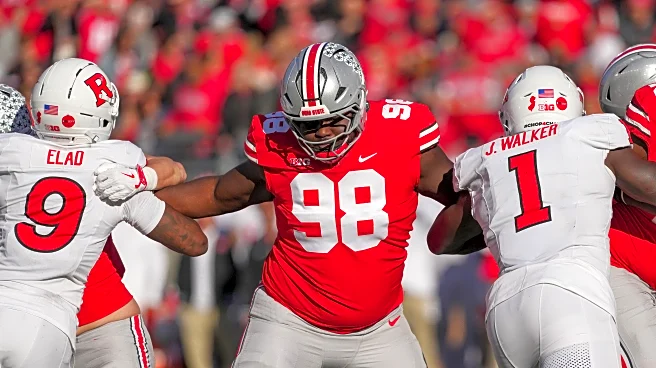
The Indiana rushing attack is fairly well-balanced, working nearly equally inside and out. Of their 431 running back attempts on the season, 230 (53%) have come between the tackles for 1,318 of their 2,603 running back yards. With Big Ten Defensive Lineman of the Year Kayden McDonald up the middle, I find it difficult to imagine the Hoosiers being able to consistently run the ball up the middle, especially with the linebackers in support.
However, Indiana has picked up the most yards running around the left end. IU has rushed for 617 yards around the left side, meaning that Sonny Styles, Arvelle Reese, and Caleb Downs will likely be called upon to shut down the Hemby and Black duo trying to stretch the field.
So yes, Indiana can run the ball — until they can’t. And history says that the Hoosiers struggle when the athletes in front of them can match their physicality snap after snap; and now they have to go up against an Ohio State defense that had 11 players named to the Big Ten All-Conference team, including six across the defensive line and at linebacker. If the Hoosiers are unable to rush the ball consistently, that means that the Buckeyes’ secondary — which leads the best passing defense in the country — will have more leverage in defending Mendoza through the air.
The Buckeyes are allowing only 121.3 passing yards per game, which is an impressive number, but what makes it even more eye-popping is that the No. 2 team in FBS, Nebraska, is over 20 yards per game behind at 141.1. So there is a bigger gap between Ohio State and the second-place Huskers than there is between Nebraska and No. 9 Fresno State. If Cignetti and Mendoza want to have the ability to move the ball through the air, they will have to force the Buckeye defense to respect the run. If they don’t, Caleb Downs, Davison Igbinosin, Lorenzo Styles Jr., and company will likely be able to clamp down on the IU receivers.
Most importantly for the Indiana Hoosiers, if they want to prove to the college football world — and Ohio State specifically — that they’re a legitimate threat to hoist that shiny gold trophy in Miami in six weeks, they’ll have to show that those gaudy rushing totals against the Big Ten’s bottom feeders weren’t just fool’s gold.