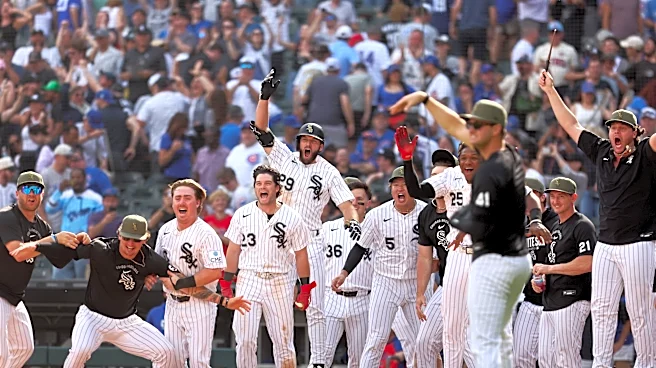




When James Russell Lowell wrote the opening line, “What is so rare as a day in June?” it was well before big league baseball existed — he and Abner Doubleday were both born in 1819. If Lowell were to pen “The Vision of Sir Launfal” today, the first line would probably stretch to “What is so rare as a day in June when the White Sox have a winning record?”
And yet, here we are, thanks to an 18-10 May produced by lots of long balls, timely late-inning hits, better than expected pitching, improved defense
(much of it thanks to dumping Lenyn Sosa and nailing Andrew Benintendi to the dugout bench when the other team is up), and, we should admit, a really easy schedule. That rarest of June days may not survive the upcoming Phillies-Braves-Dodgers-Yankees-Tigers (a much-needed breather)-Guardians gauntlet without Munetaka Murakami. Still, it’s nice while it’s here.
But how did we get here? That is, how did the players get here, and how did the organization get here, if only for a pleasant visit? After all, this is an outfit long notorious for completely incompetent player development, especially on the position player side, which now has the incompetent head of player development heading the whole shebang.
Makes no sense. Or does it? Does player development even enter into it? Let’s examine case-by-case, starting with perhaps the most important one.
What you see is what you Getz

There’s no question that Chris Getz was an abysmal director of player development. Seven years’ worth of abysmal, in fact. On the position player side, which is what we’ll deal with here, pretty much nothing came out of the farm system that wasn’t better going in.
Getz’s only discernible talent was keeping his lips firmly affixed to Jerry Reinsdorf’s keister. This talent got him promoted to general manager, because, uh, well, that’s all Reinsdorf really cares about (except avoiding taxes, but that’s another story).
As GM, Getz has had successes (the Garrett Crochet trade) and failures (putzing around on getting something for Luis Robert Jr.) but maybe, just maybe, that skill at affixing his lips finally paid off for the team and not just his own career. Reinsdorf does seem inclined to let Getz drag the White Sox kicking and screaming into the 21st century, even if it’s only to keep said lips firmly attached.
Unlike many incompetents (we won’t go into politics here; this is baseball), Getz seems smart enough to know he’s not, and thus to employ people with actual skills. Not only has he brought in some knowledgeable advisors, but the Sox are finally catching on that computers have been invented.
Until very recently, every analysis of analysis had the Sox at the very bottom in R&D staff, far below any other team, buried by the likes of Tampa Bay. At one point, they had two staffers — one of them the ancient manager’s godson — while the top teams employed dozens. A check of the front office list now (guessing by titles) shows 15 — well below average, but far better than before and headed in the right direction. Getz even got Reinsdorf to join the rest of MLB and fork over for a Trajekt machine.
So, quite possibly the best player development was the development of the player in the GM chair. As for those on the field, they came from many directions — even a little bit from player development.
Catchers
None of the catchers who have donned the Sox uniform this year came through their system. Edgar Quero came from the Angels in the 2023 trade deadline swap that sent Lucas Giolito and Reynaldo López west, and he only played 114 games in the Sox minors. Kyle Teel, part of the Crochet haul from Boston, only had 50 games in Charlotte. Drew Romo, Teel’s replacement during his IL stint, was already in the majors when picked up on waivers.
It’s certainly arguable that Quero and Teel needed a lot more development defensively, but the Sox were desperate to have somebody squatting behind the plate, so up they came.
Infield
Murakami obviously already came fully developed and has lived up to his billing. He’s even at least a little better defensively than expected. Smart move to make the free agent offer, though.
Chase Meidroth spent all of nine games in Charlotte after coming in the Crochet trade, so no White Sox development there. He is better this year than last, both at the plate and in the field, but that would seem to be the result of gaining experience, not a developmental breakthrough.
Colson Montgomery — ah, here’s a true player development success. The top 2021 draft pick was moving right up the ladder until he got to Triple-A, where he suffered a complete collapse. Montgomery looked to be a month or two away from either spending a decade riding between game sites on buses or becoming a high school coach when director of hitting Ryan Fuller (one of the good Getz hires) hauled him off to Arizona for some one-on-one quality time. Voila!! Colson came out of it a new man. Or at least a new hitter. He still has ups and downs, but the ups are sweet, and his fielding is much better than expected.
Miguel Vargas is a case of good player development, only at the major league level. He had already been with the Dodgers when he was picked up in the three-way Michael Kopech trade in 2024, but he hit poorly out west and stayed that way in Chicago. Then the Sox got him to change his hand position, and he became pretty decent for the rest of 2025. THEN — he bulked up in the offseason, as a director of nutrition is among the new Sox R&D folks, and is a downright homer machine this year, with a 2.4 bWAR already, tops on the team.
Jacob Gonzalez was a first round pick in 2023 who struggled early but has improved recently. It might be a player development success story, but it’s too soon to tell, since, as of this writing, he has only had seven MLB at-bats.
Luisangel Acuña was already in the bigs with the Mets when picked up for Robert, so no development points. And so far, no “nice trade” points, either. Maybe Getz is a horse-racing fan, appreciating bloodlines too much and hoped some magic would rub off of Acuña’s five-time All-Star older brother.
Outfielders/DH
Benintendi was famously a free agent bust the Sox are stuck with for two more years. He’s had a few key hits this season, but sports a big contract and negative bWAR. As for defense? Yikes! No development points there.
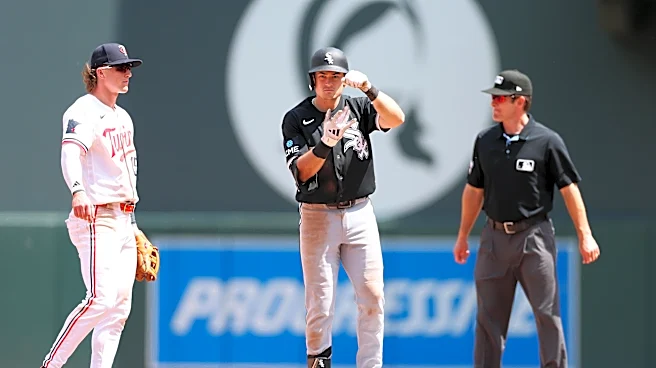
Sam Antonacci is doing a terrific job for a fifth round draft choice, but he was surprisingly good from the get-go and hasn’t looked back. He doesn’t seem like a player who needs any help developing, unless he happens to hit a slump.
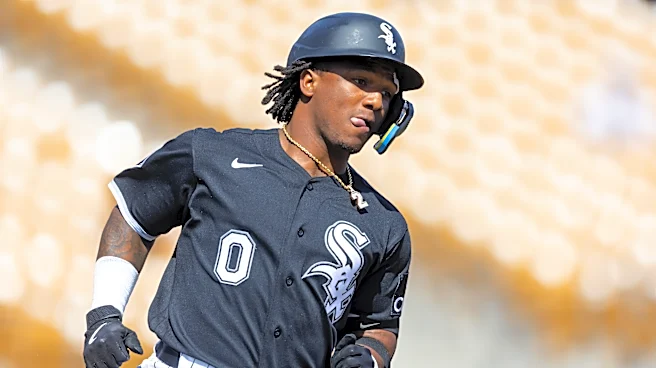
Rikuu Nishida came from even further down, an 11th round choice in 2023. He’s hit at every level, is as fast as can be, and has shown off his arm in right field, but it’s hard to say whether he’s a product of good player development or is just a good player.
As for the mix-and-match rest — Randal Grichuk, Derek Hill, Tristan Peters, Everson Pereira, Austin Hays — they were all coming from other major league teams (though we should point out Pereira did end up playing one game in Charlotte), so their development was the work of other teams. Not that the Sox couldn’t have reinforced that some, but they didn’t do the heavy lifting.
So?
The White Sox have one definite minor league development success (Montgomery) and one definite major league one (Vargas) with the rest the product of trades, claims, and free-agent signings. In other words, the usual MLB mishmash.
There are some strong candidates in the minor league system now, though, so maybe before long more of the White Sox position players really will be the result of player development success. After all, they’ve discovered the existence of computers, and Getz isn’t in position to ruin the development any longer.