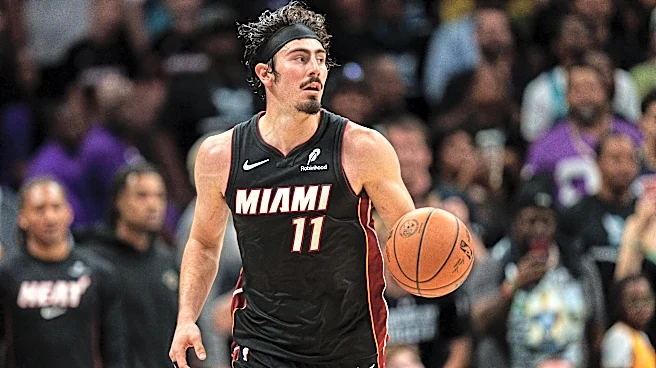






Jaime Jaquez Jr. isn’t your typical NBA player. Not in today’s league. He’s not a volume three-point shooter. He’s not a highlight-reel athlete. He’s not a lockdown defender. He’s not even a starter—at least, not yet. But he is a baller, in the purest sense of the word. And for that, the Bucks should count their lucky stars.
The path to now
Drafted 18th overall in the 2023 NBA Draft, Jaquez had a strong rookie campaign, playing 75 games (20 starts) for the 46-36 Miami Heat, averaging 11.9 PPG, 3.8 RPG, 2.6 APG, and
1.0 SPG in 28.2 MPG. He finished fourth in Rookie of the Year voting behind Victor Wembanyama, Chet Holmgren, and Brandon Miller, and even garnered some consideration for Sixth Man of the Year (6MOY), finishing ninth. He carried that play over to the playoffs too, putting up 12.8 PPG, 3.3 RPG, 3.0 APG in 30.8 MPG, but did so as a starter before going down with a hip flexor injury in Game 4.
Following his outstanding rookie year, Jaquez suffered an apparent sophomore slump, largely due to a reduction in minutes. Though he averaged 22.2 MPG through February, that number dropped to just 16.5 MPG across March and April as the Heat turned to mid-season acquisition Andrew Wiggins in the frontcourt. And in the playoffs, he became ghost—just 19 minutes total across three games.
Yet, per 36 minutes, Jaquez’s sophomore campaign essentially mirrored his rookie one, and many of his advanced stats—free throw rate, offensive and defensive rebounding percentage, assist percentage, steal percentage, block percentage—actually increased (per Basketball-Reference). His net plus/minus, however, nosedived, going from +3.0 as a rookie to -9.0 as a sophomore and suddenly his game posed more questions than it did answers. Namely, is this guy for real?
Last season, Jaquez answered that with a resounding “Yes!”, finishing second in 6MOY voting behind San Antonio’s Keldon Johnson—first in this writer’s opinion—on the back of 15.4 PPG, 5.0 RPG, and 4.7 APG on 51% shooting. No longer a bit starter, Jaquez embraced his role as leader of the bench brigade, increasing his usage to a career-high 22.3% and returning his net plus/minus to the positives (+1.6). But it wasn’t just role stability that enabled Jaquez to thrive.
Across his first two seasons, Jaquez played the majority of his game time at small forward (an estimated 51% and 56% of his minutes, respectively, per Basketball-Reference), while also spending considerable time at shooting guard (37% and 32%). For a player with limited long range prowess—he’s a career 32% three-point shooter on just 2.3 attempts per game—this was always going to be problematic. Last year, then, Heat coach Erick Spoelstra made the wise move to play him primarily at power forward, with 50% of his minutes coming at the four, 38% at the three, and just 12% at the two.
And this, Bucks fans, is who we’re getting—a ball-handling four.
Now what?
For a team that is overloaded at guard—even more so now with Gary Trent Jr.’s new deal—stocked on the wing, and set a centre, Jaquez is exactly what the doctor ordered, especially without Giannis. Despite playing just 36 games last season, Giannis (once again) led the Bucks with 176 shooting fouls drawn, 77 more than second-place Kyle Kuzma (per Basketball-Reference). For further reference, Myles Turner drew 83, Kevin Porter Jr. drew 74, and Ryan Rollins drew 61. No other player registered 40. Jaquez, meanwhile, drew 107—and he converted the resulting free throws at a 77% success rate, right on his career mark.
Outside of his penchant for drawing fouls, Jaquez’s offensive value lies in his midrange-and-below marksmanship and ability to create for others. Regarding the former, Jaquez lives in the paint, with 79% of his shots coming below the free throw line: 37% at the rim and 42% in the short mid, per Cleaning the Glass (CTG). He hits them too, converting 68% of his rim attempts (63rd percentile for forwards) and 46% of his short middies (79th percentile). But it’s more than just the numbers. Jaquez’s paintwork is the stuff of artists—and he will give it to you however you want it: reverse pivots, jump hooks, spins, pump fakes into up-and-unders, jump stops into floaters. Angles and craft and off-beat movement. Old-school basketball. And while you’d love to see him take and make more three-pointers, it’s not all doom and gloom there either—as long as you get him in the corners, where he’s a 45% marksman (82nd percentile).
As a playmaker, Jaquez leverages his downhill attacking to create open looks for shooters. But he also uses his off-beat savvy to free players flashing in the paint, and he’s more than adept at hitting cutters too. In all, Jaquez recorded a 24% assist percentage last season and a 1.02 assist to usage ratio, placing him on the 88th and 92nd percentiles, respectively (per CTG). For a Bucks team that struggled with shot creation last season, this is a blessing. Gone are the days of one-dimensional shooters, Milwaukee now has a legitimate group of at least six playmakers: Rollins, Porter, Jaquez, Tyler Herro, Kasparas Jakučionis, and Brayden Burries. At a stretch, you could even throw in Ousmane Dieng, who was forced into a primary initiator role late last season. So, while the Bucks may lack a star player, they can offset that at least somewhat by keeping the defence guessing—it ain’t so easy to load up defensively when you don’t know where the action is coming from.
Defensively, Jaquez isn’t going to stand out. He’s not long or explosively athletic, so he’s not going to rack up a heap of steals or blocks, and at 6’6” he’s at a height disadvantage when playing at the four, so he’s not going to haul in rebounds either. But he is a stout 225 lbs, making him effective in the post, and his positional knowhow and spatial awareness enable him to guard multiple positions at least satisfactorily—so that “not standing out” descriptor is true in this way too; he’s certainly not someone opposing defences will hunt.
Looking ahead, Jaquez could fill a range of roles for Milwaukee. Should head coach Taylor Jenkins want size up front, Jaquez could easily slot into his customary sixth man role and continue to punish second units. On the other hand, should Jenkins want to lean into his historical tendencies and play with pace, Jaquez could step into an expanded role as the team’s starting power forward, go full “Juan Wick”, and explode for a career-year. Of course, with the Bucks roster currently sitting at 17 and trimming needed prior to opening night, there are any number of trade potentialities that could reshape the equation. Fortunately for the Bucks, Jaquez’s versatility and old-school game should translate regardless.
Starter or sixth man, how do you see Jaquez fitting in Milwaukee? Chop it up in the comments.