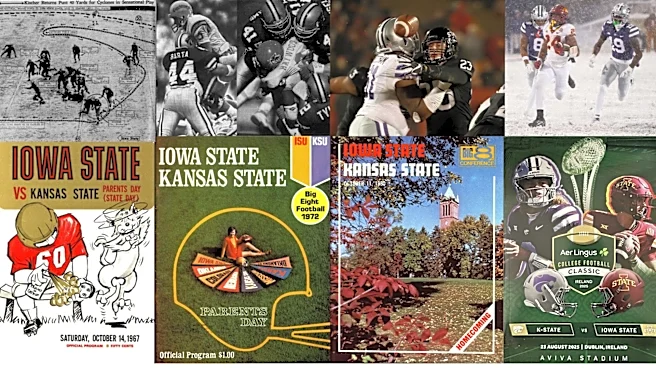

Saturday will be the 110th and final consecutive Farmageddon before 2027 becomes the first autumn in 111 years without the Cyclones and Wildcats on the same field. A schedule matrix has done what the 1918 Spanish Flu, the global mobilization of WWII and the 2020 pandemic could never have done.

To understand what this series is about is to remember those who actually built this series out of raw heartland muscle.
Ed Bock of Fort Dodge played guard at Iowa State in 1936 and had a mouth full of missing
front teeth (lost on the field to Nebraska). When the university refused to buy him false teeth, Bock fashioned himself a set out of paraffin wax.
Right in the middle of a class against Kansas State a Wildcat fullback ran him over.
As the play was over Bock looked the ref dead in the eye and spat three wax tooth impressions onto the grass. The ref was convinced the Wildcat back had delivered a blow that would have knocked a tooth out of your mouth and awarded Kansas State 15 yards for unnecessary roughness.
Spencer native Dick Mann took the field for Iowa State and threw for 173 yards and 2 touchdowns in a 32-6 hammering of the Wildcats in 1951.
Eight years after Mann’s masterclass, Knoxville native Dwight Nichols had another classic chapter in 1959 Homecoming.

He ran for a touchdown, threw for two more and set the Iowa State single game total offense record as the Cyclones outgained K-State 466 to 202 in a 26-0 shutout.
The five hour drive between the schools divided by the Missouri River, is a two-way street for football talent.
Take Darren Sproles as the prime example. Born in Waterloo – he grew up in Olathe, Kansas. In 2002, he had 103 yards and 2 touchdowns in a 58-7 Wildcat win to become the fastest player in K-State history to reach 1000 yards in a season.

If Sproles was the Iowa-born weapon who played for the Wildcats then Breece Hall was the Kansas product who donned the Cyclone cardinal. The Wichita native went 2-1 against KSU.
As a freshman in 2019 he scored a one yard touchdown right before the half on a cold night in Manhattan. In 2020 he led a 45-0 Iowa State shutout in Ames, opening up the game with a 33 yard touchdown run and then another 21 yard touchdown run three minutes later.
In 2021, Hall delivered his masterwork in Manhattan.
On the very first play from scrimmage he broke through a seam, left a diving defender in his dust at the 10, and then went 75 yards for a touchdown.
Kansas State have countered over the years by recruiting other Iowans as well. Council Bluffs native and St. Albert graduate Jake Waters came to Ames in September 2014. They were down 28-13 late in the 2nd quarter and Waters took over, churning out 138 yards on the ground and 239 through the air. He finished the game off with an eight yard go-ahead touchdown run with 90 seconds remaining to give them the win 32-28.
Two years later in 2016, Mediapolis native Jesse Ertz came back home to both Iowa and Jack Trice Stadium, throwing for 151 yards and rushing nine times for a career high 106 yards, no turnovers in a 31-26 Wildcat win.
No game in the history of Farmageddon quite matches the sheer wildness of Iowa State’s 2004 comeback – except for the 2018 contest, but that’s nine paragraphs from here.
To set the scene, Cyclones hadn’t beaten K-State since 1993, hadn’t won in Manhattan since 1988 and head coach Dan McCarney was 0-for-his-career against Bill Snyder having been outscored 166-24 in their three previous visits.
Trailing 23-9 in the fourth quarter, Atlantic native Bret Meyer engineered an 80 yard drive in six plays to set up a 3 yard touchdown pass to Mount Pleasant native Todd Miller with 3:24 remaining.

On the next Wildcat possession the ISU defense took the ball away. One play later Stevie Hicks had a 20 yard touchdown run.
On the very next snap from scrimmage, LaMarcus Hicks picked off a Wildcat pass and returned it 40 yards for a touchdown. 28 unanswered points in the final quarter and ISU walked out of Manhattan with a 37-23 win.
The rivalry record is split almost exactly down the middle between joy and heartbreak.
In the 2015 matchup, the Cyclones were in full flow in Manhattan at halftime, taking a 35-14 lead. KSU came back with a furious 24 point second half. Warren fumbled with 90 seconds to go in the fourth quarter and Lanning fumbled two plays later.
Wichita’s own Jack Cantele kicked the game winner with three seconds left for a 38-35 heartbreaker.
The 2017 battle in Manhattan was littered with controversial calls for those cheering on the Cyclones. A flag on a late hit on Kempt and what looked like a clear pass interference call (below) on Allen Lazard both got picked up.


K-State’s Skylar Thompson scrambled and found Isaiah Zuber in the back of the end zone as the clock hit zero to take a 20-19 victory and extend Kansas State’s win streak in the series to 10.
The 10 game skid finally ended in 2018. With the score at 38-28 in the 4th quarter, Willie Harvey forced a Wildcat fumble which Mike Rose recovered and returned 21 yards for a touchdown with 8:34 remaining in the game.

Brock Purdy had 337 yards through the air and David Montgomery (who tallied 149 yards on the ground) scored the game-winning 18-yard touchdown with 4:34 to go for the 42-38 victory.
Who could forget the poetic rage of “Snowmageddon” in 2023 in Manhattan? Weather conditions turned the field into a winter wonderland perhaps more at home with snowmobiles than football, Southeast Polk alumnus Abu Sama III put on one of the greatest rushing performances in school history, including the school record for most rushing yards in a Farmageddon.

He ripped through the Wildcat defense for 276 yards and three long touchdowns of 71, 77 and 60 yards.
Rocco Becht threw for 230 yards and three touchdowns, including an 82 yarder to Jaylin Noel with 8 minutes left to run the game out 42–35 in the snow.
Out here in the field where the north wind is howling over the harvested land and when the snow is blanketing Ames and Manhattan, the soil remembers.
Farmageddon isn’t dead.
It’s just waiting for the next rain.