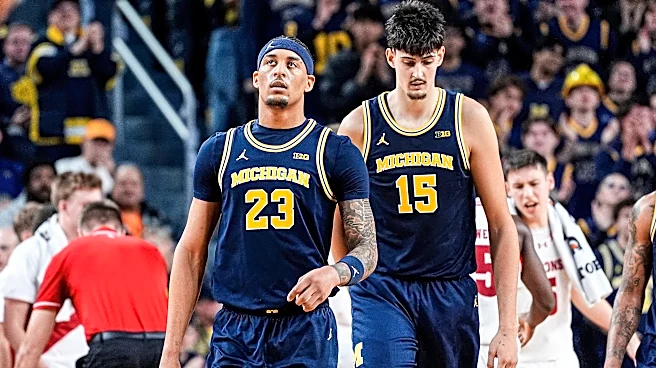






The Michigan Wolverines picked up a transfer portal commitment a few weeks ago from LSU 6-foot-10 forward Jalen Reed, who will provide post scoring, rebounding and versatility in Ann Arbor.
Reed has shown the potential to be an NBA draft pick throughout his collegiate career, but his long injury history either will make him a swing and a miss or a massive steal for Dusty May and his staff.
Reed has been extremely efficient when healthy for the Tigers, averaging 10.4 points and 6.1 rebounds per game
in the 14 games he played the last two seasons. He shot 59 percent from the field over the last two seasons, including 37.9 percent from three on limited volume, and he has a 50 percent shooting percentage across his four-year career. The athleticism and skill are undeniably there, but the question is whether he can stay healthy enough to show it at Michigan.
“Despite the challenges of the past two years, Jalen brings experience, toughness and a physical presence to our front court,” May recently said. “He’s shown he can play at a high level, and having someone with that experience is important for our program.”
To understand what Michigan is getting (and hoping to get back), it helps to trace Reed’s arc at LSU.
As a freshman in 2022-23, Reed played in 33 games with 11 starts, averaging 3.7 points and 3.2 rebounds per game. His sophomore year saw a significant leap, as he played all 32 games and averaged 7.9 points and 4.1 rebounds and shot 51.6 percent from the field.
Then came his junior season and the first injury. Reed was averaging a career-best 11.1 points and 6.5 rebounds before tearing his ACL against Florida State in Dec. 2024. He returned for his redshirt junior season and was off to a strong start (9.5 points and 5.7 rebounds per game) before suffering a torn left Achilles five games into the season. With a recovery of 9-11 months to return from that injury, the road back for Reed is long and the uncertainty is real.
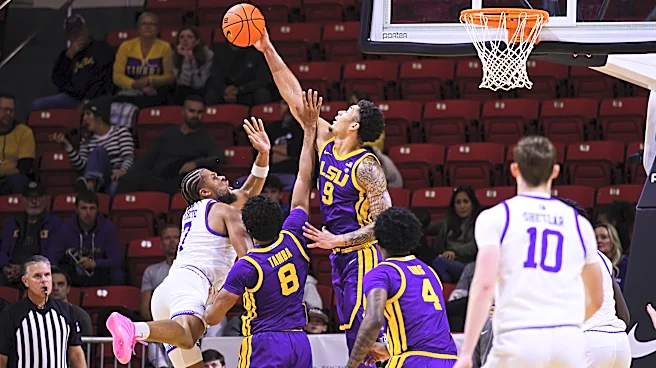
On film, Reed is a versatile and switchable defender. At 6-foot-10 with a strong frame, he has the length and athleticism to guard multiple positions, and he has experience playing on 3-through-5 players when healthy. He is physical without being reckless, comfortable using his body on the block and in the paint to contest without fouling. He also does not shy away from contact near the rim.
His rim protection is solid at the college level, and his length makes him a disruptive presence in the paint even when he does not register a block. Reed moves laterally well enough to switch onto guards in pick-and-roll coverage, which makes him an adaptable piece in May’s defensive schemes.
Offensively, Reed is a multi-tool player with a game that translates well alongside Michigan’s guard-heavy system.
Reed is dangerous in transition, with the athleticism and decision-making to create his own shot on the move.
Down in the paint, Reed is a natural finisher. He feasts in tight spaces, using his body aggressively and converting through contact. He finishes well around the rim with both hands and has the touch and footwork to operate in the mid-post. He is not afraid to draw fouls and put pressure on the defense that way.
And while his three-point shooting is a low-volume sample, Reed’s 37.9 percent career mark can give Michigan another pick-and-pop option alongside J.P. Estrella in May’s heavy ball-screen offense. Reed’s shooting touch gives opponents one more thing to account for when he is on the floor, and it opens driving lanes for Elliot Cadeau and Trey McKenney.
Reed has all of the tools to be a productive player right away for Michigan, but playing in 14 total games the past two seasons is definitely concerning. May did not give an update on Reed’s timeline when he met with the media last week, but Reed is currently not in a position to start a game tomorrow if the Wolverines were to have one.
However, what makes this a calculated bet rather than a blind one is the context. Michigan lost its entire starting front court to the draft process. The Wolverines needed front court depth, and Reed — when healthy — is an established starting big in the SEC with a multitude of legitimate skillsets. The coaching staff is not counting on him to start or carry a heavy minutes load. He can play the 4 or the 5, and if he contributes 18-22 healthy minutes per game, Michigan is a better team for it.
The risk is real. But so is the reward.