
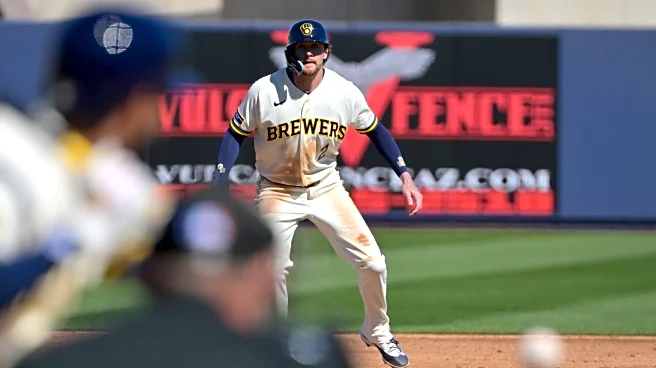
The long offseason is officially over, as regular season baseball begins later today when the Brewers battle the White Sox in Milwaukee. If you’ve been tuned out during the winter, we’re here to get you up to speed on the Brewers’ offseason moves, the roster, the farm system, and the coaching staff. But first, let’s start with a look at what’s happened in and around American Family Field and the Brewers’ broadcasting situation.
American Family Field
The Brewers made a few big changes to the stadium this offseason, including
a “complete reimagining” of the Glove Playground on the field level in right field. The playground’s new activities include “Race to First,” a “Skee-Ball-style Sausage Race,” and “Rob a Home Run.” They’ve also refreshed some of the returning attractions, including “Bring the Heat,” “Strike Zone,” and “Batter Up!”
Another major change, which isn’t expected to be completed until June, is the UW Credit Union Plaza. The plaza, located beyond the outfield walls near the pedestrian bridge over State 175/Brewers Boulevard, will include a six-hole mini golf course, the Joie Play Yard (a cow-themed play space), a beer garden, and a performance stage, which will host pregame activities, theme-night celebrations, and live music. Food trucks and other vendors will also be present for select games. A second phase to the project is expected to be completed next year, featuring fixed concessions and additional attractions. The plaza is free to visit, including on gamedays.
Other changes in the stadium include the new automated ball-strike (ABS) challenge system on the field (learn more here) and an expansion to MLB’s Go-Ahead Entry. Introduced at American Family Field last year, Go-Ahead Entry (which uses facial authentication to recognize your tickets) will be available at the Home Plate West, Home Plate East, Third Base, and UW Credit Union Plaza gates in 2026. Learn more here.
I did a full rundown on the new food options earlier in March, but the highlights include a new Fair Foods stand featuring Wisconsin State Fair favorites, an expansion to the 3rd Street Market Hall Annex in right field, an expansion to The Alley Food Truck Park in left field, and new concession items across the stadium. Learn more here.
Lastly, the Brewers are offering another loaded lineup of promotions, giveaways, and theme nights. For more information on giveaways, click here. For more information on theme nights, click here.
Getting to (and from) American Family Field
Let’s talk about the traffic around the stadium. Unless you haven’t driven since the end of the postseason, you probably already know about the major construction on I-94 around the stadium. I-94 eastbound between 70th Street and General Mitchell Boulevard, which currently features a bottleneck from four lanes to two lanes, will return to three lanes to begin the season, though the long-term lane closure will return by late summer. The I-94 eastbound exit ramp and westbound entrance ramp to General Mitchell Boulevard will also reopen.
The bad news is that an I-94 westbound lane between the Stadium Interchange and 70th Street will remain closed long-term, meaning there are only two lanes in this section as you exit the stadium. Another lane closure between 35th Street and 25th Street is scheduled to last through late 2026. To help ease gameday traffic commutes, the Wisconsin DOT launched an interactive website, linked here. Fans can also find the site at brewers.com/traffic, through QR codes at the stadium, and via the MLB Ballpark app.
Brewers TV & MLB TV
After being in limbo for much of the offseason (again), the Brewers announced a new partnership Major League Baseball to produce and distribute games for the 2026 season. While there are still a few unknowns — namely, the lack of cable channels in Wisconsin — you can now purchase a subscription for Brewers TV and/or MLB TV here. The Brewers TV package is $99.99 for the season or $19.99 per month, while an MLB TV & Brewers TV package is $199.99 for the season or $39.99 per month. The Brewers will also air 10 regular season games on over-the-air stations across Wisconsin, along with at least two Apple TV appearances.
More information about cable stations is expected to be announced on or around Opening Day, per the Brewers. We’ll communicate that information as soon as we have it, so stay tuned!
Offseason Moves
The Brewers’ offseason once again featured a major arm being traded away. This time, it was Freddy Peralta, who was sent to the New York Mets along with Tobias Myers. Other key losses include Shelby Miller (signed with Cubs), Jordan Montgomery (signed with Rangers), Connor Thomas (signed with Braves), Jose Quintana (signed with Rockies), Rhys Hoskins (signed with Guardians), Danny Jansen (signed with Rangers), Caleb Durbin (traded to Red Sox), Andruw Monasterio (traded to Red Sox), Anthony Seigler (traded to Red Sox), Nick Mears (traded to Royals), and Isaac Collins (traded to Royals).
In the additions department, the Brewers added Sammy Peralta (waivers from Angels), Ángel Zerpa (trade with Royals), Jett Williams (trade with Mets), Brandon Sproat (trade with Mets), Kyle Harrison (trade with Red Sox), Shane Drohan (trade with Mets), Jake Woodford (trade with Rays), Akil Baddoo (signed), Gary Sánchez (signed), and Luis Rengifo (signed).
The Crew additionally signed Reese McGuire to a minor league deal, though he was released and signed with the White Sox.
Roster
The Brewers officially announced their Opening Day roster on Wednesday. Here’s what it looks like:
Catchers (2): William Contreras & Gary Sánchez
Infielders (6): Jake Bauers, David Hamilton, Joey Ortiz, Luis Rengifo, Brice Turang, & Andrew Vaughn
Outfielders (5): Jackson Chourio, Sal Frelick, Brandon Lockridge, Garrett Mitchell, & Christian Yelich
Starting Pitchers (5): Kyle Harrison, Jacob Misiorowski, Chad Patrick, Brandon Sproat, and Brandon Woodruff
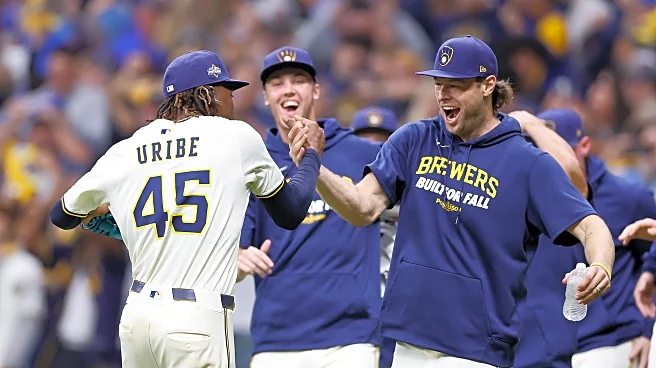
Relief Pitchers (8): Grant Anderson, Aaron Ashby, DL Hall, Jared Koenig, Trevor Megill, Abner Uribe, Jake Woodford, and Ángel Zerpa
Injured List (5): Akil Baddoo, Steward Berroa, Quinn Priester, Craig Yoho, Rob Zastryzny
Farm System
Widely viewed as one of the best (and deepest) systems in baseball, the Brewers’ farm could send several top prospects to the majors at some point this season.
Milwaukee’s top prospect is Dominican infielder Jesús Made, generally regarded as a top-five prospect league-wide. Made’s rapid ascension has so far mirrored the rise of Brewers outfielder Jackson Chourio, who made his major league debut just after his 20th birthday. Made won’t turn 19 until May, but he’s already in Double-A and just hit .310 in major league spring training. Expect to see him in a Brewers uniform sometime next season.
Aside from Made, the Brewers have a few other infield prospects who scouts think will become impactful players in the big leagues. A couple of those prospects have a shot at contributing this season, including the newly acquired Jett Williams (No. 3). Williams, a versatile defender with impressive pop for his size (5’7”), will start the season in Triple-A but should have a chance to prove himself in Milwaukee this season — whether at third base or elsewhere.
Andrew Fischer (No. 6) was the Brewers’ first round pick in 2025, which normally means he wouldn’t have a shot at making his big league debut this year. However, Fischer was always considered a more developed hitter than the average college draftee and has impressed in both pro ball and in his time with Team Italy during the World Baseball Classic. With third base still something of a question mark, it’s not out of the question that he could debut before the year is out.
Other Brewers infield prospects who you probably won’t see in a Brewers uniform this season include Luis Peña and Cooper Pratt. Peña (No. 2) is a toolsy, high ceiling prospect who still needs some more development but has a superstar ceiling. Pratt (No. 4) could probably play shortstop for Milwaukee on Opening Day, but his exit velocities and numbers at the plate aren’t MLB-level yet.
The other strength of the Brewers’ farm system right now is its pitching depth. Brandon Sproat (No. 5) will be in the rotation to open the season. Logan Henderson (No. 7), Robert Gasser (No. 17), and Shane Drohan (No. 25) will start the season in the minors, but each should get some time with the Brewers this year. Henderson and Gasser have already accrued big-league service time and will be ready when called upon. Drohan, acquired in the trade that sent Caleb Durbin to the Red Sox, hasn’t made his major league debut yet but put up a 2.27 ERA last season in 12 appearances (11 starts) with Boston’s Triple-A affiliate. You might also see Coleman Crow (No. 27), Craig Yoho (No. 29), Carlos Rodriguez, and Tate Kuehner in the big leagues, too.
Another prospect who will almost certainly make his debut with the Brewers in 2026 is catcher Jeferson Quero. Formerly a top 50 prospect in all of baseball, Quero tore his labrum after just one at-bat in 2024. His arm, his calling card as a prospect, hasn’t looked the same since. Labrum injuries are complicated and often take a long time to heal; however, there’s a chance his arm will never be what it was. Quero is set to open the year in Triple-A, but after Milwaukee cut Reese McGuire earlier this week, he’s firmly established as the organization’s No. 3 catcher behind William Contreras and Gary Sánchez. If either player lands on the injured list (or if Sánchez struggles), Quero would most likely be the next man up.
Coaching Staff
The majority of Milwaukee’s coaching staff is once again returning in 2026, with Pat Murphy still at the helm after winning his second consecutive NL Manager of the Year Award. In terms of new coaches, four join the team this year: Spencer Allen (first base coach), Guillermo Martinez (hitting coach), Juan Sandoval (assistant pitching coach), and Daniel Vogelbach (hitting coach). Four other coaches have changed roles: Jim Henderson (previously assistant pitching coach, now pitching coordinator), Jason Lane (previously third base coach, now offense and strategy coordinator), Eric Thiesen (previously hitting coach, now lead hitting coach), and Matt Erickson (previously infield coach, now third base coach (though he’ll also continue to lead infield instruction)).
Returning staff from 2025 include field coordinator Néstor Corredor (fourth season), pitching coach Chris Hook (eighth season), and bullpen coach Charlie Greene (third season). Al LeBoeuf, formerly lead hitting coach, and Julio Borbón, formerly first base coach, will transition to expanded roles in the organization and assist in efforts across baseball operations with a focus on player development and scouting. Daniel de Mondesert will transition from assistant coach to game preparation specialist. Rickie Weeks, who served as the Brewers associate manager each of the last two seasons, will transition to special assistant – baseball operations and domestic/international scouting.
Lastly, Christian Correa will return for his third season as a bullpen catcher, while Ty Duvall will join him for his first season in that role.
Season Outlook
Depending on who you ask, you could get a very different outlook on the 2026 season in Milwaukee. They made a few key trades, bolstering their young roster with more prospects while losing a key veteran in Freddy Peralta. Around them, the rest of the NL Central had mixed results this offseason, as the Cardinals completely tore it down while the Reds, Pirates, and Cubs all made efforts to improve. The Cubs lost Kyle Tucker but added Alex Bregman, while the Pirates added a few key offensive pieces as they look to provide some backing for their pitching staff headed by Paul Skenes. The Reds mostly held pat, but they did bring back old friend Eugenio Suárez.
Coming off a 97-win season after most picked the Cubs to win the division (again), I’d say the Brewers are just fine with being doubted. We’ll see what the season turns into, but another playoff appearance very well could be in the cards.