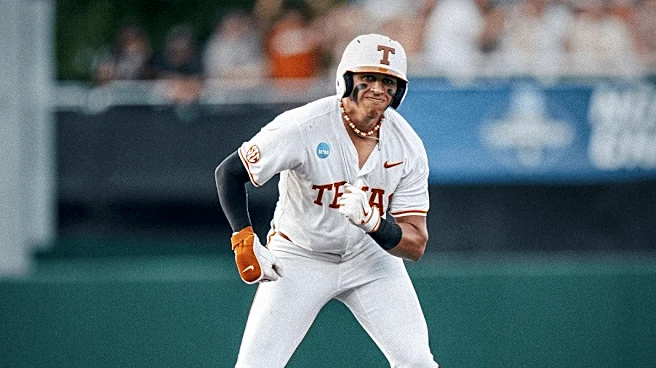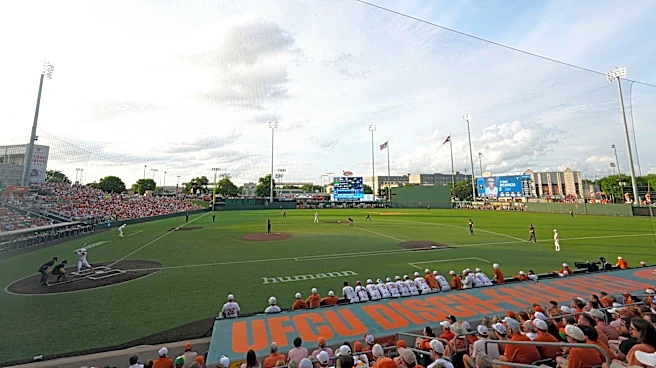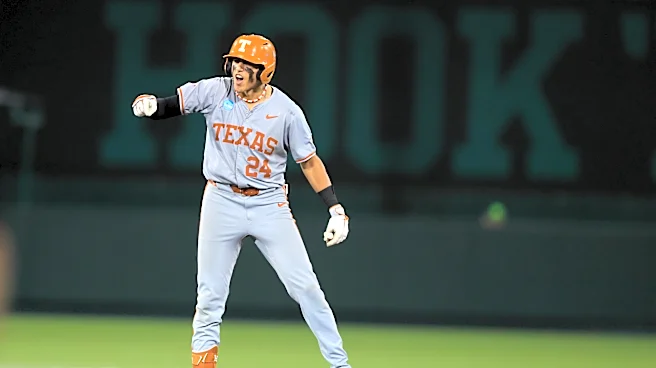

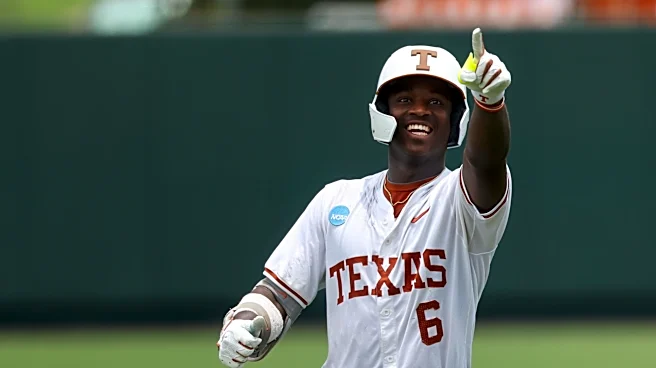
On Saturday night, as the No. 6 Texas Longhorns took on the No. 11 Oregon Ducks in the Austin Super Regional, SEC writer and podcaster Chris Marler had some thoughts on the intensity of sophomore shortstop Adrian Rodriguez in the batter’s box.
Rodriguez doesn’t hide that competitive intensity in the box, shaking his head
at the pitcher on balls before kicking rubber pullets out towards the mound.
“Whatever this shit is when taking a ball, is lame as hell,” Marler wrote.
And Rodriguez did strike out on the next pitch, but what Marler may not have noticed is that the fiery Texas shortstop had already given the Longhorns a 2-0 lead in the first on a two-run double.
What Marler couldn’t have known was that Rodriguez would go on to finish with five RBI after knocking out a run-scoring single in the fifth and executing with runners on third in the sixth and eighth innings with back-to-back sacrifice flies.
What Marler couldn’t have known was that Rodriguez would go on to cement his place in Texas super regional lore with a go-ahead, two-out, bases-loaded double in the eighth inning on Sunday to send the Longhorns through to the College World Series with a 6-5 win over Oregon.
That Rodriguez ultimately went 2-for-5 on Sunday to bat 4-for-8 (.500) with two doubles and seven RBI in the Austin Super Regional after a sensational Austin Regional that saw the Flower Mound product go 7-for-11 (.636) with three doubles, two RBI, and five runs scored.
Over those five games, Rodriguez has bolstered his average from .277 to .306 by going 11-for-19 (.579) with five doubles, six runs scored, and nine RBI.
What Marler probably doesn’t know is anything about Rodriguez — what he’s been through since he was hit by pitch against Missouri 14 months ago, the pain he’s felt ever since on his swings, and how much he’s had to grow through that adversity. How hard he’s worked with Troy Tulowitzki to prove himself defensively at shortstop.
What Marler doesn’t have is any of the perspective to understand why Texas head coach Jim Schlossnagle is so proud of Rodriguez and why the standout sophomore has earned praise instead of criticism.
Understanding where Rodriguez is right now requires understanding the hamate fracture in his left hand from March of last year that caused him to miss seven games and forced him to bat left-handed while playing through pain, an injury that sapped Rodriguez of the power that allowed him to hit five home runs before the injury.
Rodriguez ultimately had surgery to insert a staple into that hand last fall, but the pain continued into this season, caused by an allergic reaction to the metal in the staple that forced him to undergo another procedure at the beginning of April to remove the staple that left Schlossnagle hoping Rodriguez could recover enough to be impactful late.
“Ideally, before the season ends, before May, it’d be awesome to have him,” Schlossnagle said at the time. “But we may not get that this year. That may have to be next year. I just know he’s capable of helping our team. He’s the energy of our team.”
That’s high praise from Schlossnagle given all the big personalities on this team.
It’s an energy apparent in the batter’s box, and in his shoulder shaking after a big hit, a recent innovation that grew out of a song that team listens to on the road, and celebrating with his teammates even if it wasn’t his big hit.
While the energy has remained consistent from Rodriguez, his approach has changed, from going back to hitting exclusively from the left side because those swings don’t hurt as much to simplifying his swing mechanically to help keep his head still to recognizing that his power still hasn’t returned with his hand remaining at less than 100 percent as Rodriguez has learned how to settle for shooting the ball into gaps or down the lines, like the inside-out swing that won Sunday’s game over Oregon.
A rare combination of natural hitting ability and relentless work ethic caught Schlossnagle’s attention a long time ago, and the trust was mutual enough for Rodriguez to commit to Texas A&M before following Schlossnagle to Austin and flipping to Texas two years ago. But the hand injury caused that work ethic to work against Rodriguez, forcing some pragmatic changes to his formerly intense routines.
“I think it’s definitely made me more mature on how I’m going about things in the facility, how many swings I’m taking before the game — I’ve limited that down quite a bit because of the situation I’m in right now,” Rodriguez said on Saturday.
In turn, that’s helped Rodriguez gain a more healthy perspective on what effective preparation looks like.
“I think for Adrian, this would be something that really helps his career long term. He’s learning that he’s a special, special player that doesn’t have to take 1,000 swings to be ready to go. He can wake up and hit,” Schlossnagle said.
“He will get fully healthy one day. He likes baseball, so I don’t ever want to coach that out of him, I don’t want him to change that, but he’s learning that he can limit his work and still be super effective. And then really learning to use the whole field to hit, he hadn’t done that a lot in the past, but being really left on left, he’s just come so far, and super proud of him.”
The dedication shown by Rodriguez has extended past his efforts to get his hand healthy and not cause any setbacks by taking too many extra swings.
When shortstop Jalin Flores signed with the St. Louis Cardinals after the 2025 MLB Draft, Rodriguez opted against playing summer baseball to get lean enough to move to short after splitting time between second base, third base, and left field as a freshman, dropping 10 pounds to improve his range.
Rodriguez looks like a Tulowitzki-coached shortstop now — there’s an artfulness to his defense, how he approaches the ball, the smoothness of his transfer, and the ability to get throws off quickly and accurately. Despite the increased challenge of playing shortstop, Rodriguez has only committed five errors this season, three fewer than last year, and improved his fielding percentage from .929 to .968, the same fielding percentage that Trey Faltine posted at shortstop for the Longhorns as a sophomore in 2021.
Now healthy and well-adjusted enough to make an impact at the plate, Rodriguez has grown into an all-around player who serves as a linchpin for a defense that entered the super regionals ranked 22nd nationally with a .979 fielding percentage, solidifying the bond between assistant and player.
During a rare offensive timeout called by Texas before Rodriguez went to the plate with the bases loaded and two outs in the eighth inning on Sunday, Tulowitzki leaned on the rapport he’s built with Rodriguez through all the hard work they’ve put in together.
“He was just slowing my brain down — he knows I can get kind of amped up during those kind of situations — and he told me this is why you come to the SEC, this is why you’re a Texas Longhorn, and he told me that he wouldn’t have it any other way than with me in the box at that moment,” Rodriguez recounted after the game.
And then one shortstop came through for the other.
“Tulo is my guy, I’m with him every single day, working on stuff, talking to him, he’s one of my biggest mentors in my whole baseball career and helped me get better,” Rodriguez said.
So Marler can create whatever standard he wants for Rodriguez. Does he need to be so demonstrative in the batter’s box? Probably not.
But it’s a sign of his competitiveness, and the standard that Rodriguez actually has to live up to on the Forty Acres is simple — “The pride and winning tradition of The University of Texas will not be entrusted to the weak or the timid.”
Neither weak nor timid, Rodriguez has emerged from the adversity of his hand injury tougher, more mature, and playing the best baseball of his college career.
And that’s worthy of respect, no matter what any ignorant haters think.
“What a great player,” Schlossnagle said. “What a player that rises to the occasion when needed, and certainly glad he’s a Longhorn.”
Amen.