
BOSTON — It’s hard to pinpoint exactly when I realized I wasn’t very good at basketball.
It may have been the first time I picked up the ball and watched both my older sister and younger brother hurl it toward the basket with far more ease than I.
It might have been when I didn’t make the junior varsity team as a high school freshman, when nearly every girl from my 8th-grade travel team did.
Or, maybe it was on a college basketball visit that I willed into existence, in which I quickly realized that I had
just dragged my dad six hours to upstate New York only to realize that the players at Hamilton College were stronger, quicker, and simply more skilled than I could ever hope to be.
From my very first time donning basketball shoes to my most recent time (last night, in my adult recreational league in which I am undoubtedly my team’s worst player), there’s always been a massive gap between my love for the game and my talent.
For years, I viewed that reality as a huge bummer. It felt strange to be so consumed by a game that just didn’t love me back. But on a chilly Sunday in March, I had a moment of deep reflection.
Inside a morning at the Junior Celtics Academy
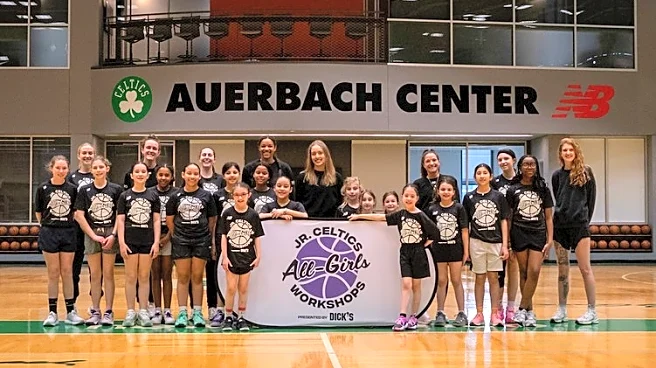
On International Women’s Day, I arrived at the Auerbach Center, the home of the Boston Celtics. Most days, as a reporter, I’m there to interview players at shootaround or practice, observe some workouts, and work on my articles.
This day was different.
Kiera Eubanks, a senior coordinator of the Junior Celtics Academy (JCA), had invited me to speak to a room full of girls between the ages of 7 and 14, and tell them a little bit more about my career as the only woman beat reporter covering the Celtics (outside of the team’s longtime sideline reporter, Abby Chin, of course).
JCA’s all-girls Sunday workshops are centered around fostering mentorship and growth, and building mental resilience. The girls are taught the fundamentals of basketball by an all-women coaching staff, and the discussion that Kiera led afterwards centered around the off-court impact that playing a sport can have.

I didn’t know what to expect, but when I arrived, the little girls were furiously competing in the very same basketball drills that I spent my Sundays competing in as a kid.
Red-light, green-light, the stop-and-go drill that tripped me up since the first time I ever picked up a basketball.
Shooting competitions. Layup lines.
It was a familiar slate of workouts, workouts that brought me back to my youth and reminded me just how hard I worked to achieve such limited on-court success.
Then, after the basketball session concluded, it was time for me to speak. I took center court alongside Kiera, who I learned was a college basketball player, something I never achieved (no disrespect to my Northeastern University club basketball team).
Then, I answered questions, something I’ve done plenty of times since I began this career, whether that looked like getting on the phone with young aspiring reporters, or speaking with kids at one of my alma maters.
But this time felt different. Maybe it was the fact that I watched the little girls compete in drills for an hour before the Q&A, but something in me clicked. It took me three seasons of covering the Celtics to realize this, but my incredibly mediocre basketball career was ultimately responsible for all of the qualities I now possess.
The girls sat eager-eyed on the Auerbach Center parquet, the same parquet where future Hall of Famers battled every practice, where Jaylen Brown and Payton Pritchard get in heated 1-on-1 battles, where Jayson Tatum tirelessly rehabbed from one of the most devastating injuries in basketball.
And, they asked me a myriad of questions: how do I know what questions to ask in a press conference? Who were my favorite players to cover? And, most importantly, how did I get this job?

I rifled through the answers; there’s few things I enjoy talking about more than covering the Celtics, after all. Then, when it came to explaining how I landed here, as a reporter covering the Celtics, I paused.
How did I get here?
I always loved writing, always loved talking — as anyone who even briefly meets me would attest — but above all, I always loved basketball. When you truly love something, that outweighs talent, but maybe not in the way that I had planned (If you ask 11-year-old me, I planned to play in the WNBA).
Nowadays, I watch every single Celtics game twice
Once is for the off-court observations: who is chatting with whom on the bench? What are the coaches focused on? How is the crowd? The rewatch is centered on the schematics. (And, if there’s something a play I don’t quite understand, I’ll note it and hope that the great Nik Land will break it down on his YouTube channel the next day).
After each rewatch, I write an article or two, record a podcast episode, and oftentimes film several other segments for my various places of employment. But, in almost three years of doing this job, it’s never, ever felt like work — not for a moment. It’s simply felt like doing the thing I love most in this world: being around basketball.
When I first fell in love with the game, I didn’t know how that would materialize, but here I was, at age 27, speaking to little girls who looked just like me, about covering the Boston Celtics.

Realistically, most of the young girls attending the All-Girls Junior Celtics Academy Workshop were not likely to become great basketball players. Maybe a few would play in high school, like me, simply because they became obsessed (or maybe we had some gifted athletes in our midst — it was too soon to tell).
Maybe, among them, was a future star.
More likely? The girls at the workshop were slated for normal lives filled with ups-and-downs — competition, failure, success, moments of high-pressure, and sudden disappointment.
Basketball would prepare them for it all. That I knew for certain.
I’ll never, ever pretend like my high school basketball career makes me any more qualified to talk about the X’s and O’s of the game — the complexity of NBA schemes is unmatched. But when a Celtics player misses a clutch free throw, I can empathize with what that emotion feels like. When Payton Pritchard gushes about his love for the game, I feel what he’s saying.
Basketball is how I learned to be a part of a team and to wholeheartedly root for others. It’s why I’ll never be envious of another reporter’s success — I learned a long time ago, my only competition is myself.
Basketball is what taught me that if I set my mind to anything at all, I can make it happen — the same unathletic girl who barely made the middle school team once hit 9 three-pointers in a varsity basketball game.
Basketball, I explained to the girls, would prepare them for it all.
On International Women’s Day, I remembered why I fell in love with the greatest sport in the world, even if it didn’t always love me back.