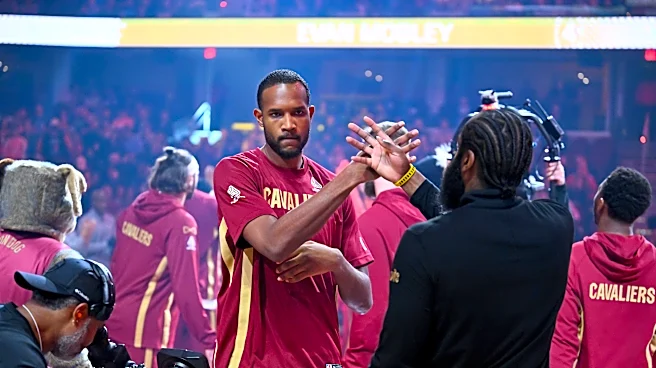




The Cleveland Cavaliers had opportunities to drastically reshape their core over the summer. Giannis Antetokounmpo and Jaylen Brown were available in trades. Reports suggested both the Milwaukee Bucks and Boston Celtics were interested in Mobley as a centerpiece for potential deals. And if one of those trades were made, maybe LeBron James would’ve decided to come back as well.
Instead, the Cavs chose not to make Mobley available. They doubled down on their belief in the 25-year-old former Defensive
Player of the Year. But in doing so, they took on a much bigger risk than they would’ve if they traded him for a big name.
Moving Mobley for an established star would’ve raised this team’s ceiling in the short term and fit better with the shortened, self-imposed timeline they created by acquiring James Harden last winter. Yet, they decided to keep Mobley, presumably believing he can be the player the team needs to lift this core to a championship now, while also providing long-term stability.
It’s easy to believe in Mobley on his best days. His scoring looks effortless when he’s getting to the rim. He has enough vision and touch as a passer to make him effective when he can clearly see the doubles. And when the outside shot is falling — as it was at times last postseason — he can be a complete scorer. That is on top of being one of the most disruptive defensive players in the league.
Yet, Mobley doesn’t reach those heights as often as you’d like him to. His baseline is a high-level offensive contributor, but not the kind that you build an offense around. There’s tremendous value in a big that can roll out of bed and give you 18 points. But that impact pales in comparison to the All-NBA offensive superstars that were available over the summer.
This has left the Cavs with a very good player. One who can be All-NBA Second Team when he’s put in the right position, although he isn’t likely to be the focal point of an offense. That’s okay, but may not be enough to get the Cavs over the hurdles they’ve continually run into in the postseason.
Support us and Let ‘Em Know with Homage!

Anything bought from the links helps support Fear the Sword. You can buy the Believeland shirt HERE. You can also shop all of Homage’s Cavs gear HERE.
Basketball is a team sport, despite how we sometimes frame the narrative. Nothing happens in isolation on the court. That is especially true for big men like Mobley, who are more dependent on their teammates to feed them the ball and hold up their end defensively. This is where the reshaped roster could work to Mobley’s benefit.
Having a full offseason with Harden will make a difference. And based on some of the lineups from training camp in Spain, Harden and Mobley could be the pairing head coach Kenny Atkinson sticks with this upcoming season, even though nothing is set in stone yet.
“A lot of discussion [goes into] who works best with who,” Atkinson said when asked about how he’s going to split the core four after practice yesterday.
“Collaborating with the players on what they like. Then, you have to consider minute stints. You have to match that. Does Evan function better in longer stints? Does JA (Jarrett Allen) function in longer stints? How you combine them plays a role in that. And then who are the three around them? It’s a lot of discussion with the staff and players, but we haven’t decided yet.”
Mobley and Harden only shared the court for about 2,000 possessions last season across the regular season and playoffs. For context, Mitchell and Mobley were on the court for over 4,000 possessions in the regular season and playoffs last season.
The Harden and Mobley pairing had solid results in the regular season as they were in the 77th percentile in net rating (+5.5), 80th percentile in offensive rating (119.5), and the 68th percentile in defensive rating (114). The really encouraging numbers came when Harden and Mobley were on the court without Allen and Donovan Mitchell. Those lineups were in the 97th percentile for net rating (+13.9), 96th percentile for offensive rating (124.2), and 88th percentile for defensive rating (110.4). Those lineup combinations dipped drastically in the playoffs — as to be expected — but the structure of a solid two-man pairing is there. This is also where the addition of Peyton Watson should help most.
Mobley is most optimized when surrounded by four shooters. This is why lineups with him and Dean Wade — Cleveland’s previously longest-tenured stretch four during the Mobley era — historically did well even though Wade was hardly a consistent offensive contributor despite having a respectable outside shot. This is where Watson should help most.
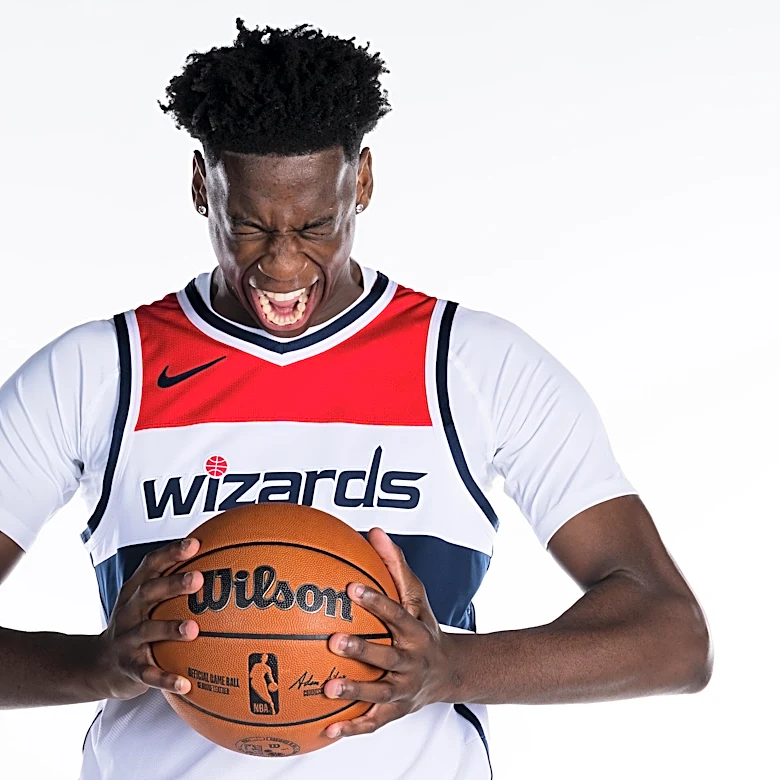
Watson’s three-point shot is more of a question mark than last season’s shooting percentage would suggest (41.1%) due to him only attempting 3.6 threes per game last season (for context, Wade attempted 3.3 threes per game last season). That said, opponents can’t cheat off Watson on the perimeter due to his shooting and ability to attack off the dribble, which will stretch defenses out. Watson has shown throughout his career that lineups can succeed when he plays power forward due to his length and ability to hold up as a rebounder.
Mobley hasn’t benefited from this ideal of a point guard and forward pairing before. The closest we’ve seen was Darius Garland and De’Andre Hunter during the 2024-25 season, yet that year Mobley spent most of his minutes with Mitchell, and Hunter wasn’t an optimal four alongside Mobley due to his poor rebounding and defense. On paper, this latest trio should be the perfect lineup combination to let Mobley’s skills shine.
That all said, the Cavs still need to fine-tune the Mobley and Allen minutes.
Cleveland was bad last postseason when both were on the floor (-6.8 net rating, 25th percentile), and even worse when they played together without Wade (-18.4 net rating, 5th percentile). We’ve seen that duo play extraordinarily well in the regular season, but it hasn’t translated over ot the playoffs as you’d envision it.
There’s an argument to be made that Cleveland’s two-big lineup can’t work in the postseason against elite competition. Playoff opponents have the game plan and personnel to take away what opposing offenses do best. This doesn’t necessarily mean that the Cavs need to trade one of their bigs. It does, however, mean that Watson and, to a lesser extent, Mario Hezonja need to be capable of playing high-leverage playoff minutes at the four.
At 25, it’s unreasonable to expect Mobley to drastically change who he is. It’s unlikely that he develops an elite face-up game or becomes a high-volume outside shooter. That’s historically not how development works. Yet, he could still fine-tune the areas of his game that he’s already good at.
Marginal improvements combined with lineup combinations that accentuate his abilities could be enough for Mobley to have a career year. After all, a big like Mobley is more reliant on his teammates and lineup construction than a score-first guard like Mitchell.
The biggest gamble the Cavs have made this era is betting on Mobley. So far, that bet has led to consistent regular-season success and mixed playoff results. The former will likely continue this season. Whether or not the latter flips to more consistently positive outcomes will determine if that gamble was worth it.