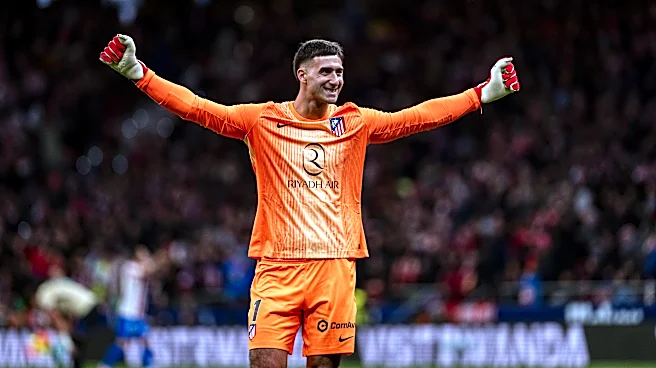




When Juan Musso arrived at Cerro del Espino in August 2024, the framing around his loan move from Atalanta was almost apologetic. This was a squad player, a number two, someone to fill in while Jan Oblak remained the fixture he had been for the better part of a decade. Atlético exercised their purchase option in June 2025, tying Musso to the club until 2028, but at the time even that felt like sensible housekeeping rather than a statement of intent.
Now though, the picture looks different. Not because
Oblak has collapsed, but because Musso has quietly, consistently done enough to make the looming goalkeeping transition feel less like a crisis in waiting and more like a managed handover. That is no small thing at a club where succession planning historically has been an afterthought.
Jan Oblak’s big shoes to fill
Understanding what Musso is stepping into requires understanding what Oblak means to this club. The Slovenian joined Atlético in the summer of 2014 and has since played 352 games for them, winning La Liga in 2020/21 and keeping 175 clean sheets. He has won six Zamora trophies, the award for the La Liga goalkeeper with the best goals-to-games ratio in a season. The most recent came in 2024/25, when he made 36 appearances, kept 15 clean sheets, made 86 saves and conceded less than a goal per game.
There was the night at Anfield in March 2020 when nine saves in a Champions League round of 16 second leg helped eliminate Liverpool. There was the aforementioned 2020/21 title season, when Atlético ground out results with a defensive stubbornness that carried Oblak’s fingerprints across every clean sheet.
In his peak years up to the title-winning season, Oblak often prevented close to 10 goals per season above what post-shot xG models would have expected from opposing shot quality, a figure that speaks to the difficulty of his stops rather than just the volume.

But that era has passed, and the numbers say so plainly. In La Liga this season, Oblak has faced 34 shots on target in 12 appearances, conceding 11 goals against a post-shot xG of 9.9 — meaning he has conceded slightly more than the model would expect — with a save rate of 70.6 percent and a goals-against average of 0.92 per 90. That compares to a save percentage of 78.6 percent in La Liga last season, with a post-shot xG of 22.3 against 27 goals conceded across 33 appearances.
Oblak is still performing. The numbers are not a disaster. But they represent a goalkeeper who is no longer operating at a level that makes the question of his successor feel distant.
A quiet arrival in Madrid
Musso’s first campaign at Atlético was deliberately limited in scope but maximally effective where it counted. Simeone deployed him almost exclusively in the Copa del Rey, which in retrospect looks like deliberate design rather than rotation.
During 2024/25, Musso played seven matches in the competition, keeping clean sheets in four of them. He also kept a clean sheet in his final league appearance of the season, a 4-0 win over Girona, ending the campaign with six clean sheets from nine appearances and looking composed with the ball at his feet throughout.
Atlético’s Copa del Rey campaign faced an early test at fourth-tie Atlético Baleares in December. Musso was called upon to make seven saves in that round of 32 tie in Palmaa, including a crucial stop from the penalty spot to deny Jaume Tovar with 10 minutes remaining.
“I’m very happy for Musso, he’s working very hard, waiting for his moment to perform for the team,” Diego Simeone said after that 3-2 win.
El Cholo does not distribute praise without intention. Musso knew that his opportunities behind Oblak would be limited, but he hasn’t wasted a single one.
Finding his feet
When Oblak picked up a muscle strain ahead of Atlético’s La Liga fixture against Getafe last month, Musso stepped in once more. What followed was not a man filling in nervously. It was a goalkeeper making a statement.
Musso became the first goalkeeper this century to keep a clean sheet in each of his first four league appearances for a Spanish club — a record that had previously stood at three, shared by Jordi Codina, Antonio Adán, Oblak himself in 2015, and David Soria in 2017. Across those four matches, Musso made six saves, including three in the game against Getafe.
In his three La Liga appearances this season, Musso has faced 11 shots on target and conceded three goals, with a save percentage of 81.8 percent, ahead of Oblak’s 70.7 percent across 26 appearances in the same competition. Granted, the sample sizes can’t be compared, but Musso can’t do more than excel when given the chance.
Musso’s average FotMob rating across those La Liga appearances stands at 7.13, compared to Oblak’s 7.03 across 2,340 minutes in the league. Again, while sample sizes make direct comparison reductive, the point is not that Musso is definitively better than Oblak: it is that, when called upon at the highest level, he has not looked out of place. That matters at a club that has rarely had to think about back-ups for a decade.
A chance to shine in the Copa del Rey
If the 2024/25 Copa del Rey run was Musso finding his footing, the 2025/26 campaign has been his coming-of-age at the club.
The first-leg semi-final against Barcelona at the Metropolitano in February was the night the penny dropped for many supporters. Atlético won 4-0. Of Musso’s four saves in the match, the one that stays in the memory came when he rushed out to deny Ferrán Torres with the score still at 2-0, spreading himself to leave Torres no angle, and then continuing to palm the ball away from danger throughout the match. On a night of glorious attacking cutting edge, FotMob’s man of the match was the man in Atlético’s goal, with a rating of 8.7.
Musso’s quick distribution after claiming the ball in his hands was another element that stood out, the Argentine showing that his sharpness with the ball at his feet was not impacted by his limited regular game time.
Then came the second leg in Barcelona. Atlético went to the Camp Nou defending a four-goal lead. Barcelona won the night 3-0 and spent the second half trying to make it four, creating chance after chance. Musso stood firm across the 90 minutes in a way that settled the tie as much as the first-leg scoreline. He conceded three goals, but none could reasonably be attributed to him; the first and third were close-range finishes, the second a penalty. Beyond that, he made six saves, each one necessary.
There was even a double stop in the second half, later flagged offside, but the reaction from his teammates told you everything: they rushed to him in celebration, as if he had just scored. Because in that moment, he effectively had. In the second half alone, Musso made three decisive interventions, denying Torres at the 54th minute, blocking a close-range effort from Marc Bernal a minute later, and holding firm as Barcelona pushed relentlessly for the goal that would have changed the complexion of the tie.
Courtesy of that win, Atlético are in the Copa del Rey final for the first time since 2013. They will face Real Sociedad in Seville on April 18. The path there runs through Musso as much as anyone else in the squad.
Looking to the future
Atlético did not have to make the Musso purchase permanent when they did so in June 2025, at a point when they had seen enough to be confident. He is under contract until June 2028, with the same expiry date as Oblak. His wages are believed to be only slightly over a quarter of Oblak’s. The financial structure is sensible: a reliable, proven deputy who does not distort the wage bill, ready to step up as the situation demands.
Musso brings senior silverware to the role too. He won the Europa League with Atalanta in 2024, the Copa América with Argentina in 2021, and La Liga Profesional with Racing Club in 2014. He has been in big moments before. The Camp Nou performance showed he can handle them.
Oblak turns 34 next January. The Slovenian is still the number one, and not even Musso himself would try to argue that. He remains trusted and, on most nights, delivers. The transition is not happening yet, and forcing one would be as mistaken as ignoring the need for one.
But a future without Oblak is edging closer.
Granted, it’s also true that Musso is only 16 months younger. There is no suggestion that Musso is the long-term successor or the man to replace Oblak for the next decade, but what has changed is the level of anxiety attached to the question. For much of the last decade, “what happens when Oblak can’t do it anymore?” carried an edge of genuine dread for Atlético supporters: not because the club would fall apart, but because nobody really knew if there was a credible answer waiting. Antonio Adán, Ivo Grbić, Axel Werner, Benjamin Lecomte… none of them were that answer. Oblak himself had operated as the club’s undisputed number one since March 2015. That is 11 years without a serious challenger.
Musso is the first one. The Copa del Rey campaign, across two seasons now, has given the fanbase a sustained look at a goalkeeper who is calm in high-pressure situations, decisive in the moments that matter and visibly trusted by the coaching staff. The record four consecutive La Liga clean sheets on debut appearance in the league reinforced what the cup had already suggested.
The transition is not happening yet. But the groundwork is there, the contract structure makes sense sand the man they have brought in has done everything asked of him. For a club that has been asking the same uneasy question for the better part of a decade, they couldn’t ask for a better answer.