



Karl Oltz asks: Like most Giants fans, I’ve been cautiously optimistic about the upcoming season. But now I am concerned since the Giants have had three season-ending injuries and we aren’t even to training camp yet. I know injuries are apart of football, but every year the Giants seem to be among the teams that suffer the most of them. Since it appears that the three injuries are Achilles tears, you have to wonder if it’s the field, player conditioning, intensity of the OTA’s, or just plain bad
luck. What’s your take? Are other teams seeing these type injuries this spring?
Ed says: Karl, I don’t know if there is a single explanation for the rash of Achilles tears. It is weird, and concerning. None of these happened on the MetLife Stadium turf, let’s be clear about that. The Giants do not practice there.
One (Gunner Olszewski) happened on grass. One (Roy Robertson-Harris) happened on Field Turf in the indoor practice field. I don’t know for certain where the injury to undrafted cornerback Thaddeus Dixon occurred.
The training and medical staffs have changed — they change at least somewhat every time there is a coaching change. The Giants have been practicing on these same fields for years without anything like this happening. There is nothing unusual about the way the Giants are conducting OTAs. Hopefully, the Giants examine everything — footwear, the way they stretch, condition of the playing surfaces, anything else that might contribute.
I honestly don’t know if there is a real answer.
I think fans will be heartened by how aggressively the Giants have reacted to the injuries, testing every player for susceptability and purchasing new equipment.
BadgroRedtoGiantsBlue asks: Can you please explain the nuances of what June First means to clubs? I know free agents signed before can not have their annual salary for the ’26 season pushed forward into further years, and those signed post June 1st can. Does this have anything to do with the signing of free agents, say like OBJ? Like if we sign him post the 1st of the month, we than can push his salary ahead and not have it count on the ’26 cap, and if before the NY Giants could not, is that a thing? So could you please clarify the machinations of June First and the NFL.
Ed says: Badgro, sorry I didn’t get to this one last week. Here is an explanation of the significance of June 1 from Over The Cap. It is more accurate and in-depth than I could give you.
The biggest impact for teams involves the modification of salary cap accounting rules for players whose contracts will be terminated after June 1 or whose contracts were terminated with the “Post June 1” designation. Prior to June 1 any player removed from a teams roster, either by release or trade, will have all their remaining salary cap allocations accelerate into the current League Year. For example a player with $1 million in prorated money from 2014 to 2017 whose contract is terminated will carry a “dead money” charge of $4 million in 2014.
However, after June 1 that “dead money” charge now splits between two seasons. Once released the team only needs to account for the current years prorated money in their 2014 salary cap accounting. All future years’ prorated money will now land as “dead money” in 2015. So for the example player above the “dead money” charges will equal $1 million in 2014 and $3 million in 2015. In practice this rule allows teams with underperforming, high priced players to release players before the season and remain salary cap compliant. If such a rule did not exist many teams would have a difficult time, with their salary caps often tight, to release a player with high prorated charges.
It is important to note, though, that the June 1 rule does not apply to future guaranteed salary. Such future guarantees immediately accelerate into the current season if a player is released. There is no split of those figures.
For many teams June 2 will open up significant cap room. This is because players designated a “June 1” cut in the offseason will finally come off the books for those teams. The offseason June 1 designation is used when players do not factor into a teams future plans but the team is usually unable to release the player due to the high “dead money” charge associated with the contract, which, in many cases, would make the team no longer salary cap compliant. Often the team does not wait until June 1 to make the move in order to avoid guarantees kicking in (usually the first week of free agency by sometimes as late as April), roster bonuses from being earned (almost exclusively in the first week or free agency) or non-exercise fees from option bonuses to be made. Prior to June 1 the players’ entire salary cap charge remains on the books even though they are no longer on the team.
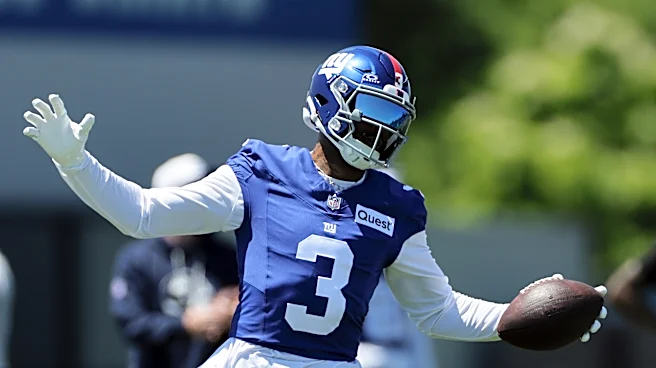
Kölnerbigblue asks: Ed, apparently Beckham has already served his 6 game suspension for PEDs while he was out of football last year. Is that normal? It just seems odd to me. I know violators don’t get a paycheck while on suspension but he wasn’t even under a contract that he could be paid under.
Also, what are you going to do with all the extra money from the OBJ clicks you’re getting? I assume the grandkids will get special presents.
Ed says: Yes, there is precedent for suspensions being served when a player is not under contract. It can prevent players from getting contracts when teams know a suspension is coming.
As for your second question, the answer is $0. I’m not paid that way.
Mark Lynch asks: Due to the multiple veteran WR signings can we suspect that the injuries to Nabers & Slayton are not progressing as well as the Giants would like?
Ed says: Mark, I think that is clearly the case with Malik Nabers. We have been saying for a while now that it appears more and more likely that Nabers won’t be ready to begin the season. The Giants are still hopeful, but it doesn’t seem to be likely. As for Darius Slayton, the Giants expect him to be ready for training camp. Nothing has changed there.
Peter Duhamel asks: Ed, regarding the contracts signed by OBJ, Smith-Shuster and Berrios, they are all reported as being for $1.3 million minimum deals. But wouldn’t they include incentive clauses for bonus payments if, having made the team, specified numbers are reached? I haven’t read anywhere about that being the case for any of them.
Ed says: Peter, all three contracts are non-guaranteed $1.3 million veteran salary benefit mininum deals. That means they count $1.075 million against the salary cap, and the players get a small bump in pay based on experience. There are no reported incentives on any of the deals. The incentive is making the team and earning the contract. The Giants take on no dead money for any of the three who do not make the roster.
Bob Donnelly asks: There was a time when the NFC East was referred to as the NFC BEAST. Do you think the BEAST reawakens in 2026?
Ed says: Bob, that is certainly possible. We know what the Eagles have been in recent years. My gut tells me there might some regression coming in Philadelphia, but that is still going to be a tough team to play. One of these years the Dallas Cowboys are actually going to be as good as the talent on their roster says they should be. Do we see a version of the Washington Commanders that resembes the 12-5 team from 2024? Do the Giants take a big step forward under John Harbaugh?
If all of those teams are as good as they could be, then, yes, the division will be very good. To be the NFC Beast, though, I think it needs to be that way for a sustained period of time.
Submit a question
Have a Giants-related question? E-mail it to bigblueview@gmail.com and it might be featured in our weekly mailbag.