


In the middle of Wisconsin, at a bend in the Wisconsin River named after a grocer named George Stevens, is a smallish town that used to be a hotbed of lumbering and is now a center for insurance and the headquarters of the U.S. operations of the Canadian National Railroad.
In this town there’s a high school, and like most high schools, there’s an athletic director for the school’s sports programs, and that athletic director is Dave Hauser.
Dave was a basketball player at the University of Minnesota-Duluth
from 1987 to 1991. At the time, Minnesota-Duluth was an NAIA program, and Hauser was a stand-out player. His teams made the NAIA tournament every year he played, but bowed out in either the first or second round each time. A member of the team’s 1,000 point club, and currently 27th all time in scoring, Dave played alongside Jay Guidinger, a center who went from the NAIA to the NBA, where he played a couple seasons with the Cleveland Cavaliers, backing up Brad Daugherty.
In 1993, a couple years after graduation, while working as a teacher in the Westfield, Wisconsin, school district, Dave married Stephanie Fermanich, a chemistry teacher in the Green Bay school system; Stephanie is currently an executive director with the Wisconsin Interscholastic Athletic Association, which oversees high school sports in the state.
On December 8, 1997, the pair welcomed a son, Sam, into the family.
From fourth grade on, Sam was playing basketball competitively.
Sam grew up in Stevens Point with an older sister Nicole and, eventually, a younger brother, Joey. All three were multi-sport athletes, putting on the uniform of the Panthers at Stevens Point Area Senior High School.
In addition to playing basketball, Sam lettered in football as a quarterback, although he never cracked the starting lineup.
As a high school player, Sam played for his father, who was then an assistant coach, along with Trev Anderson, who was the son of the head coach, but there was no nepotism going on here. Anderson would finish his high school career with 2,360 points, and as a duo, they led Stevens Point to a 100-6 record during their careers to go with a pair of state championships in 2015 and 2016, years when Sam and Trev were joined by Sam’s brother, Joey.
Over those two seasons the team notched a 55-1 record. In 2015, the team trounced the undefeated defending champions, Germantown, 67-51 in the state championship, with Anderson and Hauser accounting for 50 of those 67 points, scoring 25 points apiece. Sam scored SPASH’s first sixteen points in the contest.
The following year, the Hauser boys and Trev put on a season-long clinic. In a perfect 28-0 season, SPASH won every game by double digits, and their average margin of victory was 33 points. On March 19th the team defeated Muskego 89-64, behind 23 points and eight rebounds from Sam, for the team’s second straight state title. They finished the season ranked eleventh in USA Today’s Super 25 ranking of the country’s best boy’s basketball teams.

That season, Anderson and Hauser were joint recipients of the Wisconsin Basketball Coaches Association player of the year honors.
After wrapping up Wisconsin’s high school tournament,on April 2nd, 2016, Sam found himself at the Glenda Dawson High School in Pearland Texas competing in an event sponsored by the U.S. Marines and held in conjunction with the NCAA Final Four Tournament going on that weekend in nearby Houston. Students in the high school were dismissed from their Friday afternoon classes and invited to the gym to provide a suitable crowd for a three-point and slam dunk contest.
Hauser, after a shaky first round, tied for third in the country in the three-point contest. “I was just not making my shots in the first round; they were right there, but they weren’t falling,” he said, adding, “I was really more about having fun with it.”
By this time, Hauser had committed to play basketball at Marquette, located not far from Stevens Point in Milwaukee. He’d also been named the Gatorade Player of the Year for Wisconsin. He was rated a top-100 recruit by Scouts.com, 247Sports.com and ESPN.
Hauser hit the ground running at Marquette, starting 28 of 32 games for the Big East squad, and playing a team high 26.5 minutes per game. His stats as a freshman were a bit pedestrian, but he was primed for a sophomore leap. In his second year, he started all 35 games. His scoring average jumped from 8.8 to 14.1 points per game, and his rebounding average improved from five per game to 5.7.
Sam continued to improve as a junior, when he was joined on the squad by his brother, Joey. Sam was named to the All-Big East second team, and was named the team’s Most Valuable Player. His scoring was up slightly, and he once again started every game—and his shooting percentage splits were stellar. With an overall field goal percentage of 45.9%, free throw shooting at 92.4%, and 3-point field goal percentage of 40.2%, Hauser was carrying on a standard of shooting excellence that he had started to build in high school.

Marquette made the NCAA tournament twice in Hauser’s time with the school, but lost in the first round both times.
After his junior year, at a time when transferring meant sitting out a year, Sam announced that he would be finishing his career with the Virginia Cavaliers.
He missed the 2019/20 season, and suited up for Virginia in the COVID shortened 2020/21 season where he once again started every game, finishing a four-year career with 122 starts in 126 games.
Sam’s fourth year was his best yet. He was named to the All-ACC First Team, and came within an ace of notching a 50/40/90 season as a shooter, falling just .4% short of 90% from the free throw line to go with a 50.3% field goal percentage and a 41.7% three-point shooting rate. He was also named to the ACC’s All-Academic Team.
The highlight of the season was undoubtedly the team’s game against Louisville, where Hauser shot 9-14 for 24 points, to go with eight rebounds and two blocks in a contest that clinched the regular season title for Virginia. “That was an MVP-type performance,” Virginia coach Tony Bennett said after the game.
The Cavaliers made the NCAA tournament that year, but Hauser’s team once again lost in the first round. Hauser had a fifth year of eligibility due to COVID, even though he’d been required to sit out the COVID terminated college season, but he chose to declare for the NBA draft instead.
Hauser sat through both rounds of the draft without hearing his name called. The draft, held on July 29th, about a month later than usual due to a COVID-delayed start to the previous season, was followed by a flurry of activity as teams looked to sign up undrafted free agents, and Sam was among the players who found himself with a choice of teams to play for.
The Timberwolves, Celtics and Heat all pitched Hauser. Minnesota and Boston had contract offers on the table, while Miami only offered Sam a chance to compete for a roster spot. However, at the time, Miami had an exceptional reputation for developing diamonds in the rough. “I saw what Duncan [Robinson] had done and Max Strus had done,” Hauser said about Miami, adding, “they have a good culture for producing guys like that.”
But the difference came down to the Celtics’ contract offer and especially Boston’s President of Basketball Operations, Brad Stevens. Sam’s mother, Stephanie, who, along with his father Dave, helped him evaluate the offers on the table, said that they put together a list of pros and cons, but that they kept coming back to Stevens. “He just had the old-school, down-home way, and we just liked how he goes about things,” she observed.
“Everything about him was very trustworthy. So, the fact that he saw things in Sam had a lot of value to us.”
Sam signed a two-way contract with Boston that was upgraded to a standard NBA deal the following year.
2024 gave Hauser his first taste of championship ball since his high school days at Stevens Point eight years earlier.
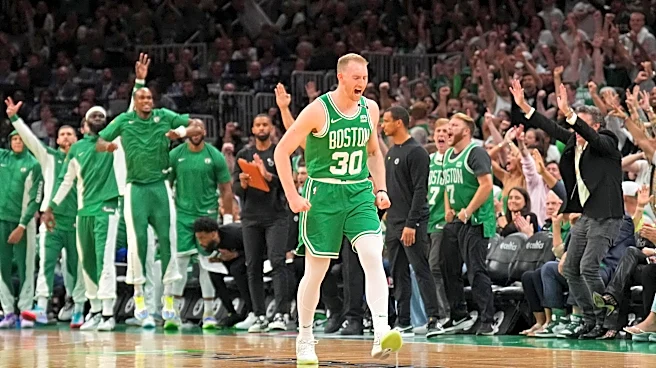
During the Finals that year, Hauser was a key reserve, scoring 8.2 points per game on better than 50% shooting across 15 minutes per contest, as the Celtics landed their 18th championship in a five game gentleman’s sweep of the Dallas Mavericks. The Celtics rewarded him with a four-year $45 contract later that summer.
His role decreased slightly the following year as he appeared in only 71 games as opposed to 79 the championship year, although his spot starts increased from 13 to 19.
With the Celtics’ depleted front court this past season, Hauser jumped to 49 starts, tallying a 39.3% three point shooting percentage on 6.5 attempts per game to headline his role as a solid contributor to Boston’s 56 win campaign.
Six years in, Hauser has more than justified the confidence that Stevens had in his potential when he swooped in on draft night to land the Stevens Point sharpshooter with a phone call and a bit of Midwestern down-to-earth chat.