


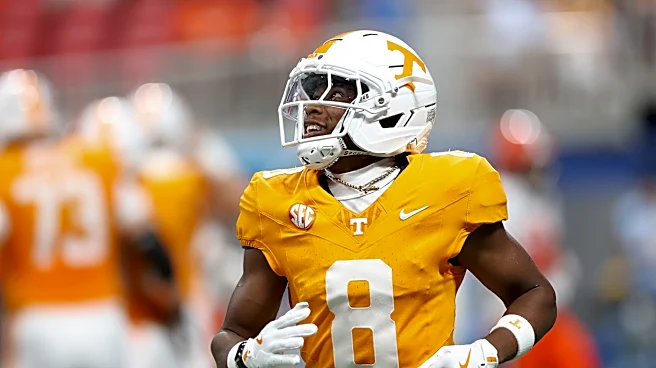
It didn’t take new Atlanta Falcons general manager Ian Cunningham and new head coach Kevin Stefanski long to understand that their new team has a VERY interesting recent draft history. There was, of course, the decision to sign Kirk Cousins and select Michael Penix in 2024, and in 2025, there was the move to trade their first-round pick to the Los Angeles Rams for the right to take Tennessee edge-rusher James Pearce Jr.
That particular gambit worked very well on the field — Pearce led all rookie edge
defenders with 11 sacks, and only Abdul Carter of the New York Giants had more pressures as a rookie than Pearce’s 45 — but that doesn’t cover the unfortunate elephant in the room. Pearce’s four felony charges (two counts of aggravated battery with a deadly weapon, one count of aggravated stalking, and one count of fleeing and eluding police officers) obviously go far beyond football, and the details are extremely upsetting. It’s too early to get into what this means for Pearce’s NFL career, and in the end, that part of things isn’t germane to this article.
Except that, in a far narrower sense, the Falcons need to figure out how to accentuate a pass rush that would be diminished without Pearce’s efforts. The 2025 Falcons ranked second in the NFL in sacks behind only the Denver Broncos with 47, but their pressure rate of 23.6% is less than you want with a blitz rate of 33.4% — second only to the Minnesota Vikings. There are other talented disruptors on the roster like Brandon Dorlus, Jalon Walker, and Zach Harrison, but without an alpha EDGE for any period of time, your defense tends to suffer.
There’s also the matter of the offense, which is built around Bijan Robinson as it should be. That doesn’t erase questions surrounding the quarterback position now that there appears to be an open battle between Penix and Tua Tagovailoa. Cousins, meanwhile, has signed with the Las Vegas Raiders so that he can teach Fernando Mendoza the wonders of Kohl’s Cash.
So, this full mock representing all of the picks the Falcons do have is an effort to get the team over the hump and in the postseason for the first time since the end of the 2017 season. Whether there’s enough to do that without a first-round pick? Well, that’s why the people in the building make the money they make.
We are simply here to do the best we can do with what we have.
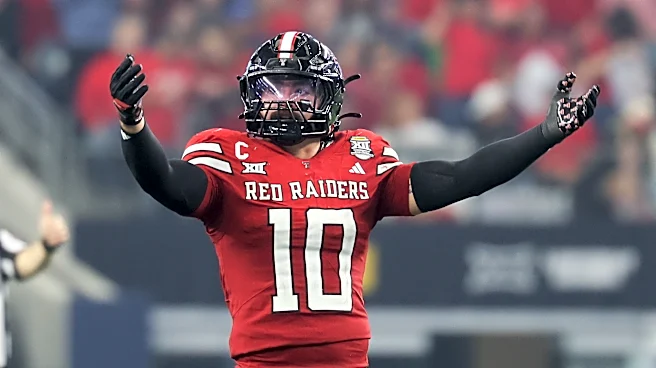
Round 2, Pick 16 (48): Jacob Rodriguez, LB, Texas Tech

It doesn’t exactly help the Falcons’ pass-rushing intentions that they lost Kaden Elliss to the Saints in free agency — Elliss is obviously a great two-level player who takes his four sacks and 30 pressures with him. Given the team’s need at pure linebacker as well, if I’m Ian Cunningham and Jacob Rodriguez is available here, I’m not thinking twice. Pull the damn trigger.
In 2025, the 6’1”, 231-pound Rodriguez was the epicenter of the Red Raiders’ dangerous defense with 94 solo tackles, 73 stops, nine tackles for loss, seven forced fumbles, one sack and six pressures in just 40 pass-rushing snaps. In coverage, he allowed 55 catches on 67 targets for 550 yards, 368 yards after the catch, two touchdowns, four interceptions, three pass breakups, and an opponent passer rating of 85.9.
Not only is Rodriguez a turnover machine who can do just about everything you need a linebacker to do; he’s also a Day 1 green dot guy who can take Jeff Ulbrich’s concepts to the field.
Everything he is, is everything the Falcons need.
Round 3, Pick 15 (78): Keyron Crawford, EDGE, Auburn

So, onto the actual edge problem. Atlanta is fortunate in that the 2026 class is loaded enough to get potential starter-quality guys in the middle rounds, and they do just that here with Auburn’s Keyron Crawford. The 6’4”, 253-pound Crawford isn’t quite a finished product yet — the former basketball player started playing football in his senior year of high school — but if a guy with Crawford’s tools had more experience, he wouldn’t be available anywhere near the third round.
As it was in 2025, Crawford had his best season to date (his second at Auburn after two at Arkansas State) with five sacks and 43 pressures in 240 pass-rushing snaps. Overall, he was also responsible for 23 solo tackles, 22 stops, five tackles for loss, one forced fumble, and some nice reps against some great college offenses. Watch his battles with Alabama’s Kadyn Proctor, and how the Crimson Tide started shading extra blocking help to Proctor’s side to deal with Crawford. It may take a second for Crawford to show his full potential, but he can also provide disruptive help in the interim.
(From Philadelphia Eagles) Round 4, Pick 22 (122): Cyrus Allen, WR, Cincinnati

Whether it’s Penix or Tagovailoa or both in 2026, the Falcons’ quarterback du jour could use as many smart receivers as possible. There’s nothing really wrong with an opening trio of Drake London, Jahan Dotson, and Olamide Zaccheaus… but would you like a bit more juice there?
Of course you would.
In the interest of making things as easy as possible for those quarterbacks, let’s give the Falcons Cincinnati’s Cyrus Allen, who is one of the best pure route-runners in this draft class. The 5’11”, 180-pound Allen played mostly in the slot last season (85% of his snaps), but he can work outside in condensed formations, and the Bearcats had Jeff Caldwell doing all his ninja stuff as the boundary ball-winner. Allen’s numbers were just fine — 49 catches on 69 targets (just one drop) for 661 yards and 12 touchdowns — but you really want to watch Allen’s tape to see the route clinics he was performing every Saturday.
The red zone success is no fluke in that context.
(Comp pick) Round 6, Pick 34 (215): TJ Hall, CB, Iowa

A.J. Terrell still has what it takes as Atlanta’s CB1, but beyond that, we may want some reinforcements to go with Mike Hughes, CJ Henderson, and Clark Phillips — especially since Hughes and Phillips are smaller guys with uncertain futures in Atlanta, and Henderson’s career has been a roller coaster.
In 2025, the 6’1”, 189-pound TJ Hall allowed 30 catches on 63 targets for 402 yards, 89 yards after the catch, two touchdowns, one interception, 10 pass breakups, and an opponent passer rating of 72.3. While Hall plays just fine in off coverage, I really like him as a press defender — last season on 39 press targets, he gave up 19 catches, one touchdown, one interception, and six of his pass deflections. Hall could stand to be a bit quicker to respond to route breaks at times, but given how he’s able to match receivers from step one to the catch point, I’m assuming the technical issues can be coached up.
Round 7, Pick 15 (231): Dae’Quan Wright, TE, Ole Miss

Why are we mocking a tight end to a team that already has Kyle Pitts and Austin Hooper? Well, Falcons faithful, you’re about to find out just how much Kevin Stefanski loves 12 and 13 personnel as a security blanket for his quarterbacks. Stefanski’s Browns frequently led the NFL, or were right up there, in usage of two and three tight ends for a good long time. Basically, he was doing 13 personnel before Sean McVay made it cool.
Stefanski would like the look of his 13 personnel reps with the guys he already has, and the addition of Ole Miss’ Dae’Quan Wright, because Wright makes getting open look easy, and that’s a skill in and of itself. Last season, the 6’4”, 244-pound Wright caught 39 passes on 55 targets for 635 yards and five touchdowns, and he has hidden potential as a deep receiver. Only three targets on passes of 20 or more air yards last season, which Wright turned into two catches for 83 yards. This is a major bargain in the seventh round for a guy who could really help Stefanski get with his ideal offensive personnel.
What do you think of this mock, Falcoholics? Is it enough to get the team to the next level? Sound off in the comments below!