


Welcome to our Lakers Season Preview Series! For the next several weeks, we’ll be writing columns every weekday breaking down the biggest questions we have about every player the Lakers added this offseason. Today, we look at Collin Sexton.
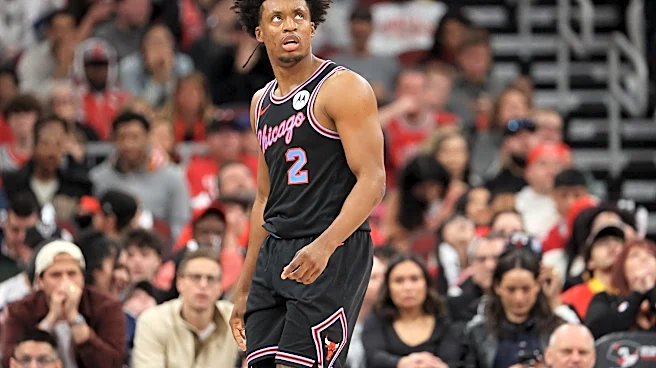
If we’re being honest, when the flurry of reports that the Lakers were acquiring Walker Kessler, Quentin Grimes, Sandro Mamukelashvili, and Collin Sexton came in rapid succession, the signing that had people almost instantly second-guessing was the deal for Sexton.
Sure, people could quibble with the dollar amounts or the player options in the contracts for Grimes and Mamu, and there was certainly some debating about the price paid in draft capital for Kessler, but the basketball fit for all of those players seemed straightforward and easily explainable.
For Sexton, though, the nitpicking and questioning were nearly immediate.
Not because Sexton is a bad player. In fact, I think it’s universally understood that the former Cavalier, Jazz, and Bull is a good player who, in a vacuum, could even be looked at as a value contract on the terms the Lakers got him at.
But, on a team that already had Luka Dončić and Austin Reaves, using the team’s room exception on a small, shot-creating guard like Sexton instead of going after a big wing who could help fill the void in the frontcourt was certainly a choice.
And now, over two months later, with the team’s offseason functionally over, training camp just weeks away, and the hole at the forward spot vacated by LeBron James still without a clear candidate universally believed capable of filling it currently on the roster, the Sexton signing remains top of mind for those looking to be critical of the choices President of Basketball Operations Rob Pelinka made when trying to build out this team.
So, though he might actually be the most established player the Lakers signed when it comes to production and ability to fill the job he’ll be asked to on opening night, it feels as though Sexton might actually have the most to prove. The reason is as simple as to show he can be more than a luxury as the team’s backup point guard, and more of a necessary rotation piece who allows head coach JJ Redick to establish the sort of offensive dominance he’s not yet been able to get to in his two seasons as Lakers head coach.
What is his best-case scenario?
Much of Sexton’s career has been spent playing on bad teams whose lethargic pursuit of wins, combined with the broader offensive limitations of those rosters, has put too much responsibility on his shoulders to be a main shot creator and offensive fulcrum. This has led to Sexton having some strong individual seasons as a scorer, but in the macro sense, too many campaigns where his overall efficiency and shot creation for others have come into question.
The hope for Sexton on these Lakers is that this sort of paradigm shift allows for him to take a meaningful step forward in ways that impact winning. Said another way, this season’s Lakers should have a particularly dynamic offense that makes Sexton’s life easier to a degree in which he can not only thrive as a scorer, but his efficiency and playmaking increase simply because the decisions and scenarios he’s put into will be so favorable.

Whether playing next to Luka or Austin, Sexton will have more opportunities to be a second-side creator who gets the ball in more advantageous situations where he can either take open catch-and-shoot threes or attack closeouts that lead to easier scoring chances. And when Sexton starts possessions with the ball, the attention Dončić and Reaves require should free him up to be the best on-ball version of himself too.
Further, coming off the bench should allow Sexton to play in the parts of games where the flow is looser and the general level of competition is not the same as when both teams’ starters are in. This should also allow him a bit more freedom overall, and offer more chances to succeed and thrive.
What is his worst-case scenario?
Sexton has never averaged fewer than 14.3 points and has only shot under 45% from the field once, all the way back in his rookie season. In other words, as a scoring guard coming off the bench, a baseline level of production has historically been baked into Sexton’s minutes.
So, rather than viewing what would be considered an outright bad season through a lens of box score stats, what would constitute a worst-case is much more likely tied to his role or fit within this roster not coming to fruition in ways where he’s positively impacting the team.
In other words, there’s a scenario in which Sexton ends up not getting as many opportunities to impact the game offensively and instead becomes more of a watcher and low-volume spot-up shooter who never quite finds his rhythm or flow. And while he still might find ways to get his numbers, those come mostly by playing on island when Luka or Austin is resting/taking possessions off or in transition rather than being a cog in a machine that keeps the defense on tilt.
And then, in this scenario, his lack of clean fit on offense exacerbates the challenges he has on defense, ultimately leading to even more inconsistency with his minutes and playing time. This, then, only reinforces the original critiques of his signing, leading to more second-guessing and questioning of him as a player and his fit, which impacts chemistry and generally brings the vibe of the team down, to say nothing of creating challenges for Redick to find and play the best lineups more often.
What is his most likely role on the team?
Sexton was signed to be the backup point guard who can serve as a spot starter should Luka or Austin miss time. I see very little in either his makeup as a player or his history of production to dissuade me from believing he can and will be able to fill this role well — maybe even to the point where he distinguishes himself as one of the better backups in the league.
Beyond that, I think his presence on the team and the discussions it fosters will be more fodder for the talking heads than it will actually matter negatively for the Lakers. I understand there were some inherent tradeoffs of signing him vs. chasing a different archetype of player, but I also believe he’ll be well worth his salary and that he’ll be truly helpful to the team.
Does that mean the Lakers couldn’t use another type of player too? Of course not, but multiple things can be true at once. Fact is, it was always going to be difficult — if not impossible — for the Lakers to fill every need in a single offseason on a roster they purposefully stripped down.
And if they didn’t have Sexton, they’d likely be relying on Bronny or a minimum-level player to fill that role while plugging their starting forward slot with a player of similar or lesser quality to Sexton.
That they went this route could be viewed as the wrong choice, but my gut says Sexton will be good enough in his role to justify his spot on the team even though it won’t erase the needs the roster has in other spots.
You can follow Darius on BlueSky at @forumbluegold and find more of his Lakers coverage on the Laker Film Room Podcast.