

Dan Campbell was asked Thursday whether the Detroit Lions would be “shooting gaps” more often with lighter personnel and more nickel looks.
His answer was emphatic.
“No, no no, we don’t shoot gaps. Yeah, we don’t shoot gaps here.”
That might sound surprising after the first two preseason games. Indeed, Detroit has shown signs of evolution, particularly in how it is using lighter personnel and moving its defensive front.
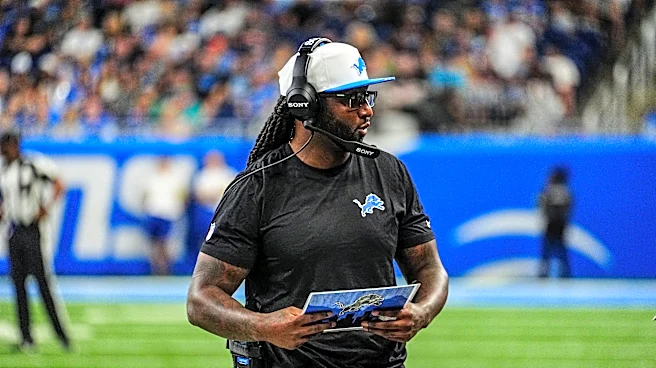
But the Lions aren’t becoming a different defense. Defensive coordinator Kelvin Sheppard
is finding different ways to make the same defensive identity work with different personnel.
And that identity still starts with stopping the run.
Note—the below defensive alignment diagram serves as a visual aid reference for understanding the letter and numbering system used to describe the gap and techniques along the line of scrimmage.

Moving gaps is not the same as shooting them
The Lions in the Kelvin Sheppard/Aaron Glenn-era have traditionally built their foundational defense in a Base 4-3—four down defensive linemen and three linebackers.
Frequently, the strong-side linebacker (SAM) is brought up on the line of scrimmage as an edge defender. The resulting alignment is a “4-3 Under” pictured below.

From left-to-right, the Lions have their SAM linebacker outside the tight end. Then they set what they call their “big end” in a 4i- technique, shading the inside shoulder of the tackle. The defensive tackles align in a common 1- and 3- techniques, occupying the A- and opposite B-gaps. Lastly, the rush end is aligned outside the tight end on the short side of the field. This 4i-1-3-7 alignment for the four defensive linemen has been, and likely will be, a staple look.
The Detroit Lions appear to have changed the type of player they want to incorporate on defense this offseason. For example, the Lions have significantly changed the makeup of the defensive tackle room. There is not currently a true nose tackle on the roster that is limited as a 0/1- technique. Every defensive tackle is capable of playing at least from the 0 to the 3, and in some cases from the 0 to the 5. Beyond the defensive front, last week I broke down how Kelvin Sheppard may find his own way to utilize more nickel personnel by implementing crossface stunts to create conflicts for the offensive line.
In their preseason game against the Washington Commanders, Sheppard repeatedly showed another layer to this schematic evolution.
In the below image, the Lions line up in a 4-3 hybrid of what is known as a “TITE” alignment.

A TITE alignment is traditionally a 3-4 staple with three defensive linemen symmetrically set in the 4i-0-4i techniques. This presents a few critical conflicts for an offensive line. First, it makes it extremely difficult for an offense to pull a guard because each of the 4i’s have inside leverage on the offensive tackles. Second, the interior leverage on each offensive tackle creates conflicts on inside zone and duo run-blocking schemes. Ultimately, TITE fronts are designed to clog B-gaps, encouraging runs to spill outside.
The other benefit is that TITE fronts can act like 4-3 Under fronts post-snap by using movement. Dan Campbell alluded to exactly that.
“But we don’t shoot gaps, man, we’re not doing that. Now, by pressure, we move, but then we get back in the gaps, stuff like that.”
In the below video, the Lions start off in a TITE front, but immediately at the snap the first step of each front player is stemming to the right. As a result, they maintain gap leverage in the wide-zone run-action design. Further, DJ Wonnum is able to better transition from run to rush more naturally and with a better angle on the tight end.
Next, the same movement stem out of the TITE alignment, except the stem goes against the direction of Washington’s wide zone. The play-side 4i, Ben Stille, and the 6- technique, DJ Wonnum, stem inside and clog the A- and B-gaps, ultimately leaving linebacker Devin White clean to fill and make the play on the ball carrier.
Lastly, Sheppard again runs the TITE alignment, but with nickel personnel (“MINT”). The same 4i-0-4i interior alignment, the same post-snap gap replacement. DJ Wonnum again makes an impact play by setting a hard edge on the attempted pin and pull scheme.
Speaking of DJ Wonnum…
If you have caught on from all three of the highlighted plays in this film study, Wonnum has a significant impact in their success.
Wonnum not only made an impact in the run-game and as a pass rusher, but Kelvin Sheppard put him in man coverage against Washington tight end Chig Okonkwo on the very first defensive snap of the game.
In the clip below, Sheppard calls a Base 4-3 Cover 1 man scheme, with a “fire” blitz with WILL linebacker Devin White. The interesting thing here is that safety Avonte Maddox is lined up pre-snap showing press man on the in-line tight end. Watch for the slight communication between Maddox and DJ Wonnum to his left.
Wonnum engages the tight end from his four-point stance, and sticks with him reasonably well out into his route.
While rookies Derrick Moore and Skyler “Sun Bleach” Gill-Howard have received most of the attention along the defensive line after the Lions second preseason game, don’t sleep on DJ Wonnum.
Clearly, Kelvin Sheppard isn’t.
And don’t sleep on Kelvin Sheppard, either.