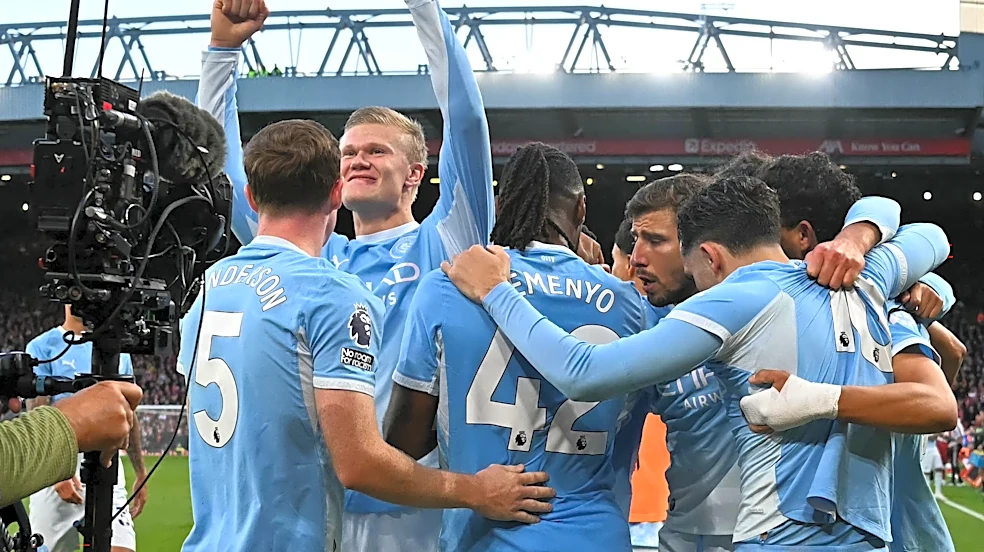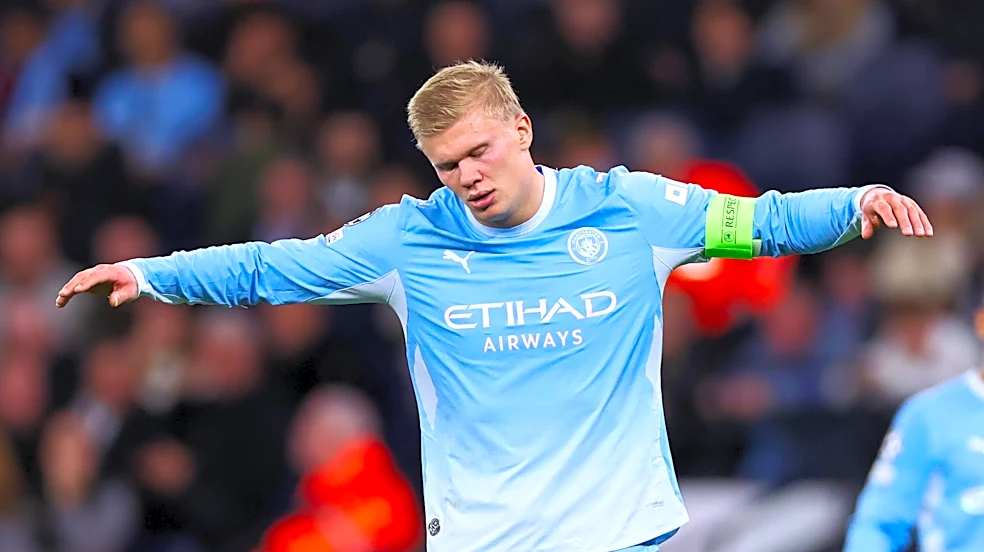








It’s hard to think of a bigger story in English football right now than the findings against Manchester City over their financial dealings.
The independent commission found City committed serious breaches of Premier League financial regulations spanning nine seasons, involving hundreds of millions of pounds in misrepresented revenue and expenditure. The club has appealed, but the potential consequences for City, and for English football, are enormous.
Yet perhaps the most remarkable part of the affair
has been the reaction from sections of City’s support. A recurring line of defence is that City are the victims of an established elite, the so-called “Red Cartel”, determined to stop anyone else challenging its dominance. To hear some of these arguments, you could almost imagine City as Robin Hood, gallantly taking on the wicked Sheriff of Nottingham and his wealthy friends from Liverpool, Arsenal and Manchester United.
Except Robin Hood wasn’t generally in the business of becoming the richest man in Nottingham.
And whatever you think of the regulations, you cannot sit down at a poker table, decide you don’t like the rules, and help yourself to a couple of extra aces. Especially when the chips you win with them are still in front of you years later.
But here’s the interesting question, particularly for Newcastle United supporters.
What if Manchester City actually have a point about the rules themselves?
The Red Cartel and the established order
There is certainly an argument that the biggest clubs have benefited from regulations that make it hard for newcomers to challenge them.
Manchester United, Liverpool and Arsenal have spent decades building enormous commercial operations and global fanbases. Under rules linking permitted spending to existing revenue, those advantages become self-reinforcing. The richest clubs can spend more because they earn more, and that spending helps them qualify for Europe, attract better players and earn more still. Challengers, meanwhile, are held back by the modest revenues they already have.
But City make unconvincing opponents of this order. In 2021 they signed up to the European Super League, a project built to protect Europe’s wealthiest clubs. They were the first to withdraw, to their credit, but when offered a seat at the top table, they were happy to pull up a chair.
There may well be an elite protecting its position. But that doesn’t make City innocent, nor does it mean the established clubs have been the only beneficiaries of an unfair system.
And what about Newcastle?
First, the obvious point. Many people have serious concerns about Newcastle’s Saudi-backed ownership, and those concerns deserve to be taken seriously. But they are a separate debate. The question here is whether the regulations give any ambitious club, whoever owns it, a realistic chance to compete.
When the takeover was completed in October 2021, Newcastle suddenly had owners with almost unimaginable resources. But having wealthy owners and being a wealthy football club are very different things.
The size of that gap is worth spelling out. According to their latest published accounts, Newcastle generated £335 million in revenue in 2024/25. Liverpool generated £703 million, Manchester City £694 million and Arsenal £691 million, each more than twice as much.
Under a system tying squad spending to revenue, that difference is enormous. The owners may have the means to close the gap quickly, but the rules have severely restricted how much they can put into the squad.
We saw the consequences in summer 2024, when Newcastle sold Elliot Anderson and Yankuba Minteh to comply with the Profitability and Sustainability Rules. Two talented young players left just as the club was trying to build a squad to challenge the elite. Both have since thrived elsewhere, at Nottingham Forest and Brighton with Anderson ironically ending up at Manchester City.
Newcastle’s own record isn’t spotless either. To stay within PSR in 2024/25, the club sold St James’ Park to a company controlled by its own owners. The move was legal under Premier League rules but not accepted by UEFA, leading to a settlement in June 2026. But it rather proves the point. When the rules make straightforward owner investment impossible, clubs are pushed towards accounting manoeuvres instead. Better, surely, to let owners invest openly, within strict limits, than to leave clubs selling their own stadiums to themselves. And whatever you make of that deal, it was disclosed, permitted domestically and bears little resemblance to the conduct described in the City findings.
So should the regulations stop a willing owner closing the gap with far richer rivals? Or are we telling ambitious clubs they are welcome to challenge the elite, provided they don’t do it too quickly?
Could there be a better system?
Football absolutely needs financial regulation. Enough clubs have been brought to the brink by reckless owners and spending gambles that failed spectacularly. But there is a difference between preventing financial irresponsibility and preventing investment.
The Premier League has already replaced PSR this season with Squad Cost Ratio rules, allowing clubs to spend up to 85 per cent of their football revenues and net player trading on squad costs. That is a substantial reform, but it doesn’t remove the underlying advantage. Eighty-five per cent of an enormous revenue base is still far more than eighty-five per cent of a modest one.
One alternative would be a five-year investment window for clubs outside the league’s highest earners. During that window, an eligible club could spend above its normal limit, but only with money its owners had genuinely put in. That would mean equity, not loans, inflated related-party sponsorship or asset sales to the owners’ own businesses. The full sum would be deposited in escrow up front, so the club isn’t exposed if the owner walks away. The extra spending would be capped, perhaps at 20 to 25 per cent above the normal limit, and would taper over the final two years, so that by year six the club is back within standard limits and sustained by the revenue its improved status has generated. Compliance would be verified independently, ideally by the new football regulator.
The idea isn’t entirely new. In 2015, UEFA introduced voluntary agreements allowing eligible clubs to follow approved business plans under financial supervision, showing that owner investment and sustainability need not be mutually exclusive.
It isn’t without problems. Freer spending would favour clubs lucky enough to attract billionaire owners, and there would be legitimate worries about wage inflation and competitive balance. But these are difficulties to manage, not reasons to dismiss the idea.
Some City supporters might ask whether this simply legalises what their club did. It doesn’t. There is an enormous difference between openly investing your own money under rules everyone has agreed to and disguising that investment as commercial income. The first is ambition. The second is cheating.
Fair rules, fairly enforced
None of this should be mistaken for sympathy towards Manchester City. The findings are extraordinarily serious, and if upheld on appeal, the sanctions should reflect the scale of the misconduct and the damage done to confidence in English football.
This is also where the claim that City were merely breaking the elite’s monopoly becomes hardest to swallow. They didn’t simply invest enough to become competitive. They became one of the most commercially powerful clubs in the world, topped Deloitte’s Football Money League and enjoyed an extraordinary period of domestic dominance.
Not every pound or trophy since can be attributed to misconduct; outstanding players and managers generated genuine growth. But that leads to the most uncomfortable question of all. If rule breaches help a club establish itself among the elite, and that position then generates enormous legitimate revenue, how can the original advantage ever really be undone?
Those extra aces won the chips. The chips are still on the table.
The answer is certainly not that Newcastle should be allowed to ignore the rules because City did. It is that English football needs a system that punishes clubs who break the rules while giving ambitious challengers a realistic chance to compete.
Manchester City are not Robin Hood.
But that doesn’t mean the Sheriff of Nottingham should be the one writing the rules.
And once the dust settles on City’s case, perhaps the Premier League should have a serious conversation about how clubs like Newcastle can challenge the established order without spending the next twenty years waiting for permission.