


Let us rewind for a moment.
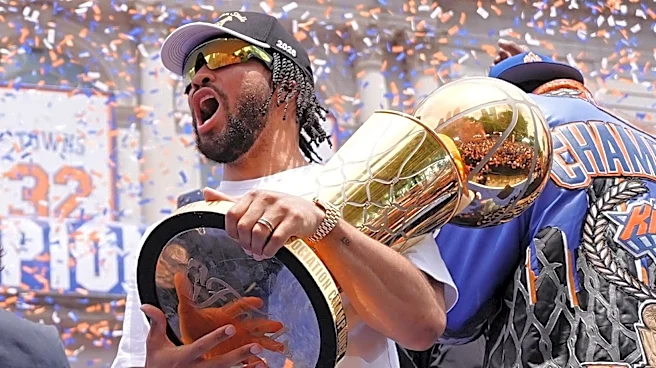
It is June 18, 2026. The New York Knicks are finally NBA Champions, parading through the Canyon of Heroes amongst an expansive sea of orange-and-blue faithful. Jalen Brunson takes the microphone, holding the Larry O’Brien Trophy over his head, ready to address a fanbase that has waited for this moment since 1973. When he speaks, he rightfully takes the time to acknowledge his teammates and thank his coaches. But he doesn’t stop there. He also takes time to address the people
he’s used as motivation for as long as he can remember—the haters.
Of course, some may view this as holding a grudge. But thisisn’t the Michael Jordan Hall of Fame speech 2.0. These words don’t reflect pettiness on Brunson’s part. Instead, it highlights the true foundation of his success. His quiet and relentless edge and determination to silence doubters made him the reigning king of New York and a poster child for underdogs everywhere.
As summer comes to an end and training camp draws near, the traits that led Brunson to an NBA Championship also shine through in a different avenue. His family officially launched a management group. It is a new advisory firm dedicated to supporting athletes, executives, and NIL talent.
What’s the name of this firm? Well, it’s Thirty-Third.
On thirty-two separate occasions during the 2018 NBA Draft, front offices looked at the resume of one of the most decorated amateur basketball players. They said, “no thanks,” and went in a different direction. It took until the 33rd pick for Dallas to call his name and make him a Maverick. When you look at his pre-draft bragging list, it’s hard to fathom how a player with that much success could fall to the second round.
Let’s have a read through his accomplishments. I bet you can’t get through it without your eyes watering up and forcing you to blink (thanks for that one, Russell Richardson).
In 2014, he won gold with FIBA Americas at 18. A year later, he was an Illinois Class 4A Champion, the state’s Mr. Basketball, a McDonald’s All-American, and the USA Basketball Male Athlete of the Year. Then, he went to the FIBA Under-19 World Cup, won gold, made the All-Tournament Team, and took home MVP. That was all before he arrived at Villanova.
As a freshman Wildcat, he won a national championship. By his junior year, he didn’t win another title; he brought home all the glory. He was the consensus National College Player of the Year. He took home both the Wooden and Naismith Awards. He won the Bob Cousy Award as the nation’s top point guard. He earned AP, USBWA, NABC, and Sporting News Player of the Year honors. He was a first-team All-American and the Big East Scholar-Athlete of the Year.
Today, his jersey hangs in Villanova’s rafters, providing him a place among collegiate immortality.
Still, NBA talent evaluators scoffed at the idea that Brunson would amount to anything notable after college. Even with all the evidence to the contrary, 32 other names that did not rhyme with “Falen Dunson” came through the speakers. They paid closer attention to his height, or lack thereof, than to his footwork. They focused on his vertical instead of his efficiency. Others’ misfortunes translated into a draft steal for the Mavericks.
Crazily enough, they ended up underestimating him too.
The draft-night disrespect was only the opening scene of a story flooded with underappreciation and nonsensical criticism. The haters followed him to Dallas, where the Mavericks brass showed their incompetent roster-management skills more than once. We’re not even talking about Luka here!
After landing the steal of the century, the Mavs never truly recognized Brunson’s value. Eligible for a contract extension before the 2021-22 season, Brunson’s team put a four-year, $55 million deal on the table. Given the financial climate, this was a huge bargain for Dallas and a no-brainer. Unfortunately, the Mav brass looked the old gift horse in the mouth (or whatever that saying is) and hesitated. They prefer the reliable “wait-and-see approach,” claiming they needed to evaluate a sample size before committing that much green.
Then Luka got hurt, allowing Brunson to step into the primary role, where he brilliantly orchestrated the offense. Even with all the chips on their side of the table, Brunson’s camp went back to the front office and said they were still willing to commit to the prior deal. Unfortunately, it takes two to tango, and Dallas wasn’t in the mood to dance.
By the time the Mavs realized they needed to pay the man, the price went up, and the relationship was rockier than the Shipwreck Coast in Australia. Look it up; it’s real rocky.
Of course, one team’s failure is another one’s success. Dallas’s fumbling of the Brunson situation led to good old Uncle Leon swooping in and bringing him to the Knicks on a four-year, $104 million contract.
Surprisingly (not), the media pooped all over that decision.
The reaction to the signing was incredibly negative. Critics laughed at the Knicks for committing that kind of money to a “role player.” Bleacher Report even went so far as to grade the acquisition a C. To many “experts,” the Knicks overpaid for a secondary piece who made his name by riding Luka’s coattails.
Even as Brunson immediately changed the culture of a cursed franchise, new avenues for doubt emerged. He led New York to the playoffs, earned an All-Star spot, made the All-NBA Second Team, and became the Garden’s go-to guy. Still, the chuckleheads behind desks and cameras would not retreat. Becky Hammon even went on national television and told the world that even though Brunson was a phenomenal talent, a team couldn’t win with a 6-foot-2 guard as their “1A.”
He faced the same skepticism on draft night. This time, the audience was bigger… by a lot. None of it was about his production. Instead, it was about old rules chiseled in stone: “short” dudes can’t lead a team to the promised land.
Of course, Brunson went and smashed that old stone to bits.
He won NBA Clutch Player of the Year. He led the team to the NBA Cup and won the tournament MVP. Then, in a postseason where everybody could find reasons the Sixers, Cavs, and Spurs would beat the Knicks, Brunson went and won a flippin’ championship.
At 30, “Captain Clutch” keeps silencing doubters. He proved Dallas wrong. He proved 32 teams that passed on him wrong. He even forced the media to eat their previous statements and admit that he was indeed a 1A superstar.
A complete masterstroke, starting Thirty-Third is the ultimate “nanny-nanny” to everyone who attached the word “nope” to his name. By focusing on athletes, executives, and underserved markets like women’s professional sports, Brunson and his family are building something to help others avoid the same challenges he was forced to navigate. They are ensuring talent and production drive value, not preconceived notions and archaic scouting philosophies.
Undervalued at every single turn of his basketball life, Brunson never altered his game or mindset. He took on the disrespect and burned the pillars of unjustified criticism to the ground. Once the thirty-third pick, he is now a champion, finally silencing the haters who fueled his flame.