
The NBA Trade Deadline, for better or worse, is behind us. Out goes Jared McCain and Eric Gordon. In comes draft picks and a bunch of seemingly temporary players.
Despite what your opinion might be, the Sixers freed up two roster spots and seem to be weighing all options there. But who makes sense? Is there any name out there who isn’t totally washed and can spell a soon-to-be 40-year-old Kyle Lowry some rotation minutes?
Before diving into names, I want to mention one answer to the Sixers’ now two
vacant standard spots that’s already on the roster: Jabari Walker. Walker has been a serviceable rotation player for most of his Sixers tenure, though Daryl Morey seemed coy about actually converting him in his post-trade deadline presser. I’d argue Walker is probably better than most of the names I’m about to get into, and he’s still quite young. He’s limited, but he embraces the dirty work and does the little things this team needs. We’ll see what happens there, but it feels likely the Sixers bring in at least one new addition to bolster the group.
Now that that’s out of the way, let’s survey the market. Pre-existing names or guys expected to be available in the near future. Can we find someone who fills the gaps and isn’t totally cooked? It won’t be easy, but let’s comb through it.
Chris Paul
Paul is an interesting potential name for the Sixers for several reasons. The future Hall of Famer has put together a tremendous career. Heading into the season, he was supposedly on a farewell tour, with retirement looming at year’s end. That didn’t really materialize.
Paul and the LA Clippers had a falling out early in the season, resulting in him being essentially banished and sitting in limbo for most of the year. That was until the trade deadline, when he was moved to Toronto and then bought out. Now he’s a free agent, likely looking for one final stretch of NBA basketball.
Paul has history with Daryl Morey, both good and bad. The Houston Rockets traded for him and paired him with MVP James Harden, producing arguably the best Rockets team of that era. The highs didn’t last long. Harden pushed for Russell Westbrook, Paul was sent out, and that trade marked the beginning of the end for that group.
Understandably, the relationship between Paul and Morey cooled after that. It’s been years, though, and time heals things. For argument’s sake, let’s say Paul would be open to Philly. Does it make sense?
I’d lean no. Paul is a small guard whose athletic burst has completely faded. He can’t score around the rim anymore. In his later Phoenix years, even while starting, he nearly abandoned paint scoring altogether because he just couldn’t finish consistently at his age and size.
But the thing about CP3 is the intangibles. He can still pass, still organize, still play real point guard. He’s the archetype people constantly beg for in the comments. The issue is that this team’s long-term vision clearly revolves around the Tyrese Maxey and VJ Edgecombe backcourt. They want the ball in their hands. At this stage, Paul’s value comes with the ball in his hands too, and that overlap creates tension.
The Sixers already have a veteran point guard in Kyle Lowry. Paul might be more playable, but is that really saying much? I’m not sure it meaningfully shifts anything.
Lonzo Ball
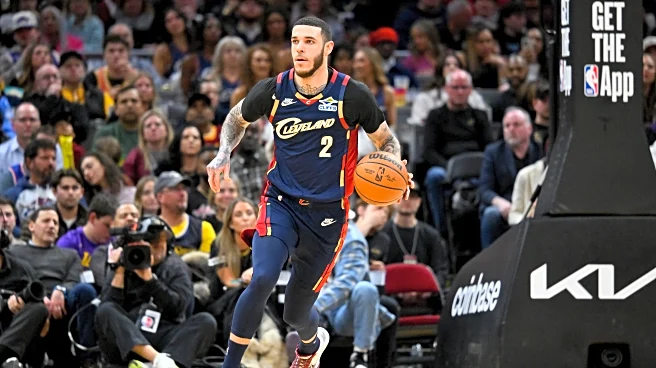
The former No. 2 overall pick has become something of a favorite among Sixers Twitter. A 6-foot-6 guard with real passing IQ is exactly what fans have been asking for since Maxey took the leap. But if it’s that simple, why is Ball available?
It comes down to injuries. Ball became the first player in NBA history to undergo a meniscus transplant, which effectively saved his career. He had limited success after the surgery with Chicago, who later traded him to Cleveland as a major offseason addition. It didn’t work. Ball looked like a shell of himself athletically and, at times, disengaged. He fell out of the rotation entirely and finished his Cavs tenure shooting 30.1 percent from the field and 27.2 percent from three. That’s rough.
He was eventually rerouted to Utah and bought out. So should the Sixers buy low?
My answer is a quick no. Credit to Ball for coming back from devastating knee injuries. But his previous athleticism is gone. Similar to Paul, he isn’t a factor near the rim and rarely attempts drives. That’s a pretty big issue for a table-setting guard. His defense, once a strength, has regressed hard. Add in the poor efficiency and it’s difficult to justify the gamble.
The idea of Ball is intriguing. The current version probably isn’t.
D’Angelo Russell
OG Process fans will see D’Angelo Russell’s name and feel a little nostalgia. He was the guy many wanted after the 2015 lottery. Years later, he’s bounced around and now finds himself in another rebuilding situation, having fallen out of favor.
Russell isn’t physically washed like Paul or Ball, but he’s been a one-dimensional player for most of his career. He doesn’t give you much defensively, so all of his value comes on the offensive end. Even with the Mavericks struggling this season, we know what Russell brings: microwave scoring, shooting and some secondary playmaking.
Despite having decent size, you’re plugging in a real question mark defensively. Nick Nurse has generally preferred length and defensive versatility around his guards, and Russell doesn’t check that box.
Still, if we’re being honest, he’s one of the better bets on this list to actually produce something. The Sixers need shooting badly after losing McCain and dealing with the Paul George suspension. Russell can provide that, if you’re willing to live with the rough stretches and questionable decisions.
I’m not racing to the buyout table for him. But he’s not an automatic no either, which is more than can be said for some of these names.
Kyle Anderson
Anderson has long been floated as a potential Sixers target. He’s not flashy, but he’s consistently been an impactful rotation player. Even this year in Utah, he averaged 7.1 points in 20.6 minutes while shooting 54.6 percent from the field across 20 games.
He fits the Nick Nurse mold well. At 6-foot-8, he has the size to switch across multiple positions. He isn’t a high-volume shooter from deep, but he can knock down open shots. Inside the arc, his game is unorthodox but effective. He finishes well and can lean on a floater or midrange when needed.
The issue is volume and spacing. The Sixers desperately need reliable perimeter shooting at a high rate, and that’s not Anderson’s calling card. They also already have similar archetypes in Trendon Watford, Kelly Oubre, Dominick Barlow and potentially Jabari Walker if he’s converted.
In a vacuum, he’s a solid player. In this specific context, the fit feels a little redundant.
Chris Boucher
Boucher is at least a name the Sixers have been linked to by a notable source. He also has familiarity with Nick Nurse from their Toronto days. And it’s worth mentioning the Sixers haven’t had a true backup stretch big in a while, which Boucher would theoretically address.
He most recently spent time with Boston, stuck at the end of the rotation and appearing in just nine games. The sample size is small, but the numbers weren’t encouraging. That said, he was productive in Toronto the year prior, playing 17.2 minutes per game across 50 appearances.
Signing Boucher would be a bet that he isn’t completely cooked and that Boston simply wasn’t the right situation. If he can return to form, he gives you a small-ball five who can shoot and a versatile four next to one of the Sixers’ centers. He’s familiar with Nurse’s system, which helps.
I’d lean toward other options, but the prior interest makes him someone to keep an eye on.
Khris Middleton
Middleton is one of the biggest names here. Multiple All-Star appearances next to Giannis. A key piece on a championship team. But recent years haven’t been kind. He was moved to Washington in the Kyle Kuzma trade and later sent to Dallas as part of their forward-looking approach. Injuries have piled up, and that’s largely why Milwaukee moved on.
This year he averaged 10.3 points, 4.7 rebounds and 3.9 assists in 24.3 minutes, shooting 43.3 percent from the field and 33.3 percent from three. The numbers aren’t eye-popping, but they’re respectable in a reduced role.
Even with the knee and ankle issues, Middleton can still shoot. The defense isn’t what it once was, but it passes the eye test more often than not. For a wing his size, he can run pick-and-roll and make smart reads.
With George sidelined and Oubre taking on more than he probably should, Middleton makes a lot of sense. He soaks up wing minutes, provides ball handling Nurse can trust, and adds shooting. When George returns, he can scale down into a smaller role comfortably.
Age and health are the question marks, but the Sixers could do much worse than Middleton.
Haywood Highsmith
Highsmith should be familiar. He was one of the few Division II players to turn pro, grinding through the Delaware Blue Coats before earning a two-way with the Sixers. He never got an extended opportunity here. That came with Miami, where he worked his way into becoming a legitimate rotation piece.
The Heat later sent him to Brooklyn in what amounted to a salary dump. He’s been rehabbing a knee injury and is nearing a return.
A reunion makes sense. Highsmith still has supporters within the organization, and there was free-agent interest a few seasons ago. He developed into a quality 3-and-D wing in Miami, and that’s exactly what the Sixers need.
He’s not flashy and doesn’t carry huge upside, but he might be the safest name on this list. I’d argue he’s the best defender among these options, and he provides shooting. That two-way combination is rare on the buyout market.
Personally, he sits at the top of my list.
Georges Niang
From one former Sixer to another, Niang is likely to hit the buyout market. He had some of his best years in Philadelphia before signing a big deal in Cleveland. Since then, he’s been traded again and landed in Utah, where there’s little incentive to prioritize him.
We know what Niang brings. Shooting and floor spacing. Not much else.
He isn’t a strong defender, and I wouldn’t trust him in high-leverage playoff minutes. But shooting isn’t in abundance right now, and Niang can provide it cheaply and reliably.
It wouldn’t be the worst move. It also wouldn’t be the most ambitious one. Ideally, the Sixers find someone who helps now and offers some long-term upside. Niang feels more like a short-term patch than a real solution.
There’s no perfect name here. That’s the reality of the buyout market. But if the goal is plugging real holes without sacrificing size, defense or shooting, a few of these options make more sense than others.